The Phosphate Rock Market is witnessing steady expansion as rising global food demand, agricultural modernization, and increasing dependence on phosphate-based fertilizers continue to strengthen the importance of phosphate resources. Phosphate rock serves as the primary raw material for producing phosphoric acid, fertilizers, animal feed supplements, and various industrial chemicals, making it a strategically important mineral for agriculture and global food security.
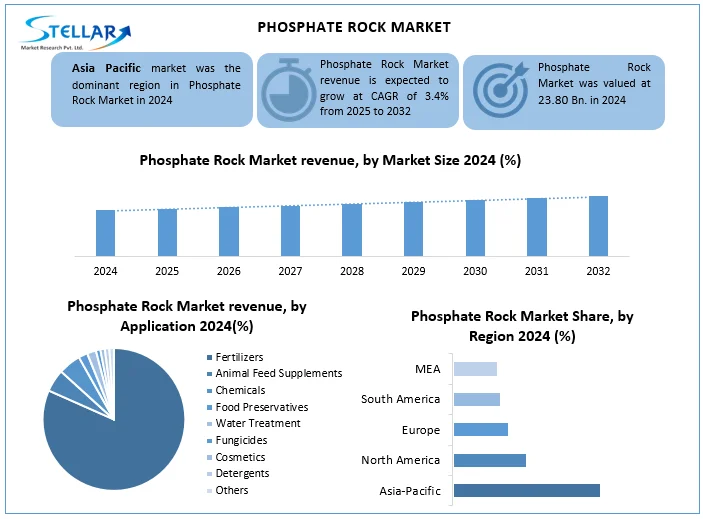
According to Stellar Market Research, the Phosphate Rock Market was valued at USD 23.80 billion in 2024 and is projected to reach USD 31.10 billion by 2032, growing at a CAGR of 3.4% during 2025–2032. Increasing fertilizer consumption, rising crop production requirements, technological improvements in phosphate extraction, and investments in sustainable mining practices are expected to support market growth throughout the forecast period.
Rising Agricultural Demand Strengthens Phosphate Rock Consumption
Agriculture remains the largest demand driver for the Phosphate Rock Market, as phosphate is an essential nutrient required for plant development, root growth, and improved crop productivity. The increasing global population, changing dietary patterns, and rising demand for food production are encouraging farmers and agricultural companies to adopt phosphate-based fertilizers.
Phosphate rock is primarily processed into fertilizers such as diammonium phosphate (DAP), monoammonium phosphate (MAP), and other phosphate compounds used in modern farming. Emerging economies are increasing fertilizer usage to improve agricultural yields and ensure food security, creating long-term demand for phosphate resources.
The expansion of commercial agriculture in countries across Asia-Pacific, Africa, and Latin America is expected to remain a key factor supporting phosphate rock consumption over the coming years.
𝐃𝐨𝐰𝐧𝐥𝐨𝐚𝐝 𝐅𝐫𝐞𝐞 𝐏𝐃𝐅 𝐁𝐫𝐨𝐜𝐡𝐮𝐫𝐞: https://www.stellarmr.com/report/req_sample/-phosphate-rock-market/2765
Fertilizer Application Segment Dominates Market Demand
Among application segments, fertilizers represent the dominant segment of the Phosphate Rock Market due to their critical role in global agriculture.
Phosphate-based fertilizers are widely used for cereals, grains, fruits, vegetables, and oilseed crops. The need to increase agricultural productivity on limited farmland is encouraging farmers to adopt nutrient-rich fertilizers that enhance soil fertility and crop output.
Beyond fertilizers, phosphate rock is also used in animal feed supplements, food preservatives, water treatment chemicals, detergents, and industrial applications. These additional uses are creating diversification opportunities for producers and reducing dependency on agricultural demand alone.
Mining Technology and Resource Optimization Create New Opportunities
Technological advancements in mining and processing are reshaping the phosphate rock industry. Companies are investing in advanced extraction methods, beneficiation technologies, and automation systems to improve operational efficiency and reduce environmental impact.
Modern phosphate mining operations are increasingly adopting:
Automated mining equipment
Advanced ore processing technologies
Digital monitoring systems
Water-efficient beneficiation processes
Resource optimization solutions
These innovations are helping companies improve phosphate recovery rates while addressing sustainability concerns associated with mining activities.
The development of efficient processing technologies is also enabling the utilization of lower-grade phosphate deposits, helping extend resource availability and strengthen long-term supply security.
Sustainable Phosphate Production Gains Importance
Environmental sustainability is becoming an increasingly important factor influencing the Phosphate Rock Market.
Mining companies are focusing on reducing carbon emissions, improving water management, minimizing waste generation, and implementing land restoration programs. Sustainable mining practices are becoming essential as governments and industries prioritize responsible resource utilization.
The growing focus on circular economy principles is also encouraging research into phosphate recovery from wastewater, agricultural waste, and industrial by-products. These initiatives aim to reduce dependence on traditional mining while improving phosphorus resource efficiency.
Asia-Pacific Leads Global Market Growth
Asia-Pacific represents one of the largest and fastest-growing regions in the Phosphate Rock Market due to strong agricultural demand, expanding fertilizer consumption, and increasing food production requirements.
China and India are major contributors to regional demand. China has significant phosphate production capabilities and remains one of the world’s largest consumers of phosphate fertilizers. India’s large agricultural sector and government initiatives supporting fertilizer availability continue driving phosphate demand.
Countries in Southeast Asia are also witnessing increasing fertilizer consumption due to agricultural expansion and efforts to improve crop productivity.
Meanwhile, North America maintains a significant position due to established mining infrastructure and strong demand from agricultural industries. The Middle East and Africa are gaining strategic importance due to major phosphate reserves, particularly in Morocco, which holds one of the world’s largest phosphate resource bases.
Industrial Applications Expand Market Opportunities
Although fertilizers remain the primary application, industrial uses of phosphate rock are creating additional growth opportunities.
Phosphate-derived chemicals are used in:
Food processing applications
Water treatment solutions
Industrial chemicals
Animal nutrition products
Specialty materials
The increasing demand for animal protein is supporting growth in phosphate-based animal feed supplements, particularly in regions experiencing rising livestock production.
Additionally, phosphate materials are gaining attention in emerging applications such as lithium iron phosphate (LFP) battery production, which is becoming increasingly important due to electric vehicle growth and energy storage expansion.
Supply Chain Security Becomes a Strategic Priority
The phosphate rock industry is highly influenced by resource availability and geopolitical factors because phosphate reserves are concentrated in a limited number of countries.
Major producers are focusing on expanding mining capacity, strengthening export capabilities, and improving supply chain resilience to address future demand requirements.
Strategic investments in phosphate processing facilities and international partnerships are becoming increasingly important as countries seek stable fertilizer supplies and reduced dependency on external sources.
Competitive Landscape
The Phosphate Rock Market is characterized by the presence of major mining companies, fertilizer manufacturers, and integrated phosphate producers focusing on resource expansion, production efficiency, and sustainable operations.
Key market players include The Mosaic Company, OCP Group, Nutrien Ltd., PhosAgro, Yara International ASA, ICL Group, EuroChem Group AG, Jordan Phosphate Mines Company, Ma’aden, and Wengfu Group.
Companies are strengthening their market positions through mining expansion projects, fertilizer production integration, technological upgrades, and sustainability initiatives. Integrated producers with access to phosphate reserves and downstream fertilizer manufacturing capabilities maintain competitive advantages through improved supply control and operational efficiency.
𝐃𝐨𝐰𝐧𝐥𝐨𝐚𝐝 𝐅𝐫𝐞𝐞 𝐏𝐃𝐅 𝐁𝐫𝐨𝐜𝐡𝐮𝐫𝐞: https://www.stellarmr.com/report/req_sample/-phosphate-rock-market/2765
Market Challenges
Despite positive growth prospects, the Phosphate Rock Market faces several challenges.
Limited availability of high-quality phosphate reserves, environmental concerns related to mining activities, and strict regulations on resource extraction can affect market expansion. Mining operations require significant capital investment and must comply with environmental standards, increasing operational complexity.
Additionally, fluctuations in fertilizer prices, geopolitical uncertainties, and supply chain disruptions can impact phosphate rock availability and pricing.
The industry is responding through improved resource management, sustainable mining technologies, and investments in alternative phosphorus recovery methods.
Future Outlook
The Phosphate Rock Market is expected to maintain steady growth through 2032 as global agriculture continues expanding and demand for food production increases. Rising fertilizer consumption, industrial applications, sustainable mining initiatives, and emerging battery material opportunities will shape the future development of the industry.
Companies investing in efficient extraction technologies, resource optimization, downstream integration, and environmentally responsible operations are expected to gain a competitive advantage.
As phosphorus remains an essential resource for agriculture, food security, and emerging clean energy applications, the Phosphate Rock Market will continue playing a vital role in supporting global economic and industrial development.
Media Contact
Stellar Market Research
Website: Stellar Market Research – Global Research Reports & Consulting
Email: sales@stellarmr.com
