Asia Pacific Automatic Door Market: Smart Building Adoption, Urbanization, and Contactless Technology Driving Growth
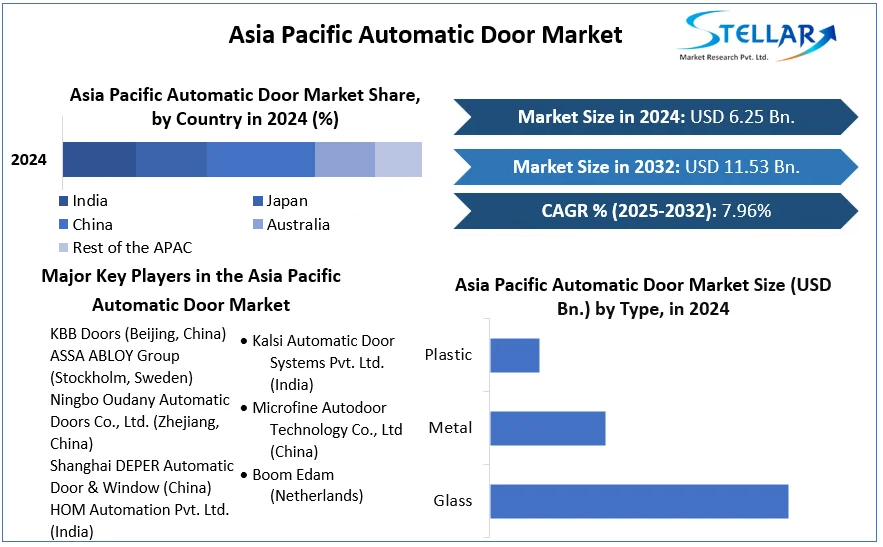
The Asia Pacific Automatic Door Market is experiencing significant growth due to rapid urbanization, increasing construction activities, rising demand for smart infrastructure, and growing adoption of automated access solutions. Automatic doors have become an important component of modern buildings by providing improved convenience, accessibility, security, and energy efficiency across commercial, industrial, and residential applications.
The increasing development of smart cities, airports, hospitals, shopping malls, corporate offices, and advanced residential projects is accelerating the demand for automatic door systems throughout the Asia Pacific region. Integration of motion sensors, infrared technology, IoT connectivity, and automated access control systems is further enhancing product capabilities.
Rising Urbanization and Infrastructure Development Supporting Market Expansion
Rapid urban population growth across countries such as China, India, Japan, South Korea, and Southeast Asian nations is creating strong demand for advanced building infrastructure. Automatic doors are increasingly being installed in high-traffic locations where efficient movement of people, hygiene, and security are critical.
Commercial infrastructure projects, including airports, metro stations, retail centers, hotels, and office complexes, are adopting automated door solutions to improve customer experience and operational efficiency. Government investments in smart city projects and modern infrastructure development are also contributing to market growth.
𝐃𝐨𝐰𝐧𝐥𝐨𝐚𝐝 𝐅𝐫𝐞𝐞 𝐏𝐃𝐅 𝐁𝐫𝐨𝐜𝐡𝐮𝐫𝐞: https://www.stellarmr.com/report/req_sample/Asia-Pacific-Automatic-Door-Market/992
Smart Building Technologies Boosting Adoption
The integration of automatic doors with smart building systems is transforming traditional entry solutions into intelligent access management platforms. Modern automatic doors can connect with sensors, security systems, building management systems, and IoT platforms to provide improved control and monitoring.
Features such as touchless operation, remote access management, and automated energy control are becoming increasingly important as businesses focus on safety, convenience, and operational savings.
Healthcare Sector Creating New Opportunities
Healthcare facilities are among the major adopters of automatic door systems due to the need for hygiene, accessibility, and controlled movement. Hospitals, clinics, and medical centers use automatic doors to reduce physical contact, improve patient mobility, and maintain sterile environments.
The increasing expansion of healthcare infrastructure in developing Asia Pacific countries is expected to create additional opportunities for automatic door manufacturers.
Commercial Sector Leading Market Demand
The commercial sector represents one of the largest application areas for automatic doors. Shopping malls, airports, hotels, restaurants, corporate offices, and entertainment facilities are increasingly adopting automated entry systems.
Automatic sliding doors are especially popular in commercial spaces due to their space-saving design, smooth operation, and ability to handle high customer traffic. Revolving doors are also used in premium commercial buildings because they help reduce energy loss by minimizing air exchange between indoor and outdoor environments.
Market Segmentation Overview
The Asia Pacific Automatic Door Market is segmented based on type, operating mechanism, and end-user application.
By Type
Sliding Doors
Sliding automatic doors are widely used in airports, hospitals, retail stores, and office buildings due to their efficient space utilization and ease of operation.
Swinging Doors
Automatic swinging doors are commonly used in healthcare facilities, commercial buildings, and residential applications where simple and reliable operation is required.
Revolving Doors
Revolving automatic doors are preferred in hotels, corporate buildings, and high-end commercial properties due to their energy-saving capabilities.
Folding Doors
Folding automatic doors are suitable for locations with limited space and are used in industrial and commercial environments.
By Operating Mechanism
Electromechanical Automatic Doors
Electromechanical systems are widely adopted due to their reliability, ease of maintenance, and suitability for multiple applications.
Hydraulic Automatic Doors
Hydraulic systems are used for heavy-duty applications where strong performance and durability are required.
By End User
Commercial
Commercial buildings remain the leading users of automatic doors due to increasing demand for customer convenience, accessibility, and modern building designs.
Industrial
Factories, warehouses, and manufacturing facilities use automatic doors to improve workflow efficiency, safety, and controlled access.
Residential
Growing interest in smart homes and premium residential projects is increasing adoption of automated door solutions.
𝐃𝐨𝐰𝐧𝐥𝐨𝐚𝐝 𝐅𝐫𝐞𝐞 𝐏𝐃𝐅 𝐁𝐫𝐨𝐜𝐡𝐮𝐫𝐞: https://www.stellarmr.com/report/req_sample/Asia-Pacific-Automatic-Door-Market/992
Regional Market Outlook
China
China represents one of the largest markets in Asia Pacific due to extensive infrastructure development, smart city projects, and commercial construction activities. Increasing adoption of automated technologies across public infrastructure and commercial buildings supports market expansion.
India
India is witnessing rising demand for automatic doors due to rapid urbanization, airport expansion, healthcare infrastructure development, and growth of modern retail spaces.
Japan and South Korea
Developed markets such as Japan and South Korea are focusing on advanced automation technologies, energy-efficient buildings, and smart infrastructure solutions.
Southeast Asia
Countries including Singapore, Indonesia, Thailand, and Malaysia are experiencing increased adoption due to tourism growth, commercial development, and infrastructure modernization.
Key Growth Drivers
Growth of Smart Cities
Smart city initiatives across Asia Pacific are encouraging the adoption of intelligent building solutions, including automated entry systems.
Increasing Demand for Touchless Solutions
Growing awareness about hygiene and contactless technology is driving demand for sensor-based automatic doors.
Expansion of Commercial Infrastructure
The development of shopping centers, airports, hospitals, and office spaces is creating strong demand for automated access systems.
Energy Efficiency Requirements
Automatic doors help reduce energy consumption by controlling indoor temperature loss and improving building efficiency.
Challenges Affecting Market Growth
Despite strong growth opportunities, the Asia Pacific Automatic Door Market faces challenges such as high installation costs, maintenance requirements, and the need for skilled technicians.
Manufacturers are addressing these challenges through improved product durability, advanced sensor technology, and cost-effective solutions.
Competitive Landscape
The market includes global and regional players focusing on product innovation, automation technology, and strategic expansion. Major companies operating in the automatic door industry include ASSA ABLOY, dormakaba, GEZE GmbH, KONE Corporation, Nabtesco Corporation, and other technology providers.
Future Outlook of Asia Pacific Automatic Door Market
The future of the Asia Pacific Automatic Door Market will be shaped by smart building adoption, IoT integration, infrastructure expansion, and increasing demand for safe and convenient access solutions.
As cities become more automated and businesses prioritize energy efficiency and user experience, automatic doors will continue becoming an essential part of modern architecture. Continuous innovation in sensors, artificial intelligence, and connected building technologies will create new growth opportunities throughout the forecast period.
