Reservoir Analysis Market: Industry Analysis, Growth Trends, Key Drivers, and Future Outlook (2026–2034)
The global Reservoir Analysis Market is experiencing steady growth as oil & gas companies increasingly rely on advanced technologies to optimize hydrocarbon recovery, reduce exploration risks, and improve production efficiency. Reservoir analysis involves evaluating underground reservoirs by integrating geological, geophysical, petrophysical, and engineering data to understand fluid behavior, reservoir characteristics, and production potential.
Reservoir analysis solutions—including reservoir simulation, geo-modeling, data acquisition, and reservoir monitoring—play a critical role in maximizing recovery rates and supporting data-driven decision-making throughout the lifecycle of oil and gas fields.
According to Stellar Market Research, the Reservoir Analysis Market is expected to witness healthy growth throughout the forecast period, driven by rising investments in exploration activities, digital oilfield technologies, and enhanced oil recovery (EOR) projects.
Growing Oil & Gas Exploration Driving Market Growth
Increasing global energy demand has encouraged oil and gas companies to invest in new onshore and offshore exploration projects. Reservoir analysis enables operators to accurately estimate reserves, identify productive zones, and optimize drilling strategies while reducing operational uncertainty.
The development of unconventional resources such as shale oil, tight gas, and deepwater reserves has further increased the importance of advanced reservoir characterization technologies.
Digital Technologies Transforming Reservoir Management
Digital transformation is reshaping reservoir analysis through artificial intelligence (AI), machine learning, cloud computing, big data analytics, and digital twin technologies. These innovations allow operators to analyze massive datasets in real time, improve reservoir simulation accuracy, and make faster operational decisions.
The integration of IoT sensors and advanced monitoring systems also enables continuous reservoir surveillance and predictive maintenance, improving production efficiency while lowering operational costs.
𝐃𝐨𝐰𝐧𝐥𝐨𝐚𝐝 𝐅𝐫𝐞𝐞 𝐏𝐃𝐅 𝐁𝐫𝐨𝐜𝐡𝐮𝐫𝐞: https://www.stellarmr.com/report/req_sample/Reservoir-Analysis-Market/1191
Key Growth Drivers of the Reservoir Analysis Market
Increasing Demand for Enhanced Oil Recovery (EOR)
As mature oil fields experience declining production, operators are increasingly adopting enhanced oil recovery techniques. Reservoir analysis helps identify the most effective recovery methods by accurately modeling reservoir behavior and predicting fluid movement.
Improved reservoir understanding contributes to higher recovery rates and more efficient resource utilization.
Rising Investment in Offshore Exploration
Growing offshore exploration activities in regions such as the Gulf of Mexico, the North Sea, Brazil, and the Middle East are creating significant demand for advanced reservoir analysis services capable of handling complex geological formations.
Adoption of Artificial Intelligence
AI-powered reservoir modeling enables faster data interpretation, automated history matching, production forecasting, and optimization of drilling programs.
Machine learning algorithms improve decision-making by identifying production trends that traditional analytical methods may overlook.
Increasing Focus on Production Optimization
Oil and gas companies continue investing in technologies that maximize production while minimizing drilling risks and operational expenses. Reservoir analysis provides critical insights that improve well placement, reservoir management, and long-term production planning.
Challenges Facing the Market
High Implementation Costs
Advanced reservoir simulation software, seismic interpretation tools, and digital monitoring systems require significant capital investment, making adoption challenging for smaller exploration companies.
Volatility in Oil Prices
Fluctuating crude oil prices influence exploration budgets and capital expenditure, directly impacting demand for reservoir analysis services and technologies.
Complex Geological Conditions
Reservoirs with heterogeneous rock formations, deepwater environments, and unconventional resources require sophisticated analytical models and highly skilled professionals, increasing project complexity.
Reservoir Analysis Market Segmentation
The Reservoir Analysis Market is segmented based on service, reservoir type, application, and region.
By Service
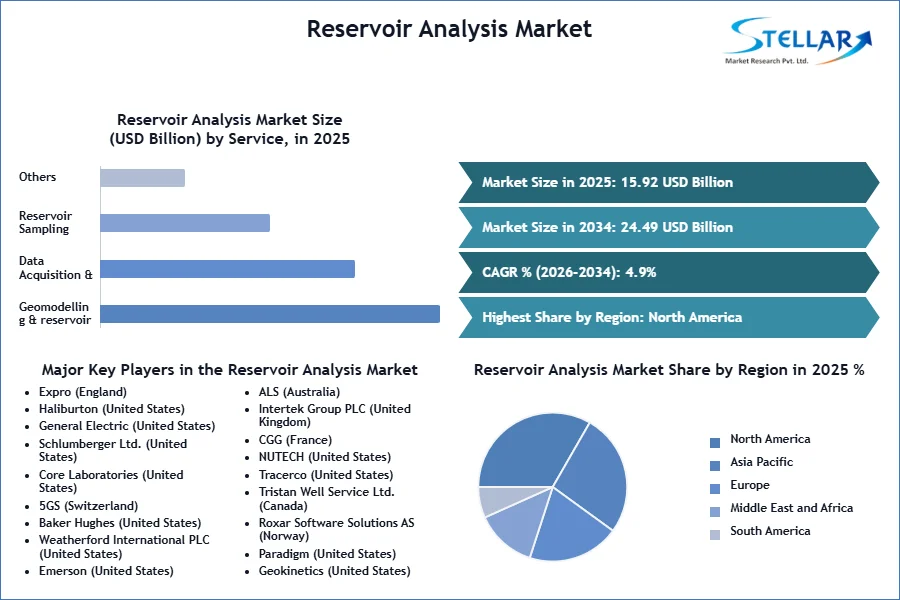
Reservoir Simulation & Geo-Modeling
This segment represents the largest share of the market due to its importance in predicting reservoir performance and optimizing field development.
Data Acquisition & Monitoring
Real-time monitoring technologies help operators continuously evaluate reservoir conditions and improve production performance.
Reservoir Sampling
Reservoir sampling provides accurate fluid and rock data essential for reservoir characterization and production planning.
By Reservoir Type
Conventional Reservoirs
Conventional reservoirs continue to account for a significant market share due to ongoing exploration and production activities worldwide.
Unconventional Reservoirs
Growing development of shale gas, shale oil, and tight reservoirs is increasing demand for advanced reservoir analysis technologies.
By Application
Onshore
Onshore operations dominate the market due to extensive drilling activities and relatively lower operational costs.
Offshore
Offshore reservoir analysis continues to expand with increasing investment in deepwater and ultra-deepwater exploration projects.
Regional Analysis
North America
North America remains the leading regional market due to extensive shale oil and gas production, advanced digital oilfield adoption, and continuous investment in exploration technologies.
The United States and Canada continue to invest heavily in reservoir modeling, enhanced oil recovery, and unconventional resource development.
Middle East & Africa
The Middle East continues to invest in reservoir optimization technologies to maximize recovery from large conventional oil fields, while Africa is witnessing growing offshore exploration activities.
Asia Pacific
Asia Pacific is expected to register strong growth due to increasing energy demand, expanding exploration activities, and rising investments in oil and gas infrastructure across China, India, Indonesia, and Australia.
Europe
Europe maintains steady growth through continued offshore exploration in the North Sea and increasing adoption of digital reservoir management solutions.
Competitive Landscape
The Reservoir Analysis Market is highly competitive, with leading companies investing in digital technologies, AI-powered reservoir modeling, and integrated reservoir management solutions.
Major companies include:
- SLB (Schlumberger)
- Halliburton
- Baker Hughes
- Weatherford International
- CGG
- Core Laboratories
- Emerson Electric Co.
- SGS SA
- Expro Group
- Tracerco
- Ikon Science
- Paradigm Group
These companies continue focusing on software innovation, cloud-based reservoir analytics, automation, and strategic partnerships to strengthen their market positions.
𝐃𝐨𝐰𝐧𝐥𝐨𝐚𝐝 𝐅𝐫𝐞𝐞 𝐏𝐃𝐅 𝐁𝐫𝐨𝐜𝐡𝐮𝐫𝐞: https://www.stellarmr.com/report/req_sample/Reservoir-Analysis-Market/1191
Emerging Trends in the Reservoir Analysis Industry
Artificial Intelligence and Machine Learning
AI is improving reservoir simulation accuracy, production forecasting, and automated interpretation of geological data.
Digital Twin Technology
Digital twins allow operators to create virtual models of reservoirs for real-time monitoring, scenario analysis, and production optimization.
Cloud-Based Reservoir Analytics
Cloud computing enables collaborative reservoir analysis while improving data accessibility and reducing infrastructure costs.
Integrated Reservoir Management
Companies are increasingly integrating geological, engineering, and production data into unified platforms for better decision-making and improved asset performance.
Future Outlook of the Reservoir Analysis Market
The Reservoir Analysis Market is expected to experience sustained growth through 2034 as oil and gas companies continue investing in digital technologies, enhanced recovery techniques, and exploration projects. AI, machine learning, cloud computing, and advanced reservoir simulation are expected to redefine reservoir management by improving operational efficiency and reducing production risks.
Growing exploration of unconventional resources and increasing emphasis on maximizing recovery from mature fields will continue creating significant opportunities for technology providers and service companies.
Conclusion
The Reservoir Analysis Market remains a critical component of the global oil and gas industry, enabling operators to optimize exploration, improve production efficiency, and maximize hydrocarbon recovery. Increasing adoption of AI-driven analytics, digital oilfield technologies, and advanced reservoir simulation tools is transforming the industry.
As energy demand continues to rise and exploration projects become increasingly complex, reservoir analysis solutions will play an even more important role in supporting efficient, cost-effective, and sustainable energy production.
