Rubidium Market: Industry Analysis, Growth Trends, Key Drivers, and Future Outlook (2025–2032)
The global Rubidium Market is witnessing steady growth as demand increases across biomedical research, electronics, specialty glass manufacturing, telecommunications, quantum computing, and advanced scientific applications. Rubidium is a highly reactive alkali metal (chemical symbol Rb) that is primarily extracted from minerals such as lepidolite, pollucite, and zinnwaldite. Although relatively rare, its unique chemical and physical properties make it valuable in high-tech and specialized industrial applications.
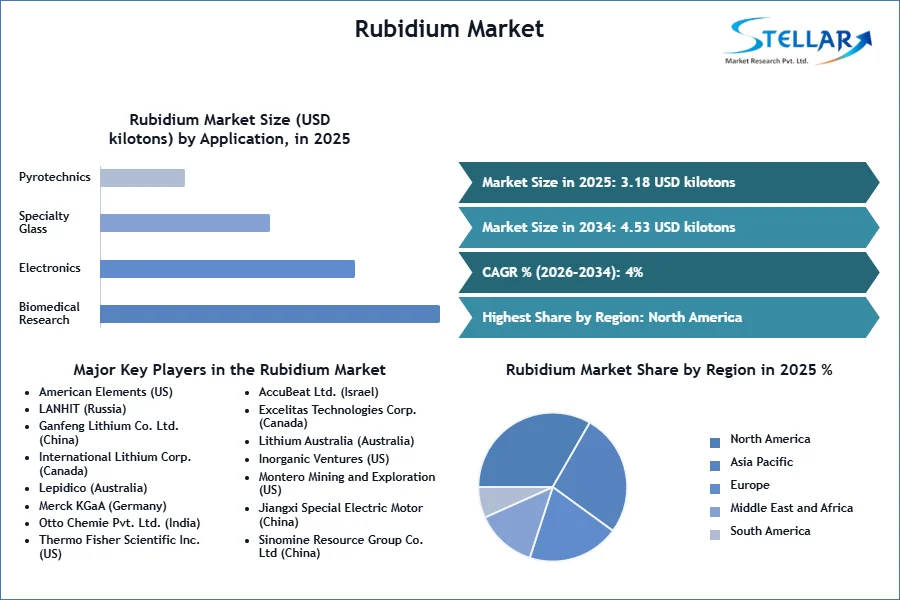
According to Stellar Market Research, the Rubidium Market reached a volume of 3.06 kilotons in 2024 and is projected to grow to approximately 4.20 kilotons by 2032, registering a CAGR of 4.01% during the forecast period (2025–2032).
Growing Demand from Electronics and Quantum Technologies
Rubidium plays a vital role in advanced electronic applications due to its photoemissive properties and exceptional conductivity. It is widely used in atomic clocks, fiber optic communication systems, GPS technologies, photomultiplier tubes, and night-vision equipment.
The rapid advancement of quantum computing and precision timing technologies is expected to create new growth opportunities for rubidium manufacturers during the forecast period.
𝐃𝐨𝐰𝐧𝐥𝐨𝐚𝐝 𝐅𝐫𝐞𝐞 𝐏𝐃𝐅 𝐁𝐫𝐨𝐜𝐡𝐮𝐫𝐞: https://www.stellarmr.com/report/req_sample/Rubidium-Market/1192
Biomedical Research Fueling Market Expansion
Biomedical research remains one of the most important application areas for rubidium. Rubidium isotopes are used in medical imaging, diagnostic technologies, and scientific research. The expansion of life science research, healthcare innovation, and pharmaceutical development continues to support global market growth.
Increasing investment in research laboratories and advanced healthcare technologies is expected to strengthen long-term demand.
Key Growth Drivers of the Rubidium Market
Rising Demand for Specialty Glass
Rubidium carbonate is widely used in the production of specialty glass with enhanced electrical conductivity, chemical stability, and optical performance.
These specialty glasses are increasingly utilized in:
- Fiber optic communication systems
- Electronic displays
- Optical devices
- High-performance laboratory equipment
Growing investments in telecommunications infrastructure continue to support demand.
Expansion of Electronics Manufacturing
Rubidium compounds are used in:
- Atomic frequency standards
- Electronic oscillators
- Photoelectric cells
- Motion sensors
- Night vision devices
- Radiation detection systems
The continuous growth of advanced electronics manufacturing is creating new opportunities for rubidium applications.
Increasing Investment in Quantum Computing
Rubidium atoms are extensively used in quantum computing research, quantum sensors, and precision measurement systems. As governments and technology companies increase investments in quantum technologies, demand for high-purity rubidium is expected to rise significantly.
Growth in Scientific Research
Universities, research institutes, and laboratories continue expanding the use of rubidium in physics, chemistry, and materials science research, contributing to steady market demand.
Challenges Facing the Market
High Cost of Rubidium
Rubidium is one of the more expensive specialty metals because of its limited availability and complex extraction process. High production costs remain a significant challenge for broader commercial adoption.
Storage and Handling Challenges
Rubidium reacts rapidly with oxygen and water, requiring specialized storage and transportation methods. These safety requirements increase operational costs for manufacturers and end users.
Rubidium Market Segmentation
The Rubidium Market is segmented based on grade, application, and region.
By Grade
Technical Grade Metal
Technical-grade rubidium is widely used in industrial manufacturing, specialty glass production, and electronic applications where ultra-high purity is not essential.
High-Purity Grade
High-purity rubidium is primarily utilized in scientific research, quantum computing, medical technologies, and precision electronic devices requiring exceptional material purity.
𝐃𝐨𝐰𝐧𝐥𝐨𝐚𝐝 𝐅𝐫𝐞𝐞 𝐏𝐃𝐅 𝐁𝐫𝐨𝐜𝐡𝐮𝐫𝐞: https://www.stellarmr.com/report/req_sample/Rubidium-Market/1192
By Application
Biomedical Research
Biomedical research represents one of the major application segments due to increasing use in medical imaging, laboratory research, and pharmaceutical development.
Electronics
Rubidium is extensively used in:
- Atomic clocks
- GPS systems
- Fiber optic communication
- Photoelectric devices
- Semiconductor research
Specialty Glass
Specialty glass manufacturers use rubidium compounds to improve electrical conductivity, optical performance, and chemical durability.
Pyrotechnics
Rubidium compounds are also utilized in specialized pyrotechnic formulations to produce distinctive visual effects.
Other Applications
Additional applications include:
- Quantum computing
- Telecommunications
- Scientific instrumentation
- Advanced optical systems
Regional Analysis
North America
North America is expected to remain a leading regional market due to strong investments in biomedical research, advanced electronics, aerospace technologies, and quantum computing research.
The region also benefits from extensive scientific research infrastructure and growing demand for precision timing systems.
Asia Pacific
Asia Pacific is projected to experience significant growth owing to expanding electronics manufacturing, increasing semiconductor production, and rising investments in advanced technology industries across China, Japan, South Korea, and India.
Europe
Europe continues to witness steady demand supported by scientific research, telecommunications, medical technology development, and industrial innovation.
Competitive Landscape
The Rubidium Market is moderately consolidated, with companies focusing on specialty chemical production, high-purity material manufacturing, and strategic resource development.
Major companies operating in the market include:
- American Elements
- LANHIT
- Ganfeng Lithium Co. Ltd.
- International Lithium Corp.
- Lepidico
- Merck KGaA
- Otto Chemie Pvt. Ltd.
- Thermo Fisher Scientific Inc.
- AccuBeat Ltd.
- Excelitas Technologies Corp.
- Lithium Australia
- Inorganic Ventures
- Montero Mining and Exploration
- Jiangxi Special Electric Motor
- Sinomine Resource Group Co. Ltd.
Emerging Trends in the Rubidium Industry
Quantum Computing Applications
The rapid development of quantum computing is creating new opportunities for rubidium-based technologies used in quantum sensors, atomic clocks, and quantum information systems.
Next-Generation Communication Systems
Growing deployment of fiber optic communication networks and precision timing technologies continues to expand rubidium usage.
Medical Imaging Innovation
Rubidium isotopes are increasingly utilized in advanced diagnostic imaging technologies, supporting growth in healthcare applications.
Advanced Battery Research
Researchers are exploring rubidium as an additive for next-generation sodium-ion batteries, which could create new commercial opportunities if large-scale adoption occurs.
Future Outlook of the Rubidium Market
The Rubidium Market is expected to witness steady growth through 2032 as demand expands across quantum computing, biomedical research, telecommunications, specialty glass manufacturing, and advanced electronics. Continued investments in scientific research, digital infrastructure, and emerging technologies are expected to strengthen long-term market prospects.
Although high costs and limited natural availability remain challenges, technological advancements and expanding high-value applications are likely to support sustained market development.
Conclusion
The Rubidium Market continues to evolve as an important niche segment within the specialty metals industry. Increasing applications in quantum computing, electronics, telecommunications, biomedical research, and specialty glass manufacturing are driving consistent market growth.
As innovation accelerates in precision technologies and scientific research, rubidium is expected to remain a strategically important material, offering significant opportunities for manufacturers and technology developers over the coming decade.
