MEA Connected Oil Field Market: Industry Analysis, Growth Trends, Key Drivers, and Future Outlook (2025–2032)
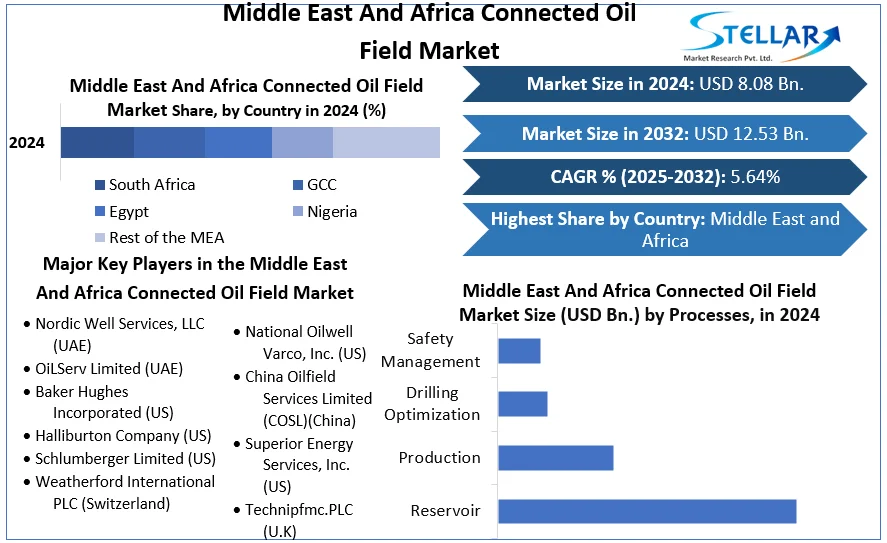
The Middle East & Africa (MEA) Connected Oil Field Market is experiencing significant growth as oil and gas operators accelerate digital transformation to improve production efficiency, reduce operational costs, and enhance asset reliability. Connected oil fields integrate technologies such as the Internet of Things (IoT), artificial intelligence (AI), cloud computing, big data analytics, digital twins, and automation to enable real-time monitoring and intelligent decision-making across upstream operations.
According to Stellar Market Research, the MEA Connected Oil Field Market is expected to witness steady growth throughout the forecast period, supported by increasing investments in digital oilfield technologies, expanding upstream exploration, and modernization of oil and gas infrastructure.
Digital Transformation Reshaping Oil & Gas Operations
Oil and gas companies across the Middle East and Africa are increasingly adopting connected oil field solutions to optimize reservoir performance, monitor equipment remotely, reduce downtime, and improve operational safety. Digital technologies allow operators to collect and analyze large volumes of field data, enabling predictive maintenance and more efficient production management.
As the region continues investing in smart energy infrastructure, connected oil fields are becoming essential for maximizing hydrocarbon recovery while lowering operating costs.
𝐃𝐨𝐰𝐧𝐥𝐨𝐚𝐝 𝐅𝐫𝐞𝐞 𝐏𝐃𝐅 𝐁𝐫𝐨𝐜𝐡𝐮𝐫𝐞: https://www.stellarmr.com/report/req_sample/MEA-Connected-Oil-Field-Market/1202
Growing Investments in Upstream Exploration
The Middle East remains one of the world’s largest oil-producing regions, while several African countries continue expanding offshore and onshore exploration activities. Increasing investments in new oil fields and production optimization are creating strong demand for connected oil field technologies capable of improving operational efficiency and resource recovery.
Key Growth Drivers of the MEA Connected Oil Field Market
Rising Adoption of Artificial Intelligence
Artificial intelligence is transforming reservoir management by enabling:
- Predictive maintenance
- Production forecasting
- Automated drilling optimization
- Equipment failure prediction
- Intelligent reservoir analysis
AI-powered analytics help operators improve production while minimizing operational risks.
Expansion of IoT-Based Monitoring
IoT sensors provide continuous monitoring of wells, pipelines, compressors, pumps, and production facilities. Real-time operational visibility enables faster response to equipment issues and improves overall field performance.
Increasing Focus on Operational Efficiency
Oil producers continue investing in automation technologies to reduce production costs, improve worker safety, and maximize equipment utilization. Connected oil fields enable centralized control and remote monitoring of multiple production sites.
Government Support for Energy Modernization
Many countries across the Middle East and Africa are investing in digital transformation strategies for the energy sector, encouraging adoption of advanced oilfield technologies to strengthen production capabilities and improve competitiveness.
Challenges Facing the Market
High Initial Investment
Implementing connected oil field infrastructure requires significant investment in sensors, communication networks, cloud platforms, cybersecurity systems, and advanced analytics software.
Cybersecurity Risks
As oil fields become increasingly connected, protecting operational technology (OT) systems from cyber threats has become a major concern for operators.
Legacy Infrastructure Integration
Many mature oil fields still operate with older equipment that requires modernization before advanced digital technologies can be fully implemented.
MEA Connected Oil Field Market Segmentation
The MEA Connected Oil Field Market is segmented based on solution, service, application, and country.
By Solution
Hardware
Hardware solutions include:
- Smart sensors
- Industrial controllers
- Communication equipment
- Monitoring devices
These components collect operational data from oil field assets.
Software
Software platforms provide:
- Data analytics
- Reservoir modeling
- Production optimization
- Asset performance management
- Predictive maintenance
Software adoption continues to increase as operators seek greater operational visibility.
By Service
Consulting
Consulting services assist operators in planning digital transformation strategies and implementing connected oil field technologies.
Integration & Deployment
System integration services connect sensors, control systems, cloud platforms, and production facilities into unified digital environments.
Support & Maintenance
Ongoing maintenance ensures system reliability, software updates, cybersecurity protection, and operational continuity.
By Application
Production Optimization
Production optimization represents one of the largest application segments, helping operators maximize output while minimizing operating expenses.
Reservoir Management
Connected technologies enable continuous reservoir monitoring, improved simulation models, and enhanced recovery planning.
Drilling Optimization
Real-time drilling analytics improve drilling efficiency, reduce non-productive time, and enhance well placement accuracy.
Pipeline Monitoring
Connected monitoring systems improve leak detection, asset integrity management, and transportation efficiency.
Regional Analysis
Middle East
The Middle East dominates the regional market due to its vast oil reserves, advanced upstream operations, and strong investments in digital oilfield technologies.
Countries including Saudi Arabia, the United Arab Emirates, Qatar, Kuwait, and Oman continue modernizing oil production through automation, AI, and IoT-based monitoring systems.
Africa
Africa is expected to witness steady growth as countries such as Nigeria, Angola, Egypt, and Algeria expand exploration activities and invest in digital technologies to improve operational efficiency and production reliability.
Growing offshore developments are further increasing demand for connected oil field solutions.
𝐃𝐨𝐰𝐧𝐥𝐨𝐚𝐝 𝐅𝐫𝐞𝐞 𝐏𝐃𝐅 𝐁𝐫𝐨𝐜𝐡𝐮𝐫𝐞: https://www.stellarmr.com/report/req_sample/MEA-Connected-Oil-Field-Market/1202
Competitive Landscape
The MEA Connected Oil Field Market features leading global technology providers and oilfield service companies focusing on digital innovation, automation, cloud platforms, and AI-driven production optimization.
Major companies include:
- SLB (Schlumberger)
- Halliburton
- Baker Hughes
- Weatherford International
- Honeywell International
- ABB Ltd.
- Siemens Energy
- Emerson Electric Co.
- Rockwell Automation
- Schneider Electric
- IBM Corporation
- Microsoft Corporation
These companies continue expanding their digital oilfield portfolios through cloud computing, industrial IoT, predictive analytics, and strategic partnerships.
Emerging Trends in the MEA Connected Oil Field Industry
Artificial Intelligence for Predictive Operations
AI is increasingly being used to forecast equipment failures, optimize drilling performance, and improve reservoir management.
Digital Twin Technology
Digital twins enable virtual simulation of oil field assets, allowing operators to monitor performance, evaluate production scenarios, and improve maintenance planning.
Cloud-Based Oilfield Platforms
Cloud computing allows centralized access to operational data, enabling faster collaboration between field engineers and decision-makers.
Autonomous Field Operations
Automation technologies, robotics, and remote operations are reducing manual intervention while improving worker safety and operational efficiency.
Future Outlook of the MEA Connected Oil Field Market
The MEA Connected Oil Field Market is expected to continue expanding through 2032 as oil producers accelerate digital transformation initiatives to improve production efficiency and reduce operational costs. Continued investments in AI, IoT, cloud computing, automation, and predictive analytics will support widespread adoption of connected oil field technologies.
Increasing exploration activities, modernization of mature oil fields, and growing emphasis on operational sustainability are expected to create significant opportunities for technology providers across the region.
Conclusion
The MEA Connected Oil Field Market is becoming a key driver of digital innovation within the regional oil and gas industry. Rising adoption of artificial intelligence, IoT-enabled monitoring, predictive analytics, and cloud-based asset management is transforming upstream operations across the Middle East and Africa.
As energy companies continue investing in smarter, safer, and more efficient production systems, connected oil field technologies will play an increasingly important role in maximizing resource recovery, improving operational performance, and supporting long-term energy sustainability.
