North America Marine Propellers Market: Industry Analysis, Growth Trends, Key Drivers, and Future Outlook (2025–2032)
The North America Marine Propellers Market is witnessing steady growth due to increasing investments in commercial shipbuilding, naval modernization, maritime tourism, and offshore marine activities. Marine propellers are essential propulsion components that convert engine power into thrust, enabling efficient movement of cargo ships, naval vessels, fishing boats, recreational boats, and offshore support vessels. Improvements in propeller design, materials, and manufacturing technologies are helping operators improve fuel efficiency, vessel performance, and operational reliability.
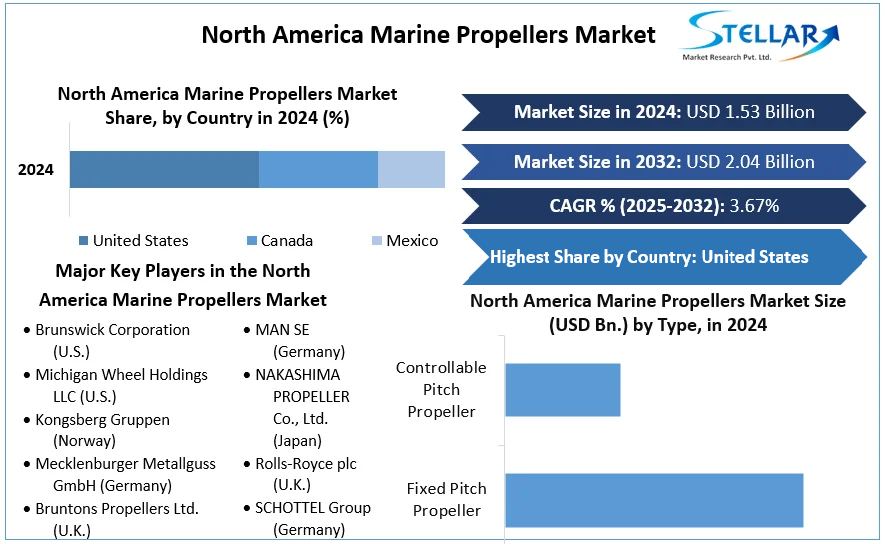
According to Stellar Market Research, the North America Marine Propellers Market was valued at USD 1.53 billion in 2024 and is projected to reach USD 2.04 billion by 2032, growing at a CAGR of 3.67% during the forecast period (2025–2032).
Growth in Shipbuilding Activities Driving Market Expansion
Increasing investments in commercial shipbuilding across the United States, Canada, and Mexico are creating strong demand for marine propulsion systems. Rising maritime trade, expanding cargo transportation, and replacement of aging vessels continue to support the adoption of advanced marine propellers.
Growing ship repair and fleet modernization activities are also contributing to market growth by increasing demand for replacement propellers and propulsion upgrades.
Rising Maritime Tourism Supporting Market Growth
Marine tourism is expanding throughout North America as governments and private operators invest in cruise infrastructure, recreational boating, and coastal tourism. The growing demand for passenger vessels, ferries, yachts, and recreational boats is increasing the need for high-performance marine propellers that deliver improved efficiency, maneuverability, and lower operating costs.
𝐃𝐨𝐰𝐧𝐥𝐨𝐚𝐝 𝐅𝐫𝐞𝐞 𝐏𝐃𝐅 𝐁𝐫𝐨𝐜𝐡𝐮𝐫𝐞: https://www.stellarmr.com/report/req_sample/North-America-Marine-Propellers-Market/1205
Key Growth Drivers of the North America Marine Propellers Market
Expansion of Commercial Shipping
International trade and container transportation continue to increase across North American ports. Cargo vessels require efficient propulsion systems capable of reducing fuel consumption while maintaining high operational performance.
Growing port infrastructure investments further support long-term demand for marine propellers.
Naval Fleet Modernization
Defense agencies across North America continue investing in new naval vessels and modernization programs. Modern warships require advanced propulsion systems offering improved durability, lower acoustic signatures, and enhanced maneuverability.
Demand for Fuel-Efficient Propulsion
Shipping companies are increasingly adopting advanced propeller technologies to improve propulsion efficiency and reduce greenhouse gas emissions.
Modern blade designs, computational fluid dynamics (CFD), and optimized hydrodynamics help lower fuel consumption and operating costs.
Growth of Offshore Marine Operations
Offshore oil and gas exploration, offshore wind projects, and marine support operations continue driving demand for specialized marine propellers capable of operating under challenging marine environments.
Challenges Facing the Market
High Manufacturing Costs
Marine propellers require precision engineering and corrosion-resistant materials such as nickel-aluminum bronze, stainless steel, and advanced alloys. These materials increase production costs but provide superior durability and performance.
Corrosion and Maintenance
Continuous exposure to seawater can result in corrosion, cavitation, and blade wear. Regular maintenance and replacement remain necessary to ensure long-term operational efficiency.
Supply Chain Challenges
Fluctuations in raw material availability and disruptions in global manufacturing supply chains may affect production schedules and equipment delivery.
North America Marine Propellers Market Segmentation
The market is segmented based on type, end user, and country.
By Type
Fixed Pitch Propeller (FPP)
Fixed pitch propellers account for a significant market share due to their:
- Simple construction
- Lower maintenance costs
- High reliability
- Cost-effective operation
They are widely used across merchant ships, fishing vessels, and recreational boats.
Controllable Pitch Propeller (CPP)
Controllable pitch propellers are increasingly adopted for:
- Naval vessels
- Offshore support ships
- Passenger ferries
- Specialized commercial vessels
CPP systems improve maneuverability, fuel efficiency, and operational flexibility.
By End User
OEM (Original Equipment Manufacturer)
The OEM segment dominates the market as increasing investments in new shipbuilding projects continue driving demand for factory-installed propulsion systems.
Aftermarket
The aftermarket segment benefits from growing demand for maintenance, repair, replacement, and performance upgrades of existing marine vessels.
Regional Analysis
United States
The United States dominates the North American market due to its strong commercial shipping industry, extensive naval fleet, large shipbuilding sector, and growing marine tourism industry.
Major manufacturers continue investing in advanced propeller technologies that improve vessel safety, efficiency, and environmental performance.
Canada
Canada remains an important market driven by commercial fishing, Arctic marine operations, offshore energy activities, and government investments in maritime infrastructure.
Mexico
Mexico is expected to witness steady growth owing to increasing shipbuilding activities, expanding offshore oil production, and continued investments in maritime transportation.
𝐃𝐨𝐰𝐧𝐥𝐨𝐚𝐝 𝐅𝐫𝐞𝐞 𝐏𝐃𝐅 𝐁𝐫𝐨𝐜𝐡𝐮𝐫𝐞: https://www.stellarmr.com/report/req_sample/North-America-Marine-Propellers-Market/1205
Competitive Landscape
The North America Marine Propellers Market is highly competitive, with manufacturers focusing on fuel-efficient designs, advanced materials, corrosion resistance, and digital engineering technologies.
Major companies operating in the market include:
- Brunswick Corporation
- Michigan Wheel Holdings LLC
- Wärtsilä Corporation
- SCHOTTEL Group
- Rolls-Royce plc
- Nakashima Propeller Co., Ltd.
- Hyundai Heavy Industries Co., Ltd.
- Kawasaki Heavy Industries, Ltd.
- MAN Energy Solutions
- Mecklenburger Metallguss GmbH (MMG)
- VEEM Ltd.
- Kongsberg Gruppen
Emerging Trends in the North America Marine Propellers Industry
Smart Propeller Design
Manufacturers are using advanced simulation software and computational fluid dynamics (CFD) to develop propellers with higher propulsion efficiency and lower underwater noise.
Sustainable Marine Technologies
Increasing environmental regulations are encouraging adoption of propellers that reduce fuel consumption and lower carbon emissions.
Lightweight Materials
Advanced composite materials and high-performance alloys are improving corrosion resistance while reducing vessel weight and maintenance requirements.
Digital Vessel Monitoring
Integration of smart sensors and predictive maintenance systems allows operators to monitor propeller performance in real time, improving reliability and reducing downtime.
Future Outlook of the North America Marine Propellers Market
The North America Marine Propellers Market is expected to experience stable growth through 2032, supported by increasing shipbuilding activities, naval modernization programs, offshore energy projects, and expanding maritime tourism. Technological advancements in propeller design, digital engineering, and sustainable propulsion systems will continue driving innovation across the industry while helping vessel operators improve efficiency and reduce operating costs.
Conclusion
The North America Marine Propellers Market remains an important segment of the region’s maritime industry, supported by expanding commercial shipping, growing naval investments, offshore energy development, and increasing recreational boating activities. As manufacturers continue developing more efficient, durable, and environmentally friendly propulsion systems, the market is expected to maintain steady growth throughout the forecast period.
