Europe Balsa Wood Market: Lightweight Material Driving Growth Across Renewable Energy, Aerospace, and Marine Industries
The Europe Balsa Wood Market is witnessing steady growth as industries increasingly focus on lightweight, sustainable, and high-performance materials. Balsa wood, known as one of the lightest commercial hardwoods, offers an excellent strength-to-weight ratio, insulation properties, and versatility, making it suitable for applications across renewable energy, aerospace, marine, transportation, and industrial sectors.
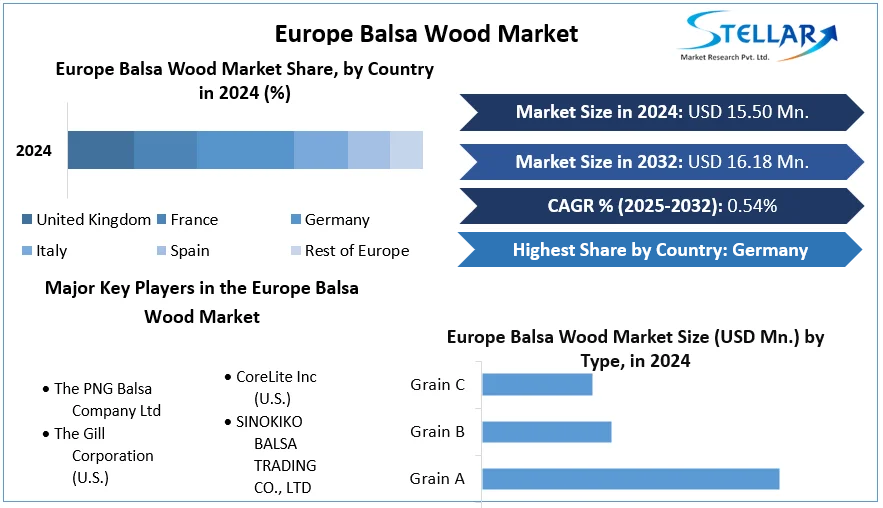
The Europe Balsa Wood Market was valued at USD 15.50 million in 2024 and is projected to reach USD 16.18 million by 2032, growing at a CAGR of 0.54% during 2025–2032. The rising adoption of environmentally friendly materials and increasing demand for lightweight composite structures are expected to support market expansion across Europe.
Growing Demand for Lightweight and Sustainable Materials
Industries across Europe are shifting toward materials that reduce weight, improve energy efficiency, and lower environmental impact. Balsa wood has gained attention due to its natural lightweight structure, high stiffness, and ability to function as a core material in composite panels.
The growing emphasis on renewable energy projects, especially wind energy infrastructure, has increased demand for advanced composite materials. Balsa wood is widely used as a core material in wind turbine blades because it provides strength while maintaining low overall weight.
Additionally, European sustainability initiatives encouraging the use of renewable and bio-based materials are creating new opportunities for balsa wood suppliers and manufacturers.
𝐃𝐨𝐰𝐧𝐥𝐨𝐚𝐝 𝐅𝐫𝐞𝐞 𝐏𝐃𝐅 𝐁𝐫𝐨𝐜𝐡𝐮𝐫𝐞: https://www.stellarmr.com/report/req_sample/Europe-Balsa-Wood-Market/1221
Renewable Energy Sector Boosting Market Growth
The renewable energy industry is one of the major contributors to the growth of the Europe Balsa Wood Market. Wind turbine manufacturers are increasingly adopting lightweight composite materials to improve turbine efficiency and reduce structural loads.
Balsa wood core materials help enhance blade performance by providing rigidity and durability without significantly increasing weight. As European countries continue expanding renewable energy capacity, demand for lightweight composite solutions is expected to increase.
The transition toward clean energy and investments in wind power infrastructure are likely to remain important growth factors for the balsa wood industry during the forecast period.
Increasing Applications in Aerospace and Defense
The aerospace and defense sector represents another important application area for balsa wood. Aircraft manufacturers continuously seek lightweight materials to improve fuel efficiency and operational performance.
Balsa wood composites are used in sandwich panels and structural components where weight reduction and mechanical strength are critical. The material’s excellent energy absorption properties make it suitable for applications requiring high-performance lightweight solutions.
With European aerospace companies focusing on sustainable aviation technologies and improved aircraft efficiency, demand for advanced composite materials is expected to create new opportunities for balsa wood applications.
Marine and Transportation Applications Supporting Expansion
Balsa wood has long been used in marine applications due to its buoyancy, lightweight characteristics, and structural benefits. Boat manufacturers use balsa core materials in hulls and decks to achieve improved strength while reducing vessel weight.
Beyond marine applications, balsa wood composites are also gaining interest in road and rail transportation industries. Lightweight structures help improve energy efficiency and reduce operational costs, making balsa wood an attractive material option for transportation manufacturers.
Germany Emerging as a Key European Market
Germany is expected to hold a significant share of the Europe Balsa Wood Market due to its strong industrial base and demand from renewable energy, transportation, and manufacturing sectors. The country’s focus on sustainable technologies and advanced engineering solutions supports the adoption of lightweight composite materials.
Other European countries, including Italy, France, the United Kingdom, and Russia, are also contributing to market development through increasing applications in industrial manufacturing, marine construction, and renewable energy projects.
Market Segmentation Overview
The Europe Balsa Wood Market is segmented based on type, application, and geography.
By Type:
- Grain A
- Grain B
- Grain C
By Application:
- Renewable Energy
- Aerospace & Defense
- Industrial
- Road & Rail
- Marine
- Others
By Geography:
- Germany
- Italy
- France
- United Kingdom
- Russia
- Rest of Europe
𝐃𝐨𝐰𝐧𝐥𝐨𝐚𝐝 𝐅𝐫𝐞𝐞 𝐏𝐃𝐅 𝐁𝐫𝐨𝐜𝐡𝐮𝐫𝐞: https://www.stellarmr.com/report/req_sample/Europe-Balsa-Wood-Market/1221
Challenges Affecting Market Development
Despite positive growth prospects, the balsa wood market faces challenges related to supply chain dependency, availability of raw materials, and competition from alternative lightweight materials such as foam cores and synthetic composites.
Fluctuations in raw material supply and transportation costs may impact pricing and availability. Manufacturers are also focusing on improving processing technologies and developing sustainable sourcing methods to overcome these challenges.
Future Outlook of Europe Balsa Wood Market
The future of the Europe Balsa Wood Market looks promising as industries continue adopting sustainable and lightweight solutions. Growth in renewable energy projects, aerospace innovation, marine manufacturing, and transportation modernization will continue creating demand for balsa wood-based composite materials.
Companies operating in this market are expected to focus on product innovation, sustainable sourcing, and advanced manufacturing techniques to strengthen their market position.
With increasing environmental awareness and the need for energy-efficient materials, balsa wood is expected to remain an important natural composite material supporting Europe’s transition toward greener industrial solutions.
