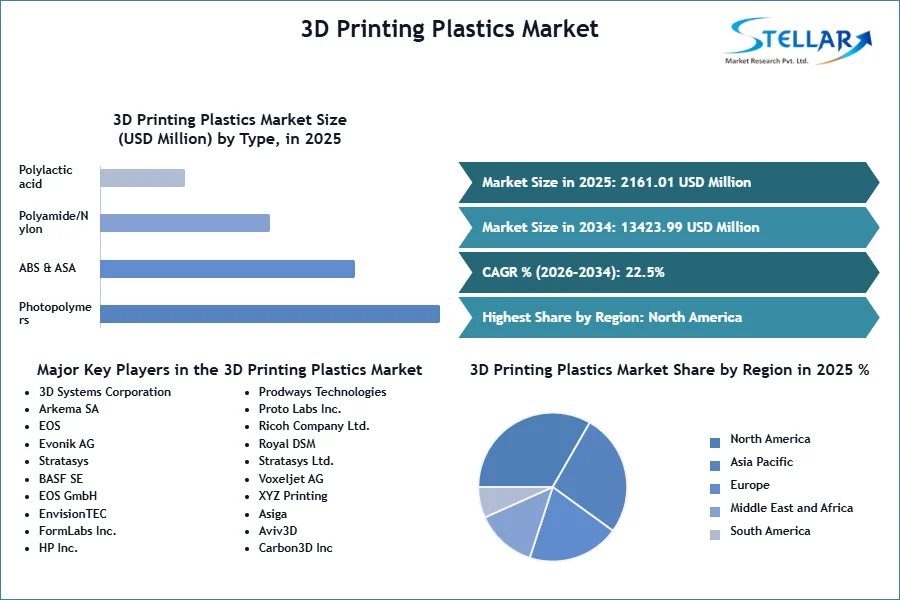
The 3D Printing Plastics Market is witnessing rapid expansion as additive manufacturing reshapes how products are designed, prototyped, and produced. Plastics such as PLA, ABS, nylon, PETG, and advanced photopolymers are widely used in 3D printing due to their versatility, affordability, and ease of processing.
3D Printing Plastics Market was valued at USD 2161.01 million in 2025. Global 3D Printing Plastics Market size is estimated to grow at a CAGR of 22.5 % over the forecast period.
From aerospace components to medical implants and consumer goods, 3D printing plastics are enabling faster production cycles, reduced waste, and unprecedented design freedom.
A Market Driven by Flexibility and Custom Manufacturing
A defining trend in the 3D printing plastics market is the shift toward decentralized, on-demand production. Instead of mass manufacturing in large facilities, companies are adopting 3D printing to produce parts closer to the point of use.
This flexibility is particularly valuable for industries that require customization, rapid prototyping, and small-batch production.
Key Market Insights
- Thermoplastics and photopolymers are the primary materials used.
- PLA and ABS dominate due to cost-effectiveness and usability.
- Nylon and high-performance polymers are growing rapidly.
- Applications include automotive, aerospace, healthcare, and consumer goods.
- Lightweight and complex structures are key advantages.
- Sustainability and recyclable plastics are emerging trends.
- Material innovation is expanding industrial adoption.
Market Drivers Accelerating Growth
1. Expansion of Additive Manufacturing
Industries are increasingly adopting 3D printing for production and prototyping.
2. Demand for Rapid Prototyping
Product development cycles are becoming shorter and more efficient.
3. Rise of Mass Customization
Consumers and industries demand personalized and unique products.
Market Challenges and Restraints
1. Performance Limitations of Plastics
Some applications require stronger materials like metals.
2. High Initial Investment
Equipment and material costs can be a barrier for smaller players.
Technology and Innovation Trends
Technology is driving transformation in the 3D printing plastics market through advancements in material science, printing techniques, and digital manufacturing ecosystems.
New high-performance polymers are being developed to improve heat resistance, mechanical strength, and durability. Multi-material printing is enabling the creation of complex, functional parts with diverse properties.
Sustainability is a major focus, with the development of bio-based plastics and recycled filaments reducing environmental impact. Resin-based printing technologies are also improving precision and surface finish for high-detail applications.
Integration with AI, IoT, and cloud-based design platforms is enabling smarter production workflows and remote manufacturing capabilities.
Visual Snapshot: 3D Printing Plastics in Action
Regional Insights: Global Adoption Across Key Industries
The 3D printing plastics market is growing worldwide:
- North America: Leading in innovation and advanced manufacturing adoption.
- Europe: Strong focus on sustainability and industrial applications.
- Asia-Pacific: Fastest-growing region due to expanding manufacturing sectors.
Recent Industry Developments
- Stratasys (2025): Introduced advanced polymer printing technologies.
- 3D Systems (2024): Expanded material capabilities.
- HP (2025): Advanced multi-jet fusion solutions.
- BASF (2024): Developed high-performance 3D printing plastics.
- ASTM International (2025): Strengthened additive manufacturing standards.
Competitive Landscape
The 3D printing plastics market is highly competitive, with material suppliers, printer manufacturers, and software providers collaborating to deliver integrated solutions.
Companies are focusing on material innovation, cost reduction, scalability, and application expansion to stay competitive.
Analyst Perspective
A senior market analyst notes:
“The 3D printing plastics market is redefining manufacturing by enabling flexibility, customization, and efficiency. Material advancements will be key to unlocking its full potential.”
Future Outlook
The 3D Printing Plastics Market is expected to witness strong growth in the coming years, driven by increasing adoption of additive manufacturing and advancements in material technologies.
The rise of sustainable materials, improved printing accuracy, and expansion into end-use production will further enhance market opportunities. As industries continue to embrace digital manufacturing, 3D printing plastics will play a crucial role in shaping the future of production.
Overall, the market presents significant opportunities for manufacturers, technology providers, and investors looking to capitalize on the evolution of next-generation manufacturing systems.
