Key Highlights
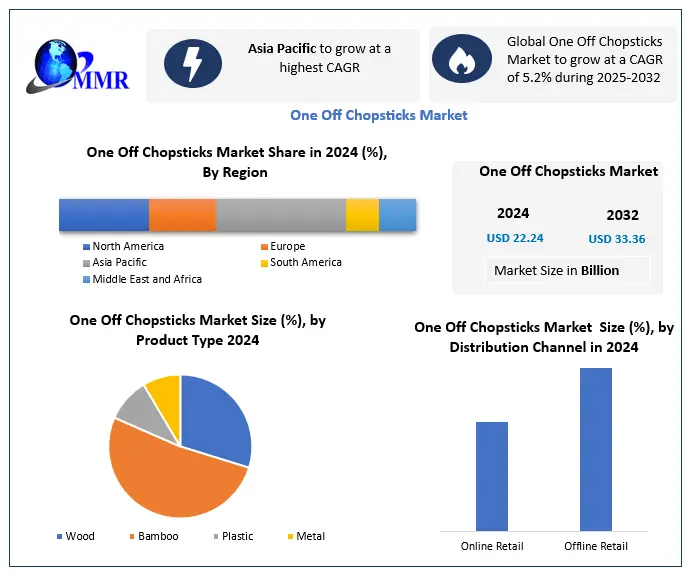
Market Valuation: Valued at USD 22.24 billion in 2024, the market is projected to reach USD 33.36 billion by 2032.
Growth Trajectory: The industry maintains a consistent CAGR of 5.2% through 2032.
Dominant Segment: Bamboo, favored for its rapid renewability and aesthetic authenticity, leads global material demand.
Design Preference: Plain, unadorned designs capture the largest market share, prioritizing cost-efficiency for mass-market foodservice.
Regional Dominance: Asia-Pacific remains the industry’s anchor, driven by deep-rooted culinary traditions and massive QSR (Quick Service Restaurant) throughput.
Why This Matters Now
The chopstick is now a core component of the “delivery-led meal kit” experience. It is no longer just a utensil; it is a touchpoint for brand hygiene and sustainability. For C-suite executives, the rise of the one-off chopstick market reflects a broader shift: food service operators are prioritizing standardized, low-overhead, and eco-friendly disposables to protect margins while satisfying the environmental expectations of younger, delivery-first demographics.
Market Overview
The One-Off Chopsticks Market also known as disposable chopsticks, are widely used across restaurants, food delivery services, quick-service restaurants (QSRs), catering businesses, and household dining. Growing urbanization, the rapid expansion of takeaway and online food delivery, and increasing consumption of Asian foods are driving consistent demand for disposable dining utensils worldwide.
Key Trends Driving Growth
Sustainability as a Baseline: Consumers are rejecting plastics. Bamboo has emerged as the preferred alternative, offering a combination of high tensile strength and rapid growth cycles that mitigate deforestation concerns.
The QSR Explosion: The expansion of fast-food chains globally has normalized the use of disposable utensils. As takeaway orders rise, the chopstick has become a mandatory utility in the delivery ecosystem.
Cultural Globalization: The mainstream adoption of Asian diets among non-Asian demographics is effectively expanding the total addressable market beyond traditional geographic boundaries.
Get a free sample
Segment Insights
Dominant Segment (Material): Bamboo. Its status as a highly renewable, low-processing resource makes it the benchmark for eco-friendly, large-scale production.
Dominant Segment (Design): Plain. Simplicity remains the key driver in high-volume settings like street food stalls and takeout counters where cost-per-unit is the primary decision factor.
Regional Growth Story
Asia-Pacific remains the undisputed leader in volume and revenue. Countries like China and Japan are not only the primary producers but the largest consumers, where the chopstick is integrated into daily routine. While North America and Europe represent smaller shares, they are the fastest-growing regions for premium sustainable chopstick adoption, as government regulations tighten on single-use plastics.
Competitive Landscape
The market remains fragmented, characterized by a mix of regional giants and local suppliers. Key players like Besta Bamboo Machine, Pacific East Company, and Nanchang Sanyou Industrial are currently optimizing for scale. However, the next 12–24 months will likely see a move toward “service-integrated” competition. Leading players are shifting from selling bulk units to providing bundled meal-kit solutions that include branded sleeves and eco-certification. This signals a move away from price-war dynamics toward value-added partnerships with major delivery aggregators.
Recent Developments
Automated Quality Control: Adoption of AI-driven computer vision to detect surface defects and splinters before packaging.
Sustainable Sourcing Shifts: Rapid divestment from timber-intensive woods toward fast-growing bamboo plantations to satisfy ESG-focused institutional investors.
Bundled Logistics: Increased focus on partnering with delivery platforms to embed chopsticks into the complete, automated restaurant-to-doorstep supply chain.
Strategic Implications
For category leaders, the “plain” chopstick is a commodity; the “certified sustainable” chopstick is a product. Operators who fail to align their utensil sourcing with clear, verifiable sustainability metrics risk being de-listed by major food delivery platforms that prioritize low-carbon footprints. The future of this market belongs to manufacturers who integrate automated quality assurance with vertically integrated bamboo supply chains.
Future Outlook
The winners will be the firms that successfully commoditize the production of eco-friendly, bamboo-based utensils at scale, while the losers will remain shackled to lower-margin, high-scrutiny plastic and non-certified timber products that are increasingly being regulated out of the commercial ecosystem.
“The evolution of the one-off chopstick market is a testament to how convenience and sustainability have become inseparable in the modern foodservice value chain. Companies that invest in high-efficiency, AI-integrated manufacturing to ensure consistency at scale will dictate the terms of supply for global takeaway leaders.” — Siddhi Dole, Analyst, Maximize Market Research
About Maximize Market Research
About Maximize Market Research
Maximize Market Research Pvt. Ltd. (MMR) is a global market research and consulting company that provides reliable, data-focused, and practical business insights. The firm serves a wide range of industries, including healthcare, pharmaceuticals, technology, automotive, electronics, chemicals, personal care, and consumer goods. Through market forecasts, competitive analysis, strategic consulting, and industry impact assessments, MMR helps organizations understand changing market conditions, identify growth opportunities, and make informed business decisions for long-term success.
2nd Floor, Navale IT Park Phase 3
Pune Banglore Highway, Narhe
Pune, Maharashtra 411041, India
+91 9607365656
sales@maximizemarketresearch.com
