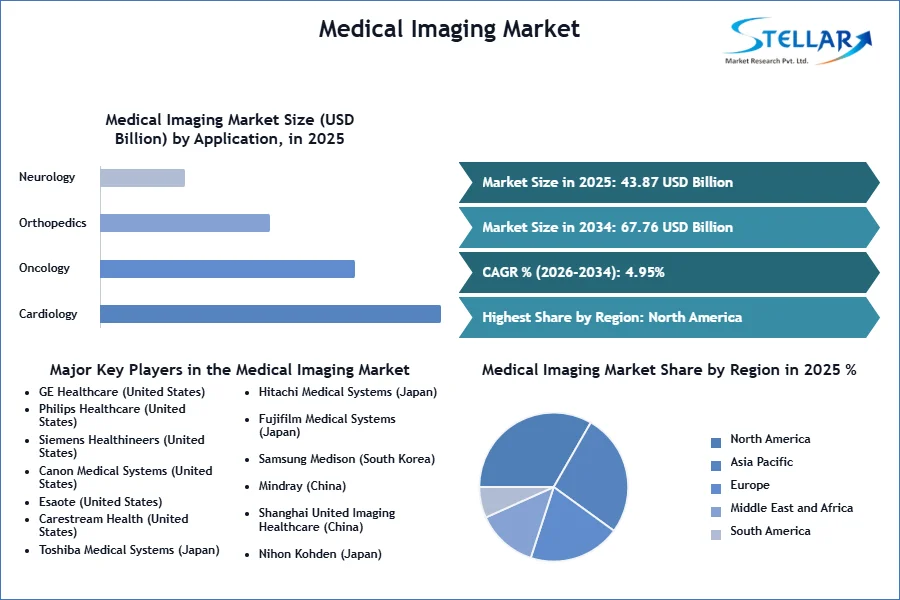
The Medical Imaging Market is undergoing a significant transformation as healthcare providers increasingly adopt advanced diagnostic technologies to improve disease detection, treatment planning, and patient outcomes. The growing prevalence of chronic diseases, rising healthcare investments, and continuous technological innovations are driving demand for high-performance imaging systems worldwide. According to Stellar Market Research, the Medical Imaging Market was valued at USD 43.87 billion in 2025 and is projected to reach nearly USD 67.76 billion by 2034, expanding at a CAGR of 4.95% during the forecast period. The integration of artificial intelligence (AI), cloud computing, and advanced imaging software is further accelerating the market’s evolution toward faster, more accurate, and personalized healthcare.
Understanding the Medical Imaging Market
Medical imaging encompasses a broad range of technologies used to visualize internal organs, tissues, bones, and blood vessels for diagnosis and treatment monitoring. Common imaging modalities include X-ray systems, magnetic resonance imaging (MRI), computed tomography (CT), ultrasound, nuclear imaging, and mammography.
These technologies play a vital role in detecting diseases at an early stage, guiding minimally invasive procedures, monitoring treatment effectiveness, and supporting preventive healthcare. As healthcare systems worldwide prioritize early diagnosis and precision medicine, medical imaging has become an indispensable component of modern clinical practice.
Hospitals, diagnostic imaging centers, specialty clinics, and research institutions continue investing in advanced imaging equipment to enhance diagnostic capabilities and improve patient care.
𝐃𝐨𝐰𝐧𝐥𝐨𝐚𝐝 𝐅𝐫𝐞𝐞 𝐏𝐃𝐅 𝐁𝐫𝐨𝐜𝐡𝐮𝐫𝐞: https://www.stellarmr.com/report/req_sample/medical-imaging-market/2820
Key Factors Driving Market Growth
Rising Burden of Chronic Diseases
The increasing prevalence of cardiovascular diseases, cancer, neurological disorders, musculoskeletal conditions, and respiratory illnesses is one of the primary drivers of the Medical Imaging Market. Early and accurate diagnosis is essential for effective treatment planning, making advanced imaging technologies increasingly important across healthcare systems.
The aging global population also contributes significantly to imaging demand, as older adults typically require more frequent diagnostic evaluations and disease monitoring. These demographic trends continue to support long-term market expansion.
Growing Adoption of Artificial Intelligence
Artificial intelligence is transforming medical imaging by improving image acquisition, interpretation, and clinical decision-making. AI-powered software assists radiologists by detecting abnormalities, prioritizing urgent cases, reducing reporting times, and improving diagnostic accuracy.
Machine learning algorithms can identify subtle imaging patterns that may be difficult to detect manually, enabling earlier diagnosis of conditions such as cancer, stroke, and cardiovascular disease. AI also helps automate repetitive workflows, allowing healthcare professionals to focus on complex clinical cases.
Expanding Healthcare Infrastructure
Governments and private healthcare organizations continue investing in hospitals, diagnostic centers, and digital healthcare infrastructure. Emerging economies are expanding access to advanced diagnostic services through new healthcare facilities and improved reimbursement policies.
The growing availability of imaging equipment in secondary cities and rural healthcare facilities is further increasing patient access to diagnostic services while supporting market growth.
Market Segmentation
The Medical Imaging Market is segmented by product, application, end user, and region.
By Product
Major imaging technologies include:
X-ray Imaging Systems
Magnetic Resonance Imaging (MRI)
Computed Tomography (CT)
Ultrasound Systems
Nuclear Imaging Systems
Mammography Systems
Among these, MRI systems represent one of the leading revenue-generating segments due to their superior soft tissue imaging capabilities and widespread use in neurology, orthopedics, oncology, and cardiology. X-ray systems continue to maintain the largest installed base because of their affordability, speed, and extensive clinical applications.
By Application
Medical imaging supports numerous clinical specialties, including:
Oncology
Cardiology
Neurology
Orthopedics
Obstetrics and Gynecology
Gastroenterology
General Imaging
Cancer diagnosis remains one of the largest application areas as imaging technologies are essential for tumor detection, staging, treatment planning, and follow-up evaluations.
By End User
The market primarily serves:
Hospitals
Diagnostic Imaging Centers
Specialty Clinics
Academic and Research Institutions
Hospitals account for the largest market share due to high patient volumes, comprehensive diagnostic services, and continuous investment in advanced imaging technologies.
𝐃𝐨𝐰𝐧𝐥𝐨𝐚𝐝 𝐅𝐫𝐞𝐞 𝐏𝐃𝐅 𝐁𝐫𝐨𝐜𝐡𝐮𝐫𝐞: https://www.stellarmr.com/report/req_sample/medical-imaging-market/2820
Technology Innovation Transforming Medical Imaging
Technological advancements continue to reshape diagnostic imaging.
Artificial intelligence is enabling automated image reconstruction, faster scan times, and improved diagnostic confidence. Deep learning algorithms assist in image segmentation, lesion detection, and workflow optimization, allowing radiologists to process larger imaging volumes with greater efficiency. AI is increasingly being integrated across the entire imaging workflow, from acquisition to diagnosis and follow-up.
Cloud-based Picture Archiving and Communication Systems (PACS) and Radiology Information Systems (RIS) are improving data accessibility by allowing physicians to securely access medical images across multiple healthcare facilities.
Portable imaging devices are also gaining popularity, particularly in emergency medicine, intensive care units, and remote healthcare settings. Mobile ultrasound and portable X-ray systems improve diagnostic capabilities where traditional imaging infrastructure may be limited.
In addition, 3D and 4D imaging technologies are enhancing surgical planning, minimally invasive procedures, and personalized treatment strategies by providing more detailed anatomical visualization.
Regional Market Outlook
North America
North America remains the largest Medical Imaging Market, supported by advanced healthcare infrastructure, high healthcare expenditure, rapid adoption of innovative technologies, and strong presence of leading medical device manufacturers.
The United States continues to lead the region with significant investments in AI-enabled imaging systems, digital healthcare, and precision medicine initiatives.
Europe
Europe maintains a strong market position due to established healthcare systems, increasing cancer screening programs, and widespread implementation of digital radiology solutions. Countries across the region continue investing in modern imaging equipment to improve diagnostic efficiency and patient outcomes.
Asia-Pacific
Asia-Pacific is expected to experience the fastest growth during the forecast period. Rising healthcare investments, expanding hospital infrastructure, growing medical tourism, and increasing awareness of early disease detection are driving demand across China, India, Japan, South Korea, and Southeast Asia.
Government initiatives to strengthen public healthcare systems and improve diagnostic accessibility are creating significant opportunities for medical imaging equipment manufacturers.
Challenges Facing the Market
Despite positive growth prospects, the Medical Imaging Market faces several challenges.
The high cost of advanced imaging equipment, installation, and maintenance remains a major barrier, particularly for smaller healthcare providers and developing economies. MRI and CT systems require substantial capital investment as well as specialized infrastructure and trained personnel.
Additionally, stringent regulatory approval processes can delay the commercialization of new imaging technologies. Data privacy concerns and cybersecurity risks associated with digital healthcare systems also require continuous investment in secure IT infrastructure.
Another challenge is the global shortage of skilled radiologists and imaging technicians, which may affect the efficient utilization of advanced diagnostic equipment in some regions.
Competitive Landscape
The Medical Imaging Market remains highly competitive, with manufacturers focusing on product innovation, artificial intelligence integration, digital healthcare solutions, and strategic partnerships.
Leading companies continue investing in research and development to improve image quality, reduce scan times, and enhance workflow automation. The industry is also witnessing increasing adoption of cloud-based imaging platforms and AI-assisted diagnostic software.
Major market participants include:
GE HealthCare
Siemens Healthineers
Philips Healthcare
Canon Medical Systems
Fujifilm Holdings Corporation
Hologic Inc.
Shimadzu Corporation
Samsung Medison
Carestream Health
Konica Minolta
These companies are expanding their global presence through technological innovation, acquisitions, and collaborations with hospitals and research institutions to strengthen their competitive positions.
Future Outlook
The future of the Medical Imaging Market is expected to be driven by continued advancements in artificial intelligence, digital healthcare, and precision medicine. As healthcare providers increasingly emphasize early diagnosis and personalized treatment, demand for advanced imaging technologies will continue to rise.
Emerging innovations such as AI-assisted diagnostics, portable imaging systems, cloud-based image management, and 3D visualization are expected to improve accessibility, efficiency, and clinical outcomes. At the same time, expanding healthcare infrastructure in emerging economies will create new growth opportunities for equipment manufacturers and healthcare providers.
With ongoing investments in diagnostic innovation and increasing adoption of intelligent imaging solutions, the Medical Imaging Market is well positioned for sustainable growth through 2034. As technology continues to enhance diagnostic accuracy and operational efficiency, medical imaging will remain at the forefront of modern healthcare, enabling faster diagnoses, better treatment decisions, and improved patient care worldwide.
Media Contact
Stellar Market Research
Website: Stellar Market Research – Global Research Reports & Consulting
Email: sales@stellarmr.com
