Key Highlights
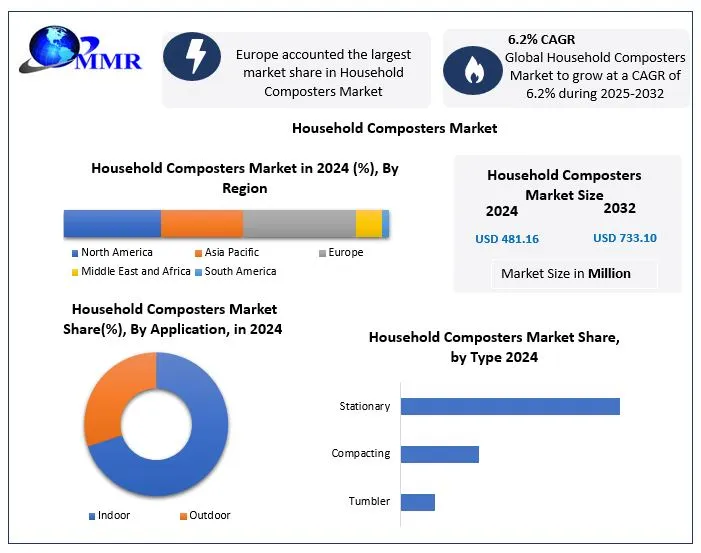
Market Valuation: Valued at USD 481.16 million in 2024, projected to reach USD 733.10 million by 2032.
Growth Rate: The industry is advancing at a CAGR of 6.2% through the 2025–2032 forecast period.
Dominant Segment: Stationary composters, traditionally favored for garden-based waste management.
Fastest-Growing Segment: Electric composters, driven by demand for compact, odor-free solutions in urban apartments.
Primary Drivers: Rising environmental awareness, zero-waste lifestyle adoption, and municipal composting subsidies.
Why This Matters Now
The global household composters market is no longer a peripheral niche for the “eco-conscious” minority; it is becoming a standard appliance in the modern urban home. With the sector poised to add over USD 250 million in value by 2032, C-suite executives who dismiss domestic waste management as a public-sector burden are missing a lucrative pivot in the FMCG and home-goods ecosystem. The current demand—particularly for tech-integrated, odor-free electric models—is vastly outstripping supply in high-density urban centers.
Market Overview
The Valued at USD 481.16 million in 2024, The Household Composters Market is benefiting from the convergence of urban gardening and aggressive municipal zero-waste mandates. Households are moving beyond basic bins toward sophisticated systems that turn food waste into nutrient-dense soil on-site. This shift is not just about environmentalism; it is about the “democratization of waste management,” where the consumer takes personal responsibility for their carbon footprint.
Key Trends Driving Growth
Urbanization and Compact Design: Urban households now drive 55% of total demand. As apartment living becomes the global standard, manufacturers are pivoting toward compact, sleek, and—most importantly—odor-free electric composting systems.
Municipal Subsidy Tailwinds: More than 100 cities globally have introduced municipal composting programs, providing direct subsidies that lower the barrier to entry for consumers. This policy environment ensures long-term, predictable demand for manufacturers.
E-commerce Penetration: Online sales are the primary growth engine, fueled by aggressive digital advertising and expert-led consultations. Digital platforms have allowed brands to educate consumers on the ROI of composting, shifting it from a “chore” to a “lifestyle upgrade.”
Get a free sample
Segment Insights
Dominant Segment: Stationary Composters. These units remain the bedrock of the suburban market, where users prefer high-capacity systems for their gardens.
Fastest-Growing Segment: Electric Composters. Tech-forward units, like those offered by Vitamix (FoodCycler) and Pela (Lomi), are experiencing rapid adoption among Millennials and Gen Z buyers who prioritize convenience and speed over traditional, time-intensive decomposition.
Regional Growth Story
Europe currently holds the largest market share, anchored by strong regulatory frameworks in Germany, the UK, and France that mandate waste segregation. However, the true volume potential for the next decade lies in the Asia-Pacific region. As living standards rise and environmental awareness takes root in India and China, these markets are transitioning from rapid urbanization to a “sustainability-first” consumer model, offering massive growth opportunities for players who can localize their designs.
Competitive Landscape
The market is currently a battleground between legacy garden-tool manufacturers and agile, tech-focused startups. Incumbents like The Scotts Miracle-Gro and Exaco Trading Co. rely on brand legacy and high-capacity stationary systems, while disruptors like Vitamix and Pela are capturing the high-margin, urban “smart” home segment. This competitive tension signals a broader market split: the industry is bifurcating into “hardware-focused” garden solutions and “software-integrated” appliance solutions. Rivals who fail to bridge this gap by offering both capacity and high-tech odor control will find their growth capped within the next 24 months.
Recent Developments
Wi-Fi Integration: New-age models from companies like Pela now include IoT connectivity, allowing users to track their waste diversion metrics via smartphone—a feature that captures premium, tech-savvy demographics.
Material Upgrades: A pivot toward high-durability, weather-resistant materials for outdoor units, specifically aimed at increasing customer retention through product longevity.
Supply Chain Scaling: Leading electric composter manufacturers are addressing current component shortages by securing multi-year contracts with semiconductor and sensor suppliers to ensure steady product availability.
Strategic Implications
The market is shifting from “bin storage” to “data-driven waste reduction.” The value proposition for the next generation of consumers is not just a place to put scraps, but a device that provides measurable data on waste reduction. Brands that treat the household composter as an appliance—integrating it into the smart-home ecosystem—will capture the loyalty of the high-spending urban demographic, whereas those stuck in the “low-tech bin” model will face aggressive price-based commoditization.
Future Outlook
Market winners will be the organizations that successfully blend aesthetic design with high-speed, odorless processing, while losers will be those chained to bulky, traditional outdoor units that ignore the realities of modern, small-space urban living.
Analyst Perspective
“The household composter market is currently undergoing a structural transformation from a garden necessity to a smart kitchen appliance. Companies that master the balance of rapid waste breakdown and seamless integration into the modern smart home will dictate the terms of supply for the next decade.” Siddhi Dole, Analyst, Maximize Market Research
About Maximize Market Research
Maximize Market Research Pvt. Ltd. (MMR) is a global market research and consulting company that provides reliable, data-focused, and practical business insights. The firm serves a wide range of industries, including healthcare, pharmaceuticals, technology, automotive, electronics, chemicals, personal care, and consumer goods. Through market forecasts, competitive analysis, strategic consulting, and industry impact assessments, MMR helps organizations understand changing market conditions, identify growth opportunities, and make informed business decisions for long-term success.
2nd Floor, Navale IT Park Phase 3
Pune Banglore Highway, Narhe
Pune, Maharashtra 411041, India
+91 9607365656
sales@maximizemarketresearch.com
