Key Highlights
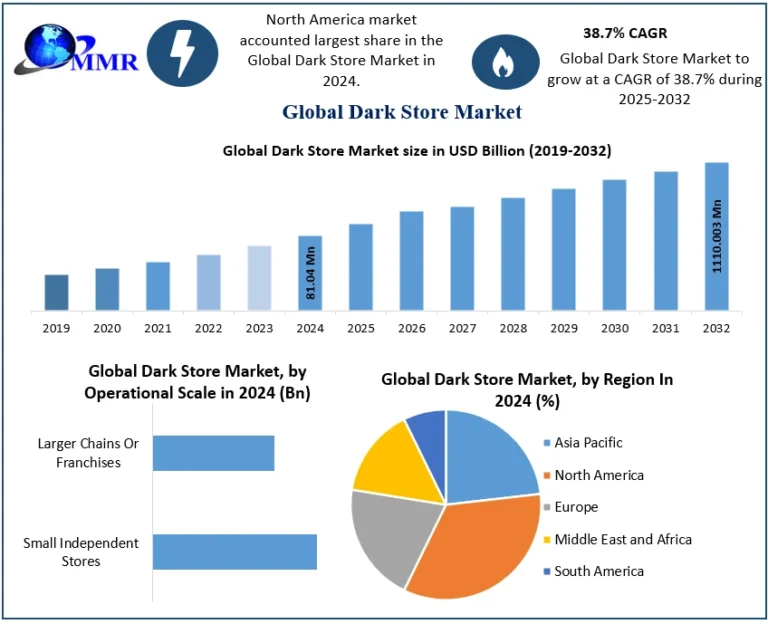
- Global market valued at USD 81.04 million in 2024.
- Expected to reach USD 1,110.00 million by 2032.
- Forecast CAGR stands at 38.7% during 2025–2032.
- Home Delivery remains the largest delivery option.
- Curbside Pickup emerges as the fastest-growing fulfillment model.
- North America maintains market leadership through advanced retail logistics.
- Asia Pacific records the strongest expansion supported by urbanization and digital commerce.
- Automation, inventory optimization, and quick commerce continue to redefine competitive advantage.
Why This Matters Now
Retail competition has shifted from shelf availability to delivery speed. Consumers increasingly expect groceries, pharmaceuticals, electronics, and household products within hours rather than days. Dark stores have become critical infrastructure that enables retailers to shorten delivery windows while improving inventory accuracy.
As quick commerce expands worldwide, retailers are investing in fulfillment facilities closer to urban consumers. Businesses capable of reducing delivery time and operating costs are gaining measurable advantages in customer retention, operational efficiency, and digital sales growth.
Market Overview
Dark stores Market are retail fulfillment facilities designed exclusively for processing online orders without serving walk-in customers. They function as localized distribution hubs that support rapid order picking, packing, and delivery across grocery, electronics, apparel, pharmacy, and household goods.
The strongest demand driver is the continued expansion of e-commerce. Rising online order volumes require retailers to reduce fulfillment times while maintaining inventory accuracy. Dark stores address both requirements by positioning stock closer to consumers and eliminating congestion associated with traditional retail stores.
Rapid urbanization has further strengthened demand. Dense metropolitan populations create favorable economics for same-day and even one-hour delivery services. Retailers increasingly view dark stores as an operational necessity rather than an experimental logistics model.
Supply-side investment is accelerating as retailers modernize fulfillment networks with warehouse automation, digital inventory management, and optimized delivery routing. These improvements increase order accuracy while lowering operational costs.
Macroeconomic trends also support adoption. Digital payment growth, increasing internet penetration, smartphone usage, and evolving consumer shopping behavior continue to shift retail spending toward online channels.
However, transportation costs, high capital investment, operational complexity, and management of perishable products remain significant operational challenges for market participants.
Key Trends Driving Growth
Technology continues to reshape dark store operations through warehouse automation, intelligent inventory systems, and digital order management platforms. Retailers are investing in technologies that reduce picking times and improve fulfillment accuracy, directly enhancing customer satisfaction.
Strategic partnerships have become another defining trend. Traditional retailers increasingly collaborate with logistics providers and technology companies to strengthen last-mile delivery capabilities without building entirely new delivery networks. These alliances reduce operational risk while accelerating expansion into new markets.
Sustainability considerations are also influencing fulfillment strategies. Localized inventory placement reduces unnecessary transportation distances and improves delivery efficiency, supporting broader emissions reduction initiatives across retail supply chains.
Raw material and transportation costs remain important operational variables. Rising fuel expenses increase last-mile delivery costs, making route optimization and inventory localization more valuable for retailers seeking profitability.
Globalization continues to expand cross-border e-commerce, encouraging retailers to establish localized fulfillment networks capable of supporting international consumer demand while maintaining competitive delivery times.
Explore detailed analysis, insights, and growth opportunities
Segment Insights
Dominant Segment: Home Delivery
Home Delivery accounted for the largest market share in 2024 because it directly aligns with consumer demand for convenience, speed, and contactless shopping.
The segment became indispensable during the COVID-19 pandemic and continues to benefit from permanent shifts in purchasing behavior. Consumers increasingly prioritize rapid doorstep delivery for groceries, pharmacy products, and household essentials.
For retailers, Home Delivery strengthens customer loyalty while expanding geographic reach beyond traditional store locations. Businesses investing in efficient delivery infrastructure are positioned to capture higher online spending and recurring purchases.
Fastest-Growing Segment: Curbside Pickup
Curbside Pickup represents the fastest-growing delivery option as consumers seek flexible fulfillment alternatives without entering retail stores.
The model combines online convenience with reduced delivery costs. Retailers also benefit by lowering last-mile transportation expenses while maintaining rapid order fulfillment.
Growing consumer preference for convenience and minimal waiting times continues to support widespread adoption across grocery and retail chains.
Service Type Insights
Business-to-Consumer (B2C) remains the primary revenue generator due to increasing online retail purchases by individual consumers. Businesses continue expanding digital storefronts supported by mobile applications and integrated fulfillment systems.
Business-to-Business (B2B) also presents significant opportunities by supplying retailers, wholesalers, restaurants, and commercial buyers through efficient inventory management and scheduled fulfillment services.
Product Insights
Grocery products remain the largest application area because consumers increasingly rely on rapid fulfillment for daily essentials.
Pharmacy products continue gaining importance as healthcare providers and consumers prioritize fast access to medications.
Electronics, apparel, and household goods also benefit from expanding e-commerce adoption, allowing retailers to diversify product portfolios while improving inventory utilization.
Regional Growth Story
North America leads the global Dark Store Market through highly developed e-commerce ecosystems and significant investments by major retailers. Advanced logistics infrastructure and widespread consumer acceptance of online grocery shopping continue supporting market leadership.
Europe maintains strong momentum as countries including the United Kingdom, Germany, and France expand digital grocery services. Automation-driven fulfillment centers are improving operational efficiency while strengthening delivery capabilities.
Asia Pacific represents the fastest-growing regional opportunity. Rapid urbanization, rising disposable incomes, expanding smartphone adoption, and increasing internet penetration continue accelerating online retail demand. China, India, and Japan remain major investment destinations for dark store infrastructure supporting same-day delivery models.
South America and the Middle East & Africa are emerging markets where expanding digital commerce encourages retailers to strengthen localized fulfillment capabilities. Investments in logistics infrastructure are gradually improving regional competitiveness while supporting future market expansion.
Competitive Landscape
Competition is intensifying as established retailers, digital marketplaces, and logistics platforms invest aggressively in fulfillment infrastructure.
Amazon continues strengthening its competitive advantage through automated fulfillment capabilities supporting Amazon Fresh and Prime delivery services. Walmart is expanding grocery fulfillment networks to improve delivery speed while integrating digital and physical retail operations.
Ocado differentiates itself through highly automated fulfillment technology, positioning the company as a leading innovation provider within online grocery logistics. Instacart leverages partnerships with retailers to expand delivery coverage without relying solely on proprietary retail infrastructure.
Regional players including JD.com, Kroger, DoorDash, Swiggy, Flipkart, Dunzo Daily, Grab, Tesco, Target Brands, Albertsons, FreshDirect, Auchan, Ola Foods, Uber, and Wolt continue investing in logistics partnerships, fulfillment expansion, and delivery optimization to strengthen market positioning.
The competitive landscape increasingly favors companies capable of combining technology, logistics expertise, and localized fulfillment networks to reduce delivery times while maintaining operational efficiency.
Recent Developments
- Major retailers continue expanding dedicated dark store networks to improve online order fulfillment.
- Companies are increasing investment in warehouse automation and inventory management technologies.
- Retailers are strengthening partnerships with third-party delivery providers to expand last-mile capabilities.
- Supermarket chains continue scaling online grocery operations following sustained consumer demand for home delivery.
- Logistics optimization initiatives remain focused on reducing delivery times and improving inventory accuracy.
Analyst Perspective – Siddhi Dole
The next phase of competition will depend less on retail footprint and more on fulfillment efficiency. Companies that successfully integrate automation, localized inventory management, and data-driven logistics into their dark store networks will achieve superior delivery performance while lowering operating costs. Retailers unable to modernize fulfillment infrastructure risk losing market share as quick commerce becomes the industry standard.
Analyst Perspective – Komal Patil
Dark stores are evolving from pandemic-driven solutions into long-term retail infrastructure. Strategic partnerships between retailers, technology providers, and delivery platforms will define future competitiveness. Organizations capable of balancing rapid delivery, operational scalability, and sustainable logistics investments will be better positioned to capture growing online retail demand across global markets.
Future Outlook
Retailers that combine automated dark store networks with scalable last-mile delivery partnerships will capture the greatest value as quick commerce becomes the defining competitive advantage in global retail.
About Maximize Market Research
Maximize Market Research Pvt. Ltd. (MMR) is a global market research and consulting company that provides reliable, data-focused, and practical business insights. The firm serves a wide range of industries, including healthcare, pharmaceuticals, technology, automotive, electronics, chemicals, personal care, and consumer goods. Through market forecasts, competitive analysis, strategic consulting, and industry impact assessments, MMR helps organizations understand changing market conditions, identify growth opportunities, and make informed business decisions for long-term success.
Contact Us :
2nd Floor, Navale IT Park Phase 3
Pune Banglore Highway, Narhe
Pune, Maharashtra 411041, India
+91 9607365656
sales@maximizemarketresearch.com
