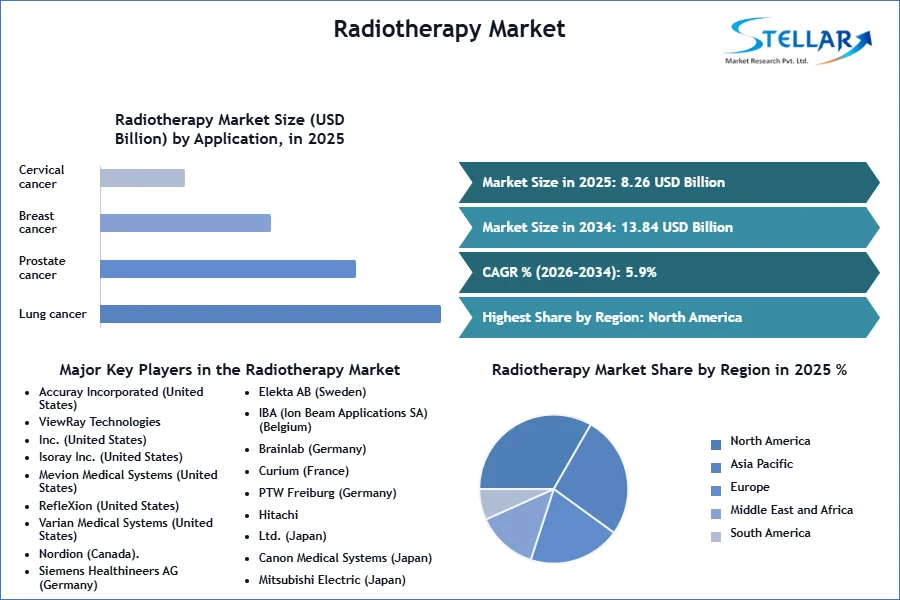
The global Radiotherapy Market is witnessing significant growth as healthcare systems increasingly adopt advanced radiation-based cancer treatment technologies to improve precision, patient outcomes, and treatment efficiency. Rising cancer incidence, increasing demand for minimally invasive therapies, and rapid advancements in image-guided and precision radiotherapy systems are driving market expansion. According to Stellar Market Research, the Radiotherapy Market was expected to grow from USD 8.26 billion in 2025 to USD 13.84 billion in 2034, at a CAGR of 5.9% during the forecast period.
The market is transforming through innovations such as artificial intelligence-powered treatment planning, proton therapy, robotic systems, and adaptive radiotherapy solutions that enable more accurate tumor targeting while reducing damage to healthy tissues.
𝐃𝐨𝐰𝐧𝐥𝐨𝐚𝐝 𝐅𝐫𝐞𝐞 𝐏𝐃𝐅 𝐁𝐫𝐨𝐜𝐡𝐮𝐫𝐞: https://www.stellarmr.com/report/req_sample/radiotherapy-market/2834
Understanding the Radiotherapy Market
Radiotherapy is a medical treatment that uses high-energy radiation to destroy cancer cells, control tumor growth, and prevent disease progression. It is one of the most widely used cancer treatment methods and is often combined with surgery, chemotherapy, immunotherapy, and targeted therapies to improve patient outcomes.
Modern radiotherapy technologies allow healthcare professionals to deliver highly focused radiation doses directly to tumors while minimizing exposure to surrounding healthy organs. The treatment is used for various cancers, including breast cancer, prostate cancer, lung cancer, cervical cancer, brain tumors, and head and neck cancers.
The growing global cancer burden and increasing demand for personalized oncology care are encouraging hospitals and cancer treatment centers to invest in advanced radiotherapy equipment and software solutions.
Key Factors Driving Market Growth
Rising Global Cancer Incidence
The increasing prevalence of cancer worldwide is one of the strongest factors supporting the growth of the Radiotherapy Market. Cancer remains a major healthcare challenge, with millions of new cases diagnosed annually across different regions.
Radiotherapy plays a critical role in cancer management because it can be used as a primary treatment, an adjuvant therapy after surgery, or a palliative treatment to relieve symptoms in advanced-stage cancer patients.
As healthcare providers focus on improving cancer survival rates and expanding access to oncology treatments, demand for advanced radiotherapy systems continues to increase.
Growing Adoption of Precision Radiation Therapy
Technological advancements are transforming radiotherapy from conventional radiation delivery into highly precise and personalized treatment.
Techniques such as:
Intensity-Modulated Radiation Therapy (IMRT)
Image-Guided Radiation Therapy (IGRT)
Stereotactic Body Radiation Therapy (SBRT)
Proton Therapy
Adaptive Radiotherapy
are gaining adoption due to their ability to improve treatment accuracy and reduce side effects.
Precision radiotherapy enables clinicians to adjust radiation doses based on tumor characteristics, patient anatomy, and real-time imaging data, improving therapeutic effectiveness.
Increasing Healthcare Infrastructure Investment
Governments and healthcare organizations are investing in cancer care infrastructure, particularly in emerging economies where access to advanced oncology treatment remains limited.
The expansion of specialty cancer hospitals, oncology centers, and medical technology facilities is creating new opportunities for radiotherapy equipment manufacturers.
Public healthcare initiatives and financial support programs are also improving access to cancer treatment services, supporting long-term market development.
Market Segmentation
The Radiotherapy Market is segmented based on technology type, product type, application, end user, and region.
By Technology Type
Major radiotherapy technologies include:
External Beam Radiotherapy
Internal Radiotherapy (Brachytherapy)
Systemic Radiotherapy
External Beam Radiotherapy represents a major segment due to its widespread use in treating various cancer types. Advanced external beam systems, including linear accelerators, are increasingly adopted because of their precision and treatment flexibility.
Brachytherapy continues to play an important role in treating cancers such as cervical, prostate, and breast cancer by delivering radiation directly near or inside the tumor site.
By Product Type
The market includes:
Linear Accelerators (LINACs)
Proton Therapy Systems
Radiotherapy Software
Treatment Planning Systems
Imaging Systems
Linear accelerators remain among the most widely used radiotherapy devices due to their effectiveness, reliability, and ability to support multiple treatment techniques.
Radiotherapy software solutions are gaining importance as hospitals increasingly adopt digital treatment planning, automation, and artificial intelligence-based optimization tools.
By Application
Key cancer applications include:
Breast Cancer
Prostate Cancer
Lung Cancer
Gynecological Cancer
Brain Cancer
Other Cancers
Breast cancer and prostate cancer represent significant application areas due to their high global prevalence and frequent use of radiotherapy in treatment protocols.
Technology Trends Transforming Radiotherapy
Technological innovation is one of the most important factors shaping the future of the Radiotherapy Market.
Artificial intelligence is increasingly being integrated into radiotherapy workflows to improve treatment planning, image analysis, and radiation dose optimization. AI-based systems help clinicians analyze medical images faster and develop personalized treatment strategies.
Adaptive radiotherapy is another emerging trend that allows treatment plans to be modified based on changes in tumor size, patient anatomy, or treatment response.
Proton therapy is gaining attention because it can deliver radiation more precisely than conventional methods, reducing exposure to healthy tissues. Although high installation costs remain a challenge, increasing investments in proton therapy centers are expanding market opportunities.
Robotic-assisted radiotherapy systems and advanced imaging technologies are also improving treatment accuracy and operational efficiency.
Regional Market Outlook
North America
North America dominates the Radiotherapy Market due to advanced healthcare infrastructure, high cancer treatment adoption, and strong presence of leading medical technology companies.
The United States represents a major contributor because of significant investments in oncology research, advanced radiation therapy centers, and early adoption of innovative technologies.
Europe
Europe maintains a strong position due to established healthcare systems, increasing cancer awareness, and government support for advanced cancer treatment facilities.
Countries such as Germany, France, and the United Kingdom continue investing in modern radiotherapy infrastructure and precision oncology programs.
Asia-Pacific
Asia-Pacific is expected to witness significant growth during the forecast period due to rising cancer prevalence, expanding healthcare infrastructure, and increasing investments in medical technology.
Countries including China, India, Japan, and South Korea are improving access to cancer treatment through new oncology centers, government healthcare initiatives, and technology adoption.
Growing healthcare expenditure and increasing awareness about cancer treatment options are creating strong opportunities for radiotherapy providers across the region.
Challenges Facing the Market
Despite strong growth potential, the Radiotherapy Market faces several challenges.
High equipment costs remain a major barrier, particularly for hospitals in developing regions. Advanced systems such as proton therapy require significant investment in infrastructure, maintenance, and specialized expertise.
A shortage of trained radiation oncologists, medical physicists, and technical professionals can also limit the effective use of radiotherapy technologies.
Additionally, strict regulatory requirements and lengthy approval processes for advanced medical devices may increase development timelines and operational costs.
Competitive Landscape
The Radiotherapy Market is highly competitive, with companies focusing on technological innovation, strategic partnerships, product expansion, and global market penetration.
Major players operating in the market include:
Siemens Healthineers AG
Elekta AB
Canon Medical Systems Corporation
Brainlab AG
IBA Worldwide
Mevion Medical Systems
Hitachi High-Tech Corporation
Curium
Isoray Inc.
Leading companies are investing in artificial intelligence integration, advanced treatment planning software, precision radiation systems, and next-generation oncology solutions to strengthen their market positions.
𝐃𝐨𝐰𝐧𝐥𝐨𝐚𝐝 𝐅𝐫𝐞𝐞 𝐏𝐃𝐅 𝐁𝐫𝐨𝐜𝐡𝐮𝐫𝐞: https://www.stellarmr.com/report/req_sample/radiotherapy-market/2834
Future Outlook
The future of the Radiotherapy Market is expected to be shaped by continued innovation in precision medicine, artificial intelligence, and advanced radiation delivery technologies. Increasing cancer prevalence, growing healthcare investments, and rising demand for personalized treatment approaches will continue driving market expansion.
The integration of AI-driven workflows, adaptive radiotherapy, and advanced imaging technologies will improve treatment accuracy and patient outcomes. Emerging economies will provide significant growth opportunities as healthcare infrastructure expands and cancer care accessibility improves.
As oncology treatment continues shifting toward precision-based approaches, the Radiotherapy Market is positioned for sustained growth through 2032, offering significant opportunities for healthcare providers, technology developers, and investors focused on advancing global cancer care.
Media Contact
Stellar Market Research
Website: Stellar Market Research – Global Research Reports & Consulting
Email: sales@stellarmr.com
