Key Highlights
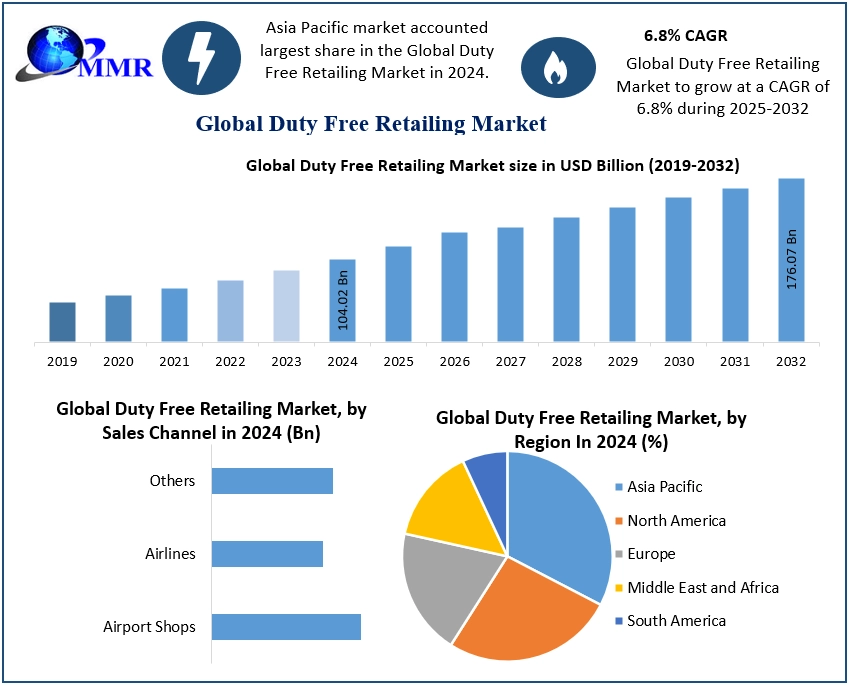
Market Valuation: Valued at USD 104.02 billion in 2024, projected to reach USD 176.07 billion by 2032.
Growth Rate: The industry is advancing at a CAGR of 6.8% through the 2025–2032 forecast period.
Dominant Product Segment: Cosmetics & Personal Care, favored for its high turnover, gift-giving appeal, and value proposition for travelers seeking premium brands at excise-exempt prices.
Dominant Distribution Channel: Airports, serving as the primary nodes for global travel retail due to high foot traffic and captive audience dwell times.
Key Growth Drivers: Rising international tourism volumes, the global middle-class expansion, and the strategic push by airports to increase non-aeronautical revenue.
Why This Matters Now
The duty-free retailing sector is no longer a passive passenger convenience; it is a high-stakes battleground for global luxury and FMCG brands. With the market trajectory aiming for USD 176 billion by 2032, C-suite leaders who treat duty-free as an afterthought are forfeiting a critical touchpoint with the world’s most affluent, mobile consumers. As airport operators prioritize non-aeronautical revenue, the physical “terminal” is being reimagined as a premium retail destination that demands more sophisticated integration than ever before.
Market Overview
The Valued at USD 104.02 billion in 2024, The Duty-Free Retailing Market is tethered to the pulse of global travel. The sector is currently enjoying a structural tailwind as international tourist arrivals recover and exceed pre-pandemic baselines. This market is unique because it combines a “captive” shopping environment with the allure of tax-exempt pricing, creating a powerful incentive for travelers to engage in premium consumption during their transit.
Key Trends Driving Growth
The Premiumization Pivot: Consumers are increasingly trading up to luxury categories within duty-free shops. Whether it is premium spirits or high-end skincare, travelers associate “travel-exclusive” editions with quality and prestige, fueling revenue growth per passenger.
Digital Transformation: The transition toward omnichannel retailing is accelerating. Modern duty-free operators are deploying “pre-order” platforms, mobile click-and-collect services, and AI-driven personalized marketing that engages the traveler long before they reach the departure gate.
Infrastructure Privatization: Airports worldwide are aggressively privatizing and expanding retail footprints to diversify income streams. This expansion creates larger, more sophisticated environments that cater to the consumer’s desire for an “experiential” rather than just a “transactional” shopping moment.
Get a free sample
Segment Insights
Dominant Segment (Product Type): Cosmetics & Personal Care. This category consistently holds the largest revenue share. It is the go-to segment for travelers due to the frequent replenishment cycle of beauty products and the high demand for exclusive travel-size sets.
Dominant Segment (Distribution Channel): Airport Shops. Airports remain the apex distribution channel. They provide the necessary dwell time and foot traffic to support large-scale luxury retail operations that are difficult to replicate elsewhere.
Fastest-Growing Segment: Airport Distribution Channel. While other channels like seaports and border shops exist, the continued expansion of major international hubs—particularly in Asia and the Middle East—ensures airports maintain their runaway lead in volume and growth.
Regional Growth Story
Asia-Pacific leads the global market, anchored by a burgeoning middle-class population and increased disposable income. The region’s focus on mega-airport infrastructure and duty-free island concepts, such as those in Hainan, serves as a blueprint for other markets. Europe remains a steady, high-performing region driven by strong leisure tourism, while North America is capitalizing on modernized airport retail spaces to catch up to the efficiency standards set by APAC hubs.
Competitive Landscape
The market is consolidated among heavyweights like Avolta (formerly Dufry/Autogrill), Lotte Duty Free, The Shilla Duty Free, DFS Group, and Gebr. Heinemann. Current competition is not just about floor space; it is about “ecosystem dominance.” Major players are aggressively pursuing long-term airport concessions and exclusive brand partnerships to lock out rivals. The next 12–24 months will likely see further M&A activity as operators seek to acquire specialized tech-logistics firms to solve the “last-mile” delivery and inventory synchronization challenges inherent in travel retail. Rivals who remain purely localized face extinction, as the market increasingly favors operators who can offer a seamless, standardized experience across global travel hubs.
Recent Developments
Strategic Consolidation: Global operators are aggressively bidding for multi-decade concessions in key international airports, creating high barriers to entry for smaller players.
Omnichannel Integration: Massive investment in mobile applications that allow for duty-free pre-ordering 24–48 hours before a flight, effectively increasing conversion rates among time-constrained business travelers.
Sustainable Sourcing: Increasing pressure to stock eco-friendly and “clean” beauty products is leading retailers to audit their supply chains, ensuring premium brand partnerships align with modern ESG expectations.
Strategic Implications
The market is bifurcating into “retailers who provide a service” and “retailers who provide an experience.” The former are vulnerable to e-commerce and price-comparison apps. The latter—those integrating technology, exclusivity, and premium services—are successfully extracting higher value from every foot of retail space. Success in this market now requires an integrated strategy that connects digital inventory, personalized traveler data, and high-touch in-terminal service.
Future Outlook
Market winners will be the operators that successfully bridge the gap between physical terminal convenience and digital pre-trip engagement, while losers will be those chained to stagnant, transactional store formats that ignore the modern traveler’s demand for a seamless, premium, and personalized shopping journey.
Analyst Perspective
“Duty-free retailing is entering its most sophisticated era. The operators that move away from being simple gate-side kiosks to becoming fully integrated, digitally-native luxury retailers will not only capture the traveler’s wallet but will define the future of the global travel experience.” — Siddhi Dole, Analyst, Maximize Market Research
About Maximize Market Research
Maximize Market Research Pvt. Ltd. (MMR) is a global market research and consulting company that provides reliable, data-focused, and practical business insights. The firm serves a wide range of industries, including healthcare, pharmaceuticals, technology, automotive, electronics, chemicals, personal care, and consumer goods. Through market forecasts, competitive analysis, strategic consulting, and industry impact assessments, MMR helps organizations understand changing market conditions, identify growth opportunities, and make informed business decisions for long-term success.
2nd Floor, Navale IT Park Phase 3
Pune Banglore Highway, Narhe
Pune, Maharashtra 411041, India
+91 9607365656
sales@maximizemarketresearch.com
