Key Highlights
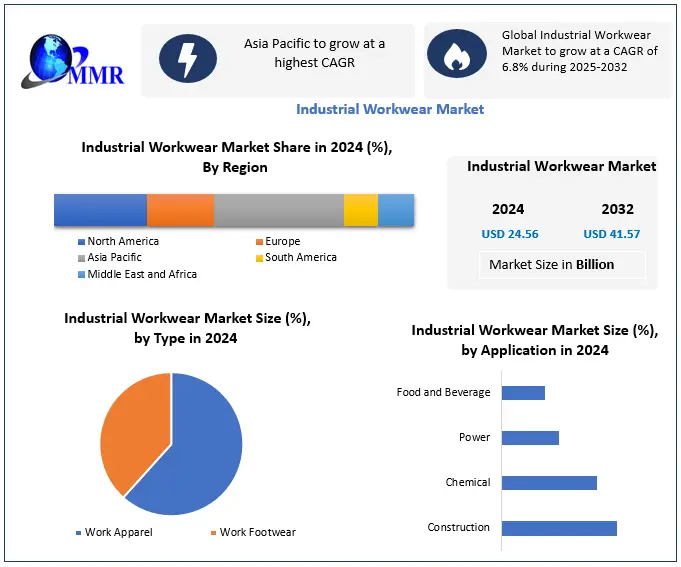
Industrial Workwear Market valued at USD 24.56 Billion in 2024, projected to reach nearly USD 41.57 Billion by 2032 at a 6.8% CAGR, confirming it as a durable, regulation-driven growth category.
The market is global in scope, covering multi-industry demand from factories to field operations, making workwear a critical cost and risk line item for large industrial employers.
Growth is anchored in mandated safety compliance and rising awareness of workplace risk, which converts regulation into recurring, non-discretionary demand for garments and PPE.
The 2025–2032 forecast window signals an extended investment cycle for manufacturers, distributors and brands building capacity and modernizing product portfolios.
Why This Matters Now
A market heading toward USD 41.57 Billion by 2032 is no longer a procurement afterthought; it is a strategic lever for operational continuity and workforce protection. For C‑suite leaders, every unplanned outage, incident investigation or compliance penalty ties back to choices made about industrial workwear, training and supplier strategy.
Industrial workwear sits at the intersection of safety regulation, labor availability and ESG expectations. As manufacturers and logistics operators scale to meet global demand—including for FMCG and food and beverage products—failure to treat workwear as a strategic category will show up as higher incident rates, insurance costs and reputational risk.
Market Overview
The Industrial Workwear Market was valued at USD 24.56 Billion in 2024 and is forecast to grow at a CAGR of 6.8% from 2025 to 2032, reaching nearly USD 41.57 Billion. This growth path indicates a steady, compounding category, not a volatile boom-and-bust cycle, which suits long-term planning and capital investments.
The market forecast through 2032 provides an eight-year runway for manufacturers and brands to expand production, upgrade materials and optimize supply chains. For global players in chemicals, construction, energy, logistics and processing, this translates into predictable replacement cycles and recurring spend that can be negotiated, consolidated or re-specified to capture savings and resilience.
Key Trends Driving Growth
Regulatory tightening on occupational health and safety is a primary engine behind industrial workwear demand. As standards rise, companies must upgrade from basic uniforms to certified protective garments, driving higher average selling prices and more advanced product mixes.
Another key trend is professionalization of industrial operations globally, including in emerging markets. As factories and warehouses modernize, workwear becomes part of broader initiatives around productivity, standard operating procedures and quality systems, embedding demand into corporate playbooks.
For FMCG and food and beverage plants, increasing focus on hygiene, contamination control and traceability is intensifying the need for dedicated workwear solutions across production, cold chains and distribution. Workwear decisions now link directly to audit outcomes, customer audits and retailer requirements.
Request a Free Sample Copy or View Report Summary: https://www.maximizemarketresearch.com/request-sample/39796/
Segment Insights
Dominant Segment — Core Industrial Workwear: The global revenue base indicates that standard industrial workwear and basic protective clothing together form the volume backbone of the category. This concentration shows that essential, everyday garments—rather than niche specialties—will continue to drive the bulk of orders and contract renewals.
Fastest-Growing Segment — Enhanced Protective Workwear: Within the forecast growth to USD 41.57 Billion, higher-grade safety garments configured for specific risks (heat, chemicals, mechanical hazards) are expanding faster than legacy uniforms. This signals a shift from generic uniforms to engineered safety solutions, creating space for innovation and premium pricing.
Sector Adoption: Demand spans heavy industry, logistics, utilities and processing environments, creating diversified revenue streams. This reduces cyclical risk and allows suppliers to balance exposure across construction cycles, manufacturing demand and infrastructure projects.
Regional Growth Story
The market is characterized as global, capturing demand from both mature industrial economies and emerging manufacturing hubs. This spread allows vendors to benefit from re‑shoring in some regions and continued off‑shoring and greenfield facility growth in others.
Regions investing heavily in infrastructure, industrial parks and logistics corridors will continue to expand their industrial workwear spend as workforce sizes and risk profiles grow. For global FMCG and food and beverage players operating multi-country plant networks, this means workwear strategy has to scale across jurisdictions while still meeting local standards.
Competitive Landscape
The march to USD 41.57 Billion by 2032 indicates an arena where both global brands and regional specialists are competing on safety certifications, durability and service models. Players are moving beyond pure garment supply to bundled solutions, including laundering, tracking and replacement services, signaling a shift from one‑off sales to recurring service revenue.
For rivals, any move toward integrated solutions or proprietary fabrics is a warning that the basis of competition is shifting. Over the next 12–24 months, expect consolidation and partnerships around high‑performance materials, digital tracking and logistics capabilities, as companies race to lock in contracts with large industrial employers and government-linked projects.
Recent Developments
The establishment of a clear forecast from USD 24.56 Billion in 2024 to nearly USD 41.57 Billion by 2032 confirms industrial workwear as a long-horizon investment category, encouraging capacity expansions and technology upgrades.
Multi-industry adoption is broadening, as sectors beyond traditional heavy industry start to treat industrial workwear as a core component of safety and brand identity.
Buyers in complex sectors such as manufacturing and logistics are increasingly moving toward standardized workwear specifications across sites to simplify procurement, compliance and training.
Global scale and the long forecast window are encouraging vendors to explore new production locations and sourcing strategies to manage cost, lead time and geopolitical risk.
Strategic Implications
For industrial corporates, including those in FMCG and food and beverage, the 6.8% CAGR signals that workwear deserves central treatment in risk committees and ESG dashboards. Bundling workwear procurement with safety, insurance and workforce retention strategies can unlock savings while improving incident metrics.
For investors and boards, the forecast to nearly USD 41.57 Billion by 2032 frames industrial workwear as a stable cash‑flow category with structural tailwinds. Capital directed toward innovation in materials, lifecycle management and regional distribution will find a long-duration growth runway rather than a short-term spike.
Future Outlook
By 2032, with revenues approaching USD 41.57 Billion, industrial workwear will be deeply embedded in how companies design plants, manage contractors and report ESG performance. As regulations tighten and labor markets remain constrained, employers will compete not only on wages but on visible safety commitments, including the quality and comfort of workwear.
Over the next decade, winners will treat industrial workwear as a strategic asset that reduces accidents, strengthens employer brand and stabilizes operations, while losers will keep seeing it as a commodity line item—and pay for that mistake in downtime, fines and attrition.
Related Reports
Global Compostable Packaging Materials Market https://www.maximizemarketresearch.com/market-report/global-compostable-packaging-materials-market/87381/
Global Hermetic Laser Packaging Market https://www.maximizemarketresearch.com/market-report/global-hermetic-laser-packaging-market/102413/
Global Waterproof Headphones Market https://www.maximizemarketresearch.com/market-report/global-waterproof-headphones-market/53538/
Analyst Perspective
“The Industrial Workwear Market, valued at USD 24.56 Billion in 2024 and projected to reach nearly USD 41.57 Billion by 2032 at a 6.8% CAGR, is shifting from a tactical purchase to a strategic pillar of risk management,” said Siddhi Dole, Analyst at Maximize Market Research. “Executive teams that align workwear decisions with safety, ESG and talent strategies will convert regulatory pressure into durable competitive advantage.”
About Maximize Market Research
Maximize Market Research Pvt. Ltd. (MMR) is a global market research and consulting company that provides reliable, data-focused, and practical business insights. The firm serves a wide range of industries, including healthcare, pharmaceuticals, technology, automotive, electronics, chemicals, personal care, and consumer goods. Through market forecasts, competitive analysis, strategic consulting, and industry impact assessments, MMR helps organizations understand changing market conditions, identify growth opportunities, and make informed business decisions for long-term success.
2nd Floor, Navale IT Park Phase 3
Pune Banglore Highway, Narhe
Pune, Maharashtra 411041, India
+91 9607365656
sales@maximizemarketresearch.com
