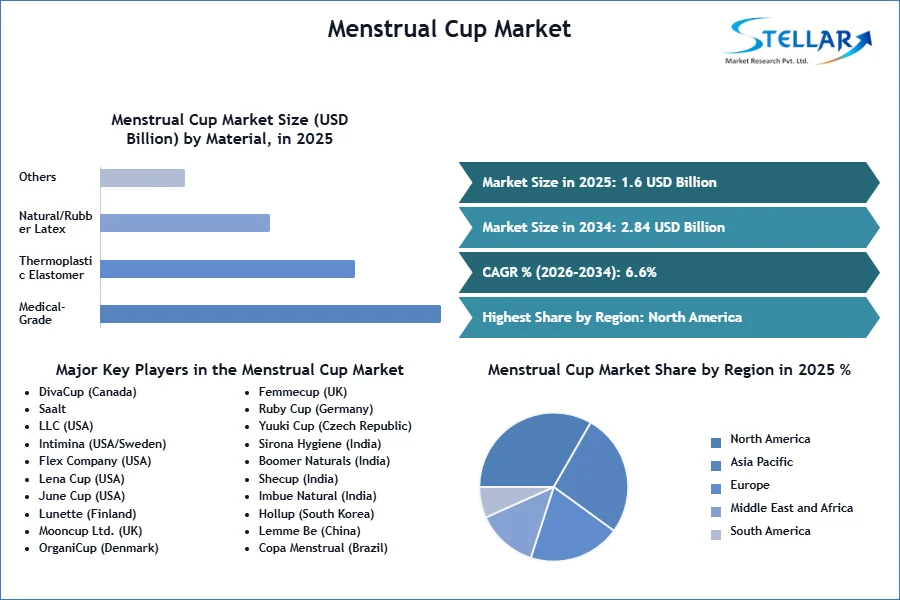
The global Menstrual Cup Market is experiencing significant growth as consumers increasingly shift toward sustainable, cost-effective, and convenient feminine hygiene products. Growing awareness about menstrual health, rising environmental concerns associated with disposable sanitary products, and increasing access to women’s healthcare solutions are driving market expansion. According to Stellar Market Research, the Menstrual Cup Market was valued at USD 1.6 billion in 2025. Its total industry revenue is expected to grow by 6.6 % from 2026 to 2034, reaching nearly USD 2.84 billion in 2034.
The market is evolving with innovations in medical-grade materials, improved designs, digital awareness campaigns, and increasing acceptance of reusable menstrual care products worldwide.
Understanding the Menstrual Cup Market
A menstrual cup is a reusable feminine hygiene product designed to collect menstrual fluid rather than absorb it. Typically made from medical-grade silicone, thermoplastic elastomers (TPE), or latex, menstrual cups are inserted into the vagina and create a secure seal to prevent leakage. Unlike traditional disposable pads and tampons, reusable menstrual cups can be cleaned and used for several years, making them an environmentally friendly alternative.
The increasing focus on sustainable living has positioned menstrual cups as an important product category within the feminine hygiene industry. Consumers are becoming more aware of plastic waste generated by disposable menstrual products and are seeking alternatives that provide long-term economic and environmental benefits.
In addition to sustainability advantages, menstrual cups offer convenience, longer usage duration, and reduced recurring costs, making them attractive to students, working professionals, travelers, and environmentally conscious consumers.
𝐃𝐨𝐰𝐧𝐥𝐨𝐚𝐝 𝐅𝐫𝐞𝐞 𝐏𝐃𝐅 𝐁𝐫𝐨𝐜𝐡𝐮𝐫𝐞: https://www.stellarmr.com/report/req_sample/menstrual-cup-market/2833
Key Factors Driving Market Growth
Rising Awareness About Menstrual Health and Hygiene
Growing awareness regarding menstrual health is one of the primary factors supporting the expansion of the Menstrual Cup Market. Governments, healthcare organizations, and nonprofit initiatives are increasingly promoting menstrual education and hygiene awareness programs, particularly in developing regions.
Improved knowledge about safe menstrual practices is encouraging more women to explore alternative hygiene products beyond conventional sanitary pads and tampons. Educational campaigns focusing on reusable menstrual solutions are helping reduce misconceptions and increase product acceptance.
The expansion of women’s health initiatives and improved access to information through digital platforms are expected to continue driving adoption globally.
Increasing Demand for Sustainable Hygiene Products
Environmental concerns surrounding disposable sanitary products are significantly influencing consumer purchasing decisions. Traditional menstrual products often contain plastic components and contribute to long-term waste accumulation.
Menstrual cups address these concerns by offering a reusable solution that reduces waste generation over several years of usage. The growing global movement toward sustainable and zero-waste lifestyles is encouraging consumers to adopt environmentally responsible personal care products.
Manufacturers are responding by developing eco-friendly menstrual cups using safe, durable, and biocompatible materials while introducing recyclable packaging solutions.
Cost-Effectiveness Supporting Consumer Adoption
The long-term economic advantage of menstrual cups is another important market driver. Although the initial purchase cost is higher than disposable products, reusable menstrual cups can reduce recurring expenses over their lifespan.
For many consumers, especially in regions facing menstrual product affordability challenges, menstrual cups provide a practical and economical solution. This cost advantage is increasing adoption among younger consumers and women seeking affordable menstrual hygiene options.
Market Segmentation
The Menstrual Cup Market is segmented based on product type, material, size, distribution channel, and region.
By Product Type
The market includes:
Reusable Menstrual Cups
Disposable Menstrual Cups
The reusable menstrual cup segment dominates the market due to increasing sustainability awareness and consumer preference for long-term cost savings. Reusable cups are widely adopted because they reduce waste and provide extended usability compared with disposable alternatives.
Disposable menstrual cups are also gaining attention among travelers and first-time users seeking convenient options without maintenance requirements.
By Material Type
Major materials used in menstrual cups include:
Medical-Grade Silicone
Thermoplastic Elastomer (TPE)
Natural Rubber Latex
Medical-grade silicone holds a leading position due to its durability, flexibility, safety profile, and compatibility with sensitive skin. Silicone-based cups are widely preferred because they provide comfort and can withstand repeated sterilization.
Manufacturers are increasingly focusing on improving material quality and developing softer designs to enhance user comfort.
By Distribution Channel
Key distribution channels include:
Online Stores
Retail Stores
Pharmacies
Other Specialty Channels
Online platforms are becoming an important sales channel due to increasing digital adoption, wider product availability, consumer reviews, and discreet purchasing options.
Retail stores and pharmacies continue to play a significant role by improving accessibility and allowing consumers to purchase feminine hygiene products conveniently.
Technology and Product Innovation Transforming the Market
Innovation is playing an important role in shaping the future of the Menstrual Cup Market. Manufacturers are focusing on improving product design, comfort, safety, and user experience.
New-generation menstrual cups feature ergonomic shapes, improved flexibility, leak-resistant designs, and multiple size options to accommodate different user needs. Some companies are also exploring smart menstrual cup technologies integrated with digital tracking capabilities to support menstrual health monitoring.
Antimicrobial materials and advanced silicone formulations are also being developed to improve hygiene and reduce concerns related to bacterial growth.
Mobile applications and digital platforms are further supporting menstrual health education by providing information about product usage, menstrual cycle tracking, and healthcare guidance.
Sustainability Trends Supporting Market Expansion
Sustainability is one of the strongest trends influencing the menstrual hygiene industry.
Consumers are increasingly evaluating personal care products based on their environmental impact, encouraging manufacturers to develop reusable and eco-friendly solutions. Menstrual cups contribute to waste reduction by replacing thousands of disposable products throughout their usable life.
Companies are also adopting sustainable packaging, responsible sourcing practices, and environmentally friendly manufacturing processes to align with changing consumer expectations.
The growing global emphasis on reducing plastic waste and promoting circular economy practices is expected to create additional opportunities for menstrual cup manufacturers.
Regional Market Outlook
North America
North America represents one of the leading markets for menstrual cups due to high awareness levels, strong purchasing power, and increasing demand for sustainable personal care products.
Consumers in the United States and Canada are increasingly adopting reusable menstrual solutions as environmental awareness and interest in wellness products continue to grow.
Europe
Europe is a significant market supported by strong sustainability initiatives, environmental regulations, and consumer preference for eco-friendly products.
Countries such as Germany, the United Kingdom, and France are witnessing increasing adoption of reusable menstrual hygiene solutions due to growing awareness of waste reduction and sustainable lifestyles.
Asia-Pacific
Asia-Pacific is expected to experience strong growth during the forecast period due to rising menstrual health awareness, expanding healthcare initiatives, and increasing availability of affordable products.
Countries including India, China, and Southeast Asian nations are witnessing greater adoption as governments, NGOs, and healthcare organizations promote menstrual hygiene education and accessibility.
Challenges Facing the Market
Despite strong growth potential, the Menstrual Cup Market faces several challenges.
Limited awareness and cultural barriers remain key obstacles, particularly in developing regions where traditional menstrual products are deeply established. Some consumers may also experience difficulties with initial usage, insertion, or maintenance, affecting adoption rates.
Additionally, concerns regarding product hygiene, proper cleaning practices, and lack of education about safe usage can limit acceptance among first-time users.
Manufacturers and healthcare organizations are addressing these challenges through awareness campaigns, educational programs, and improved product designs.
Competitive Landscape
The Menstrual Cup Market is competitive, with companies focusing on product innovation, sustainability, educational initiatives, and global expansion.
Major players operating in the market include:
Diva International Inc.
Saalt LLC
Intimina
Flex Company
Lena Cup
Mooncup
Lunette
MeLuna
The Keeper
These companies are investing in improved materials, customer education programs, digital marketing strategies, and expanded distribution networks to strengthen their market positions.
𝐃𝐨𝐰𝐧𝐥𝐨𝐚𝐝 𝐅𝐫𝐞𝐞 𝐏𝐃𝐅 𝐁𝐫𝐨𝐜𝐡𝐮𝐫𝐞: https://www.stellarmr.com/report/req_sample/menstrual-cup-market/2833
Future Outlook
The future of the Menstrual Cup Market is expected to be shaped by increasing sustainability awareness, improved menstrual health education, and continuous product innovation. As consumers become more environmentally conscious and seek affordable long-term hygiene solutions, demand for reusable menstrual products is expected to rise.
Advancements in smart menstrual health technologies, improved material safety, and personalized product designs will further enhance consumer acceptance. Emerging markets will provide significant growth opportunities as awareness programs and healthcare accessibility continue expanding.
With growing emphasis on sustainable lifestyles and women’s health empowerment, the Menstrual Cup Market is positioned for steady growth through 2032, offering opportunities for manufacturers, healthcare organizations, and investors focused on the future of feminine hygiene solutions.
Media Contact
Stellar Market Research
Website: Stellar Market Research – Global Research Reports & Consulting
Email: sales@stellarmr.com
