Key Highlights
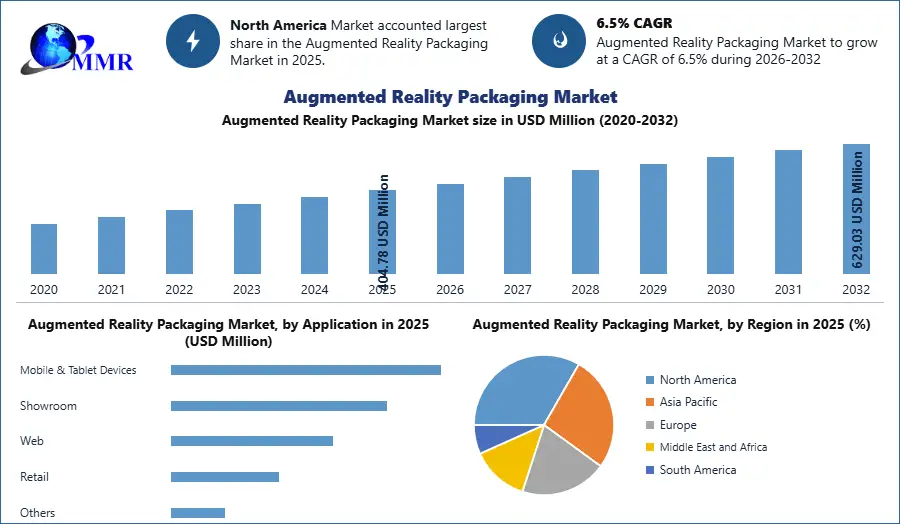
Market Scale: The market was valued at USD 404.78 Bn in 2025 and is projected to reach USD 629.03 Bn by 2032.
Growth Velocity: A CAGR of 6.5% indicates steady, long-term adoption across global supply chains.
Consumer Shift: AR tools are shifting from novelty entertainment to functional information delivery, including traceability and interactive brand storytelling.
Strategic Driver: E-commerce growth forces brands to compete for attention on screens, where physical-to-digital conversion remains the primary hurdle.
Why This Matters Now
Your shelf-space battle is being lost in the digital ether. Traditional, static packaging is effectively invisible to the digitally native consumer who expects real-time, interactive data at the moment of purchase.
Market Overview
The global Augmented Reality Packaging Market is undergoing a structural transition. Valued at USD 404.78 Bn in 2025, the sector is moving toward a valuation of USD 629.03 Bn by 2032, expanding at a CAGR of 6.5%. This growth is not driven by the technology itself, but by the requirement to solve the “engagement deficit” that plagues traditional retail packaging. Brands now view the package not as an end-state, but as a gateway to dynamic digital ecosystems.
Key Trends Driving Growth
Consumers now demand hyper-transparency regarding ingredient sourcing and nutritional metrics. AR acts as the primary interface for clean-label validation, allowing brands to provide deep-dive product information without cluttering the physical package design.
Sustainability also dictates the adoption of these technologies. Brands are using AR to showcase eco-friendly supply chain initiatives, providing QR-activated visualizations of the product’s lifecycle. This satisfies the demand for accountability while maintaining aesthetic minimalism on the shelf.
Segment Insights
Dominant Segment (Tracking & Interaction): Current market dominance belongs to packaging solutions integrated with QR-code and NFC-driven interactive triggers. These enable immediate access to reward programs, digital manuals, and reordering flows.
Fastest-Growing Segment (Advanced Immersive Experience): The high-growth segment is characterized by computer-vision-based AR, where the entire product design acts as the digital trigger. This shift signals a move toward richer, brand-immersive environments over simple information retrieval.
Regional Growth Story
North America and Europe retain the largest share, driven by mature e-commerce infrastructure and high penetration of 5G networks. However, the Asia-Pacific region is emerging as the fastest-growing market. High mobile-first consumer habits in these regions have made AR scanning an everyday interaction, forcing global FMCG players to localize their digital packaging strategies rapidly.
Competitive Landscape
The market is consolidating around firms that offer unified hardware-software solutions. Leading players are moving away from bespoke, one-off projects toward scalable SaaS platforms. This transition signals a pivot to recurring revenue models for packaging tech providers. Smaller rivals who focus solely on creative content creation face significant margin pressure; their only viable path to survival is partnership or acquisition by major packaging converters looking to digitize their portfolios.
Recent Developments
Hardware Integration: Significant investment in lightweight AR-scanning technology, reducing the friction of third-party application downloads.
Cross-Industry Partnerships: FMCG majors are forming deep-tech alliances with visual-search firms to scale AR across global product lines.
Data Aggregation: Companies are beginning to leverage AR-interaction data to refine supply chain logistics, using scan rates to predict localized demand surges.
Strategic Implications
The divide between winners and losers will be determined by the speed of integration. Winners will treat the package as an owned media channel, using AR to harvest first-party consumer data and drive direct-to-consumer (DTC) loyalty. Losers will continue to treat packaging as a physical expense, failing to recognize that every physical unit is an untapped digital touchpoint.
Future Outlook
As we approach 2032, the firms that successfully blur the line between physical goods and digital services will command superior margins and brand loyalty, while those clinging to static packaging will face rapid obsolescence in an increasingly augmented marketplace.
Analyst Perspective
“The move toward a USD 629.03 Bn market is not about the technology’s wow-factor; it is about the necessity of data,” says Siddhi Dole. “Companies that use AR to solve transparency and engagement challenges are effectively turning their products into active, data-gathering assets, fundamentally changing the economics of the retail shelf.”
About Maximize Market Research
Maximize Market Research Pvt. Ltd. (MMR) is a global market research and consulting company that provides reliable, data-focused, and practical business insights. The firm serves a wide range of industries, including healthcare, pharmaceuticals, technology, automotive, electronics, chemicals, personal care, and consumer goods. Through market forecasts, competitive analysis, strategic consulting, and industry impact assessments, MMR helps organizations understand changing market conditions, identify growth opportunities, and make informed business decisions for long-term success.
2nd Floor, Navale IT Park Phase 3
Pune Banglore Highway, Narhe
Pune, Maharashtra 411041, India
+91 9607365656
sales@maximizemarketresearch.com
