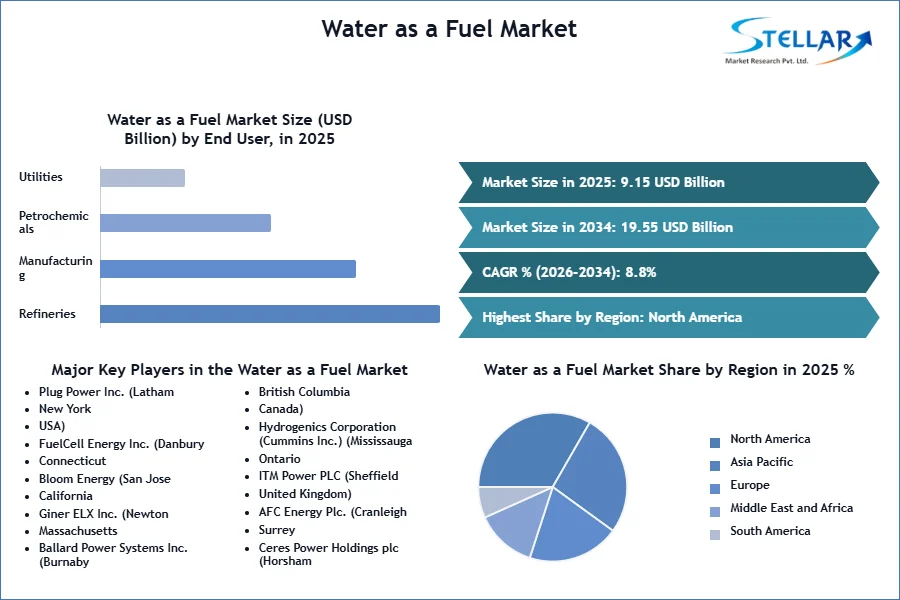
The Water as a Fuel Market was valued at USD 9.15 bn in 2025 and is expected to reach USD 19.55 bn by 2034, at a CAGR of 8.8% during the forecast period.
The global Water as a Fuel Market is gaining momentum as governments, industries, and energy companies accelerate the transition toward low-carbon energy solutions. Rising pressure to reduce greenhouse gas emissions, increasing investments in hydrogen infrastructure, and growing adoption of renewable energy technologies are driving demand for water-derived fuel solutions. The market is being transformed by advancements in electrolysis, green hydrogen production, renewable-powered fuel systems, and advanced energy storage technologies.
Understanding the Water as a Fuel Market
The Water as a Fuel Market represents technologies that utilize water as a source for producing clean energy carriers, primarily hydrogen. Water itself is not directly burned as a conventional fuel; instead, hydrogen is extracted from water molecules through processes such as electrolysis and other advanced conversion technologies. The produced hydrogen can then be used in fuel cells, industrial applications, transportation systems, power generation, and energy storage solutions.
Water-based fuel technologies are becoming increasingly important within the global clean energy ecosystem because hydrogen offers a pathway to decarbonize sectors where direct electrification remains challenging. Heavy transportation, steel manufacturing, chemical production, refining, and long-duration energy storage are among the industries exploring hydrogen-based solutions.
The market is supported by improvements in electrolyzer efficiency, renewable energy integration, hydrogen storage technologies, and government-led clean energy initiatives.
𝐃𝐨𝐰𝐧𝐥𝐨𝐚𝐝 𝐅𝐫𝐞𝐞 𝐏𝐃𝐅 𝐁𝐫𝐨𝐜𝐡𝐮𝐫𝐞: https://www.stellarmr.com/report/req_sample/water-as-a-fuel-market/2859
Key Factors Driving Market Growth
Rising Demand for Green Hydrogen Solutions
The increasing focus on reducing carbon emissions is one of the strongest drivers of the Water as a Fuel Market. Industries worldwide are searching for alternatives to fossil fuels to achieve net-zero targets and comply with stricter environmental regulations.
Green hydrogen produced through water electrolysis using renewable electricity is gaining attention as a clean energy carrier. Unlike conventional fossil fuel-based energy systems, hydrogen produced from renewable sources can significantly reduce carbon emissions when integrated into suitable applications.
Governments across major economies are investing in hydrogen strategies, funding programs, and infrastructure development to accelerate clean energy adoption.
Expansion of Renewable Energy Integration
The growth of renewable energy sources such as solar and wind power is creating new opportunities for water-based fuel technologies. Renewable electricity can be used to power electrolyzers, enabling the production of green hydrogen without direct carbon emissions.
As renewable energy capacity expands globally, the availability of low-cost electricity is expected to improve the economic feasibility of hydrogen production.
Energy companies are increasingly exploring hybrid systems that combine renewable power generation, hydrogen production, and storage capabilities to improve grid stability and energy security.
Increasing Industrial Adoption of Hydrogen
Hydrogen demand is expanding across several industrial sectors, supporting market growth. Refineries, petrochemical plants, fertilizer manufacturers, steel producers, and chemical industries are adopting hydrogen technologies to reduce emissions from traditional processes.
The automotive sector is also exploring hydrogen fuel cells for commercial vehicles, long-distance transportation, and heavy-duty mobility applications where battery-based solutions may face limitations.
Growing investments in hydrogen infrastructure, including production facilities, storage systems, and distribution networks, are expected to strengthen market development.
Market Segmentation
The Water as a Fuel Market is segmented based on fuel type, technology, end-user, and region.
By Fuel Type
The market includes:
Hydrogen
Oxyhydrogen
Hydrogen Segment Dominates Market Growth
Hydrogen represents the leading fuel type due to its broad industrial applications, scalability, and established role in clean energy strategies.
Hydrogen produced through water electrolysis is gaining strong attention because it supports decarbonization efforts across transportation, industrial manufacturing, and power generation sectors.
Oxyhydrogen, a mixture of hydrogen and oxygen generated through electrolysis, is used in specialized applications such as welding, combustion enhancement, and smaller-scale energy systems. However, its adoption remains limited compared with hydrogen due to infrastructure and storage challenges.
By Technology
Major technologies include:
Electrolysis
Natural Gas Reforming
Electrolysis Emerges as the Fastest-Growing Technology
Electrolysis is expected to witness significant growth due to increasing demand for green hydrogen production. This technology separates water into hydrogen and oxygen using electricity, with environmental benefits depending on the electricity source.
Advancements in proton exchange membrane (PEM), alkaline, and anion exchange membrane (AEM) electrolyzers are improving efficiency, scalability, and operational flexibility.
Natural gas reforming currently maintains a strong market position because of existing industrial infrastructure and cost advantages. However, concerns regarding carbon emissions are encouraging a transition toward cleaner hydrogen production methods.
By End User
Key end-user industries include:
Refineries
Manufacturing
Petrochemicals
Utilities
Automotive
Aerospace
Electronics
Others
Refineries and petrochemical industries remain important users of hydrogen due to their established consumption patterns. Meanwhile, automotive and utilities sectors are expected to create new opportunities as hydrogen infrastructure expands.
Technology Trends Transforming the Market
Technological advancements are accelerating the development of water-based fuel systems.
Advanced Electrolyzer Technologies
Next-generation electrolyzers are improving hydrogen production efficiency while reducing operating costs. Innovations in membrane materials, catalysts, and system design are helping manufacturers achieve higher performance and longer equipment lifecycles.
Artificial Intelligence and Digital Energy Management
AI-powered energy management systems are being integrated into hydrogen production facilities to optimize electricity usage, predict maintenance requirements, and improve operational efficiency.
Digital monitoring platforms allow operators to analyze hydrogen production performance, manage renewable energy inputs, and reduce operational downtime.
Hydrogen Storage and Distribution Innovation
Efficient hydrogen storage remains a key focus area. Companies are developing solid-state storage technologies, advanced compression systems, and improved transportation solutions to increase hydrogen accessibility.
Sustainability and Environmental Impact
Sustainability is a major factor influencing the expansion of the Water as a Fuel Market.
Hydrogen produced through renewable-powered electrolysis can support global decarbonization efforts by replacing fossil fuels in emission-intensive industries. It can also improve energy resilience by enabling renewable energy storage and balancing electricity supply fluctuations.
Companies are increasingly investing in environmentally responsible hydrogen production methods, carbon reduction strategies, and renewable energy integration to align with global climate goals.
Regional Market Outlook
North America
North America represents a significant market due to strong investments in hydrogen infrastructure, clean energy policies, and technological innovation.
The United States and Canada are supporting hydrogen development through government incentives, research programs, and industrial partnerships. The region’s focus on reducing industrial emissions and expanding clean transportation solutions is creating strong growth opportunities.
Europe
Europe is one of the leading regions for water-based fuel adoption due to ambitious carbon neutrality targets and strong renewable energy policies.
Countries including Germany, France, and the Netherlands are investing in electrolyzer projects, hydrogen corridors, and industrial hydrogen applications.
Government support programs and renewable energy expansion are accelerating the adoption of green hydrogen technologies.
Asia-Pacific
Asia-Pacific is expected to experience strong growth due to rapid industrialization, increasing energy demand, and expanding renewable energy capacity.
Countries such as China, Japan, South Korea, and India are investing heavily in hydrogen production infrastructure and clean energy strategies. Growing industrial demand and government-backed hydrogen initiatives are creating significant opportunities across the region.
Challenges Facing the Market
Despite strong growth potential, the Water as a Fuel Market faces several challenges.
High capital costs associated with electrolyzers, hydrogen storage systems, and infrastructure development remain major barriers. Large-scale hydrogen projects require significant investments in production facilities, transportation networks, and supporting technologies.
Energy efficiency challenges also affect market expansion. Hydrogen production through electrolysis requires substantial electricity input, making access to affordable renewable energy essential.
Competition from alternative clean energy technologies, including battery storage and direct electrification solutions, may also influence market adoption in certain applications.
Competitive Landscape
The Water as a Fuel Market is becoming increasingly competitive, with companies focusing on electrolyzer innovation, hydrogen infrastructure expansion, partnerships, and renewable energy integration.
Key players operating in the market include:
Plug Power Inc.
Nel ASA
Bloom Energy
Air Liquide
Thyssenkrupp Nucera
ITM Power PLC
Panasonic Corporation
Siemens Energy
Linde plc
Cummins Inc.
Leading companies are investing in large-scale hydrogen projects, advanced electrolyzer technologies, and strategic collaborations to strengthen their positions in the evolving clean energy market.
𝐃𝐨𝐰𝐧𝐥𝐨𝐚𝐝 𝐅𝐫𝐞𝐞 𝐏𝐃𝐅 𝐁𝐫𝐨𝐜𝐡𝐮𝐫𝐞: https://www.stellarmr.com/report/req_sample/water-as-a-fuel-market/2859
Future Outlook
The future of the Water as a Fuel Market will be shaped by continued investment in green hydrogen, renewable energy integration, technological innovation, and global decarbonization strategies.
As industries seek alternatives to fossil fuels, hydrogen produced from water is expected to become an increasingly important component of the global energy transition. Improvements in electrolyzer efficiency, declining renewable energy costs, and supportive government policies will create new growth opportunities.
Emerging markets with expanding renewable energy capacity and industrial demand are expected to play a critical role in future market development.
With increasing focus on clean energy security and carbon-neutral solutions, the Water as a Fuel Market is positioned for steady growth through 2032, supporting the transformation of global energy systems.
Media Contact
Stellar Market Research
Website: Stellar Market Research – Global Research Reports & Consulting
Email: sales@stellarmr.com
