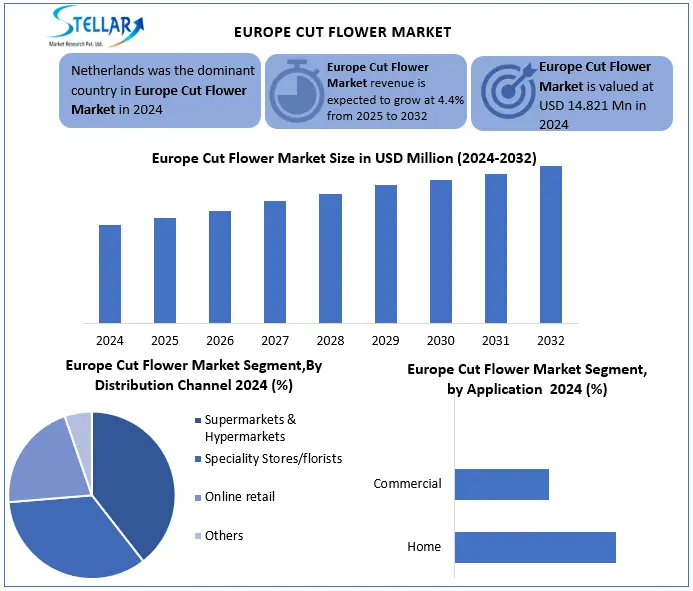
The Europe Cut Flower Market is witnessing steady growth as rising demand for floral gifting, expanding online flower delivery platforms, and increasing consumer preference for sustainably sourced flowers reshape the regional floriculture industry. Strong logistics infrastructure, advanced greenhouse cultivation, and innovations in post-harvest handling continue to strengthen Europe’s position in the global flower trade. According to Stellar Market Research, the Europe Cut Flower Market was valued at USD 14.82 billion in 2024 and is projected to reach USD 20.91 billion by 2032, expanding at a CAGR of 4.4% during the forecast period. The market is further supported by digital retail growth, eco-friendly packaging, and investments in cold-chain logistics.
Understanding the Europe Cut Flower Market
The Europe Cut Flower Market comprises fresh flowers harvested for decorative, gifting, hospitality, and event purposes. Popular varieties include roses, chrysanthemums, carnations, lilies, and gerberas, which are distributed through supermarkets, florists, online retailers, and wholesale flower auctions.
Europe remains one of the world’s largest centers for floriculture, with the Netherlands serving as the primary trading hub through Royal FloraHolland, the world’s largest flower auction. Advanced greenhouse technology, efficient transportation networks, and strong export capabilities enable Europe to maintain its leadership in global flower distribution. Growing consumer interest in premium bouquets, personalized floral arrangements, and sustainable products continues to drive market expansion.
𝐃𝐨𝐰𝐧𝐥𝐨𝐚𝐝 𝐅𝐫𝐞𝐞 𝐏𝐃𝐅 𝐁𝐫𝐨𝐜𝐡𝐮𝐫𝐞: https://www.stellarmr.com/report/req_sample/europe-cut-flower-market/2863
Key Factors Driving Market Growth
Rising Demand for Floral Gifting
Flowers continue to play an important role in birthdays, weddings, anniversaries, corporate gifting, and seasonal celebrations across Europe. Increasing disposable income and changing consumer lifestyles have encouraged greater spending on premium floral arrangements.
Hotels, restaurants, event organizers, and corporate offices are also increasing flower purchases to enhance customer experiences and interior aesthetics, creating additional demand across commercial applications.
Expansion of Online Flower Delivery
The rapid growth of e-commerce has transformed the European flower industry. Consumers increasingly prefer ordering flowers online because of greater convenience, wider product selection, same-day delivery, and personalized gifting options.
Digital platforms are helping florists reach larger customer bases while offering subscription services, customized bouquets, and AI-driven recommendations. The growing popularity of online retail is expected to remain a major growth driver throughout the forecast period.
Growing Preference for Sustainable Floriculture
Environmental awareness is encouraging consumers to purchase sustainably grown flowers produced with reduced pesticide use, efficient water management, and biodegradable packaging.
Growers across Europe are investing in environmentally friendly greenhouse technologies, renewable energy, and certification programs to meet increasing demand for ethically sourced floral products.
Market Segmentation
The Europe Cut Flower Market is segmented by type, application, distribution channel, and country.
By Type
The market includes:
Rose
Chrysanthemum
Carnation
Gerbera
Lilium
Others
Rose Segment Leads the Market
Roses accounted for the largest market share in 2024 due to their enduring popularity for gifting, weddings, festivals, and decorative applications.
Their strong cultural significance, year-round demand, and wide variety of colors continue to support market leadership. Lilies and chrysanthemums are also witnessing increasing demand due to their premium appearance and versatility in floral arrangements.
By Distribution Channel
Major distribution channels include:
Supermarkets & Hypermarkets
Specialty Stores/Florists
Online Retail
Others
Supermarkets remain an important retail channel because they offer convenient access to fresh flowers. However, online retail is the fastest-growing segment as consumers increasingly prefer digital ordering and home delivery services.
Technology Trends Transforming the Industry
Smart Greenhouse Technologies
European flower growers are adopting automated greenhouse systems that optimize irrigation, lighting, temperature, and humidity to improve flower quality while reducing production costs.
Artificial intelligence and IoT-based monitoring systems help growers maximize yields and minimize resource consumption.
Cold Chain Innovation
Maintaining freshness during transportation remains critical for cut flowers. Companies are investing in advanced cold-chain logistics, temperature-controlled packaging, and ethylene-absorbing technologies that extend shelf life and reduce waste.
These innovations improve export efficiency and help suppliers deliver fresher flowers across international markets.
Sustainable Packaging
Manufacturers are increasingly replacing plastic wrapping with biodegradable materials, recyclable paper packaging, and eco-friendly bouquet designs to meet consumer sustainability expectations.
Sustainability and Regulatory Trends
Sustainability is becoming a major competitive differentiator in the European flower industry.
Consumers increasingly seek Fairtrade-certified flowers, locally sourced products, and environmentally responsible cultivation practices. European producers are reducing water consumption, improving energy efficiency, and investing in renewable-powered greenhouses.
At the same time, stricter EU import regulations regarding pesticides, plant health, and pest management continue influencing sourcing strategies and encouraging higher production standards across global supply chains.
Regional Market Outlook
Netherlands
The Netherlands dominates the Europe Cut Flower Market through its advanced greenhouse industry, Royal FloraHolland auction system, and highly efficient logistics infrastructure. The country exports billions of flower stems annually and serves as Europe’s primary floral trading hub.
Spain and Italy
Spain and Italy are emerging as rapidly growing producers due to favorable climates, lower production costs, and increasing demand for locally grown flowers. Their focus on seasonal production and sustainable farming practices is strengthening regional competitiveness.
Germany, France, and the United Kingdom
These countries remain major consumer markets driven by strong gifting traditions, high disposable income, expanding hospitality sectors, and growing online flower purchases.
Market Challenges
Despite favorable growth prospects, several challenges remain.
Cut flowers are highly perishable and require efficient harvesting, grading, packaging, refrigerated storage, and transportation. Delays within logistics networks can significantly reduce product quality and increase waste.
Climate change also poses production risks, with changing weather patterns affecting flower-growing regions both within Europe and among key import suppliers. Rising labor costs and stricter environmental regulations may increase operating expenses for growers.
Competitive Landscape
The Europe Cut Flower Market features a combination of flower breeders, growers, wholesalers, auction operators, and online floral retailers.
Major market participants include:
Dümmen Orange
Royal FloraHolland
Florensis
Marginpar BV
Chrysal
Porta Nova
Selecta One
David Austin Roses
Euroflorist
Leading companies are investing in new flower varieties, greenhouse automation, sustainable cultivation methods, digital sales platforms, and international distribution networks to strengthen their competitive positions.
𝐃𝐨𝐰𝐧𝐥𝐨𝐚𝐝 𝐅𝐫𝐞𝐞 𝐏𝐃𝐅 𝐁𝐫𝐨𝐜𝐡𝐮𝐫𝐞: https://www.stellarmr.com/report/req_sample/europe-cut-flower-market/2863
Future Outlook
The future of the Europe Cut Flower Market will be driven by sustainable floriculture, digital retail expansion, premium gifting trends, and continuous innovation in logistics and greenhouse technologies.
Growing demand for eco-friendly flowers, biodegradable packaging, and locally produced floral products will create new opportunities for growers and retailers. Advances in AI-powered greenhouse management, precision agriculture, and cold-chain solutions will further improve production efficiency and product quality.
With Europe’s strong floriculture infrastructure, expanding e-commerce ecosystem, and enduring cultural demand for flowers, the Europe Cut Flower Market is well positioned for sustained growth through 2032.
Media Contact
Stellar Market Research
Website: Stellar Market Research – Global Research Reports & Consulting
Email: sales@stellarmr.com
