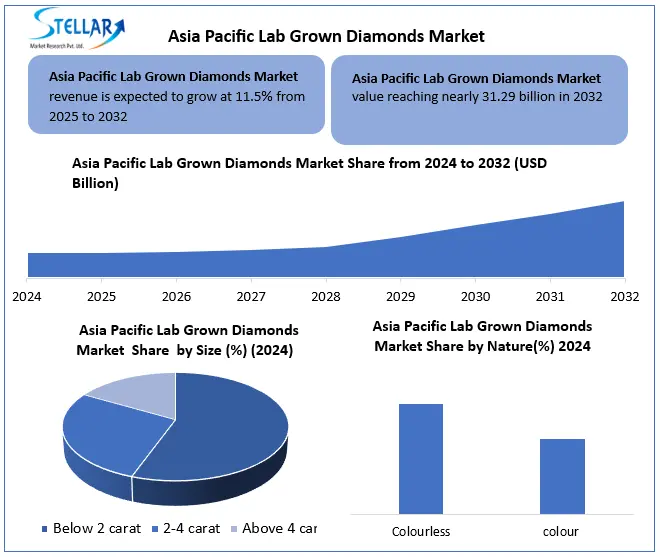
The Asia Pacific Lab Grown Diamond Market is experiencing rapid expansion as consumers increasingly embrace sustainable luxury, affordable fine jewelry, and technologically advanced diamond production. Growing awareness of ethical sourcing, rising disposable incomes, and continuous improvements in Chemical Vapor Deposition (CVD) and High Pressure High Temperature (HPHT) technologies are transforming the regional diamond industry. According to Stellar Market Research, the Asia Pacific Lab Grown Diamond Market was valued at USD 13.1 billion in 2024 and is projected to reach USD 31.29 billion by 2032, growing at a CAGR of 11.5% during the forecast period. The market is being driven by environmentally conscious purchasing, expanding e-commerce platforms, and increasing demand for premium yet affordable diamond jewelry.
Understanding the Asia Pacific Lab Grown Diamond Market
Lab-grown diamonds possess the same chemical composition, crystal structure, optical properties, and physical characteristics as mined diamonds. Instead of forming naturally over millions of years, they are produced within controlled laboratory environments using advanced technologies such as Chemical Vapor Deposition (CVD) and High Pressure High Temperature (HPHT).
Asia Pacific has emerged as the world’s leading production and consumption hub for lab-grown diamonds, with China and India playing central roles in manufacturing, cutting, polishing, and exports. Growing middle-class populations, increasing online jewelry purchases, and shifting consumer preferences toward sustainable products continue to accelerate market expansion.
𝐃𝐨𝐰𝐧𝐥𝐨𝐚𝐝 𝐅𝐫𝐞𝐞 𝐏𝐃𝐅 𝐁𝐫𝐨𝐜𝐡𝐮𝐫𝐞: https://www.stellarmr.com/report/req_sample/apac-lab-grown-diamond-market/2864
Key Factors Driving Market Growth
Rising Demand for Ethical and Sustainable Jewelry
Environmental and ethical concerns surrounding traditional diamond mining are encouraging consumers to choose lab-grown diamonds. These diamonds are conflict-free, require significantly less land disturbance, and have a lower environmental footprint than conventional mining.
Millennials and Gen Z consumers, in particular, increasingly prioritize sustainability, transparency, and responsible sourcing when purchasing fine jewelry.
Expanding Middle-Class Consumer Base
Rapid economic growth across China, India, Southeast Asia, and other Asia Pacific countries has increased disposable incomes and luxury spending.
Consumers seeking premium-quality jewelry at more affordable prices are increasingly selecting lab-grown diamonds, especially for engagement rings, wedding jewelry, and fashion accessories.
Growth of E-Commerce Jewelry Sales
Online jewelry platforms have made lab-grown diamonds more accessible than ever before. Digital retailers offer wider product selections, competitive pricing, certification transparency, and customization options that appeal to younger buyers.
The combination of digital marketing, virtual try-on technologies, and direct-to-consumer business models continues to strengthen online sales throughout the region.
Market Segmentation
The Asia Pacific Lab Grown Diamond Market is segmented by manufacturing method, nature, size, application, and country.
By Manufacturing Method
The market includes:
High Pressure High Temperature (HPHT)
Chemical Vapor Deposition (CVD)
Chemical Vapor Deposition (CVD) Leads Market Growth
The Chemical Vapor Deposition (CVD) segment holds the dominant market share because it produces high-quality diamonds with excellent clarity and consistency.
Continuous improvements in reactor technology, production efficiency, and scalability have enabled manufacturers to produce larger, premium-grade diamonds while reducing manufacturing costs.
HPHT technology continues to play an important role, particularly for industrial applications and specific gemstone production requirements.
By Nature
Major product categories include:
Colourless
Coloured
Colourless diamonds dominate the market due to strong demand for bridal jewelry, engagement rings, luxury accessories, and premium fashion products.
By Size
The market includes:
Below 2 Carats
2–4 Carats
Above 4 Carats
Diamonds below 2 carats account for the largest share because they are widely used in engagement rings, earrings, pendants, and everyday fine jewelry.
By Application
Applications include:
Fashion
Industrial
The fashion segment represents the largest revenue contributor as consumers increasingly adopt lab-grown diamonds for luxury jewelry and designer collections. Industrial applications continue expanding across electronics, precision cutting tools, semiconductors, and advanced manufacturing.
Technology Trends Transforming the Industry
Advanced Diamond Manufacturing
Continuous investment in CVD and HPHT technologies is improving crystal quality, production speed, and manufacturing efficiency.
These innovations enable producers to manufacture larger, higher-quality diamonds while lowering production costs.
Expanding Industrial Applications
Beyond jewelry, lab-grown diamonds are finding applications in quantum computing, semiconductor manufacturing, thermal management systems, high-performance electronics, and advanced sensing technologies.
Research institutions and technology companies are increasingly investing in synthetic diamond materials because of their exceptional hardness, thermal conductivity, and electrical insulation properties.
Digital Retail Innovation
Jewelry brands are integrating artificial intelligence, virtual consultations, 3D visualization, and augmented reality to enhance online shopping experiences and improve consumer confidence when purchasing high-value products.
Sustainability Trends
Sustainability has become one of the strongest competitive advantages for lab-grown diamonds.
Consumers increasingly value products that minimize environmental impact while ensuring ethical production practices. Manufacturers are investing in renewable energy-powered production facilities, energy-efficient reactors, and transparent supply chains to strengthen sustainability credentials.
Many brands also emphasize carbon footprint reduction and responsible manufacturing practices as key elements of their marketing strategies.
Regional Market Outlook
China
China dominates the Asia Pacific Lab Grown Diamond Market due to its advanced manufacturing capabilities, large-scale production facilities, government support, and technological expertise in HPHT diamond production.
The country’s extensive production infrastructure and strong export capabilities have established China as one of the world’s leading suppliers of lab-grown diamonds.
India
India has rapidly emerged as a global hub for CVD diamond production, cutting, polishing, and jewelry manufacturing.
Government support, skilled labor, and a well-established diamond processing ecosystem continue attracting investments from both domestic and international companies. India’s exports of lab-grown diamonds have increased significantly in recent years as global demand continues to rise.
Japan and South Korea
Japan and South Korea continue investing in premium jewelry manufacturing, advanced materials research, and industrial diamond applications, creating new growth opportunities beyond traditional luxury markets.
Market Challenges
Despite strong growth prospects, several challenges remain.
Falling retail prices caused by increasing production capacity may pressure profit margins for manufacturers. Consumer education also remains important, as misconceptions regarding the quality and value of lab-grown diamonds continue to influence purchasing decisions.
The market also faces intense competition from natural diamonds, although widening price differences and sustainability advantages continue supporting consumer adoption.
Competitive Landscape
The Asia Pacific Lab Grown Diamond Market features strong competition among manufacturers, jewelry brands, and technology companies.
Major market participants include:
Henan Huanghe Whirlwind Co., Ltd.
Zhongnan Diamond Co., Ltd.
SF Diamond
Mini Diamonds
Limelight Diamonds
Bhanderi Lab Grown Diamonds
Shree Ramkrishna Exports
GIVA
IIa Technologies
EDP Corporation
Leading companies continue investing in production capacity expansion, advanced CVD technology, product innovation, sustainability initiatives, and direct-to-consumer sales channels to strengthen their competitive positions.
𝐃𝐨𝐰𝐧𝐥𝐨𝐚𝐝 𝐅𝐫𝐞𝐞 𝐏𝐃𝐅 𝐁𝐫𝐨𝐜𝐡𝐮𝐫𝐞: https://www.stellarmr.com/report/req_sample/apac-lab-grown-diamond-market/2864
Future Outlook
The Asia Pacific Lab Grown Diamond Market is expected to maintain strong momentum through 2032 as ethical consumerism, technological innovation, and affordable luxury continue driving demand.
Growing adoption of CVD technology, expanding industrial applications, increasing online jewelry sales, and supportive government initiatives will further strengthen regional market growth. As production efficiencies improve and consumer awareness continues to rise, lab-grown diamonds are expected to capture a larger share of both the jewelry and industrial materials markets.
With China and India leading global manufacturing while regional consumers increasingly embrace sustainable luxury, the Asia Pacific Lab Grown Diamond Market is well positioned for sustained long-term growth. (Stellar Market Research)
