Key Highlights
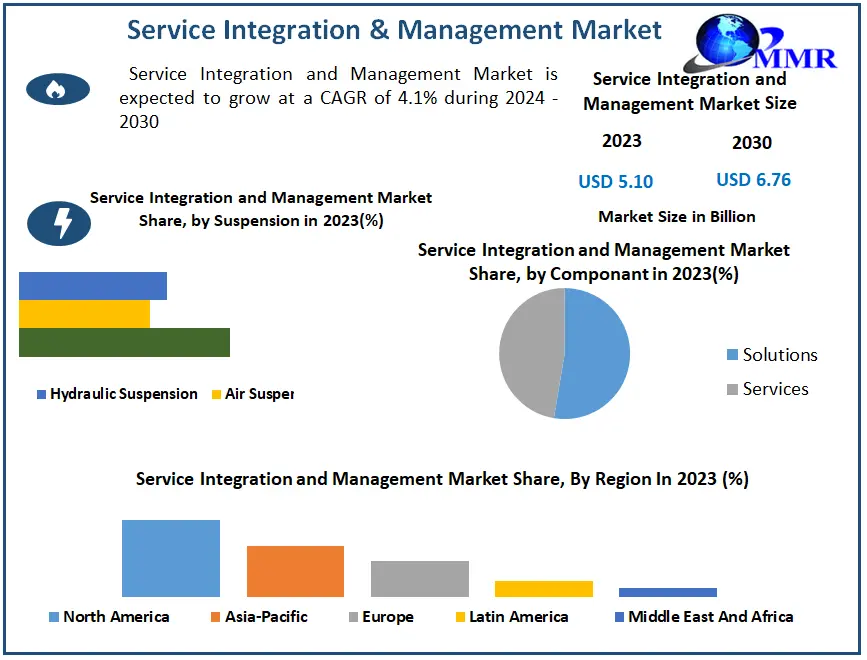
- The Service Integration and Management Market was valued at USD 4.69 Billion in 2023 and is expected to reach nearly USD 6.76 Billion by 2030, growing at a CAGR of 4.1%.
- Increasing IT complexity and multi-provider environments are pushing organizations toward centralized service management frameworks.
- Technological Solutions remain the dominant segment due to demand for integration, automation, security, and operational efficiency.
- Asia Pacific is identified as the fastest-growing regional market, supported by expanding SMEs and rising digital transformation activity.
Why This Matters Now
Enterprise technology stacks are becoming harder to control. Companies are adding cloud platforms, software applications, external vendors, and digital services faster than traditional management models can handle. The result is a growing need for structured systems that connect multiple providers and maintain consistent service delivery.
For business leaders, the issue is no longer only technology adoption. The challenge is operational coordination. Service Integration and Management solutions provide a framework for managing complex service ecosystems, helping enterprises reduce fragmentation and improve visibility across technology operations.
Market Overview
The Service Integration and Management Market reached USD 4.69 Billion in 2023 and is forecast to grow to nearly USD 6.76 Billion by 2030 at a CAGR of 4.1%. The expansion reflects increasing demand from organizations seeking better control over diverse IT environments and multiple service providers.
SIAM enables organizations to integrate services from different providers into a coordinated operating model. This approach helps businesses manage service performance, improve communication between vendors, and create more consistent digital operations.
The market is gaining importance across industries as companies continue adopting hybrid IT models. The growing use of cloud services and digital platforms is increasing the need for service integration capabilities that can connect complex technology environments.
Key Trends Driving Growth
Digital transformation is reshaping enterprise operations and creating demand for stronger IT governance. Organizations are increasingly using multiple technology providers, making service coordination a strategic priority rather than a technical function.
Automation and artificial intelligence are emerging as important technology trends within service management. These capabilities help organizations optimize workflows, improve monitoring, and accelerate responses across interconnected systems.
Hybrid service delivery models are also influencing market demand. Businesses need platforms capable of managing internal systems, cloud services, and third-party providers through a unified framework.
Segment Insights
- Dominant Segment: Technological Solutions
Technological Solutions hold the largest market share. The segment benefits from enterprise demand for tools and platforms that support integration, automation, security, and efficient management of modern IT ecosystems. - Fastest-Growing Segment: Business Solutions
Business Solutions are expected to record the fastest growth. Companies are increasingly focusing on aligning IT investments with business performance, customer satisfaction, and strategic objectives. - Largest Organization Segment: Large Enterprises
Large enterprises maintain dominance because they operate complex technology environments involving multiple applications, systems, and service providers. Their larger IT budgets allow greater investment in SIAM solutions. - Fastest-Growing Organization Segment: Small and Medium Enterprises
SMEs are expected to experience faster adoption as cloud services and digital technologies increase IT complexity and create demand for cost-effective service management solutions.
Regional Growth Story
Asia Pacific represents the fastest-growing region for the Service Integration and Management Market. Growth is supported by increasing numbers of SMEs, expanding digital transformation initiatives, and rising adoption of service management solutions to handle growing IT complexity.
North America remains a significant market due to the presence of major technology companies and strong enterprise demand for advanced service integration capabilities. The region includes leading players such as IBM, DXC Technology, ServiceNow, and CGI.
Europe continues to contribute through technology modernization efforts and adoption of enterprise service management frameworks. Companies including Accenture, Atos, and Capgemini are active participants in the regional competitive environment.
Competitive Landscape
The SIAM market is shaped by global technology providers offering integrated consulting, implementation, and service management capabilities. IBM, HCLTech, Wipro, Fujitsu, TCS, Infosys, Accenture, and ServiceNow compete by combining technology platforms with managed services expertise.
Competitive activity signals a market moving toward end-to-end service ecosystems rather than standalone tools. Providers that can combine automation, cloud expertise, and multi-vendor coordination are positioned to strengthen customer relationships over the next 12–24 months.
For smaller competitors, the challenge will be differentiation. As large technology firms expand their service portfolios, emerging players will need specialized solutions, industry expertise, or faster deployment models to capture enterprise demand.
Recent Developments
- In September 2023, Infosys launched Infosys Cobalt Airline Cloud, designed to support digital transformation in the commercial aviation sector through cloud-based capabilities. The move signals growing demand for industry-focused cloud ecosystems.
- In September 2022, Fujitsu introduced Virtuora Service Management and Orchestration for intelligent and automated service delivery across multi-layer, multi-vendor networks and cloud environments. The development highlights increasing demand for automated orchestration.
Strategic Implications
Enterprises adopting SIAM solutions are moving from fragmented vendor management toward integrated digital operating models. This transition creates opportunities for companies that can improve service visibility, reduce operational complexity, and support faster technology changes.
Technology providers must focus on automation, interoperability, and scalable service frameworks. Customers are increasingly looking for partners that can manage complete service environments rather than deliver isolated technology components.
Future Outlook
The Service Integration and Management Market is expected to maintain steady expansion as organizations continue building complex digital ecosystems. Companies that successfully integrate automation, cloud management, and multi-provider coordination will capture growth, while those relying on fragmented service models risk losing competitiveness.
Analyst Perspective
“Rising IT complexity and the increasing adoption of digital technologies are creating stronger demand for Service Integration and Management solutions. Organizations are looking for structured frameworks that can simplify multi-provider environments and improve operational efficiency,” said Siddhi Dole, Analyst at Maximize Market Research.
About Maximize Market Research
Maximize Market Research Pvt. Ltd. (MMR) is a global market research and consulting company that provides reliable, data-focused, and practical business insights. The firm serves a wide range of industries, including healthcare, pharmaceuticals, technology, automotive, electronics, chemicals, personal care, and consumer goods. Through market forecasts, competitive analysis, strategic consulting, and industry impact assessments, MMR helps organizations understand changing market conditions, identify growth opportunities, and make informed business decisions for long-term success.
2nd Floor, Navale IT Park Phase 3
Pune Banglore Highway, Narhe
Pune, Maharashtra 411041, India
+91 9607365656
sales@maximizemarketresearch.com
