Key Highlights
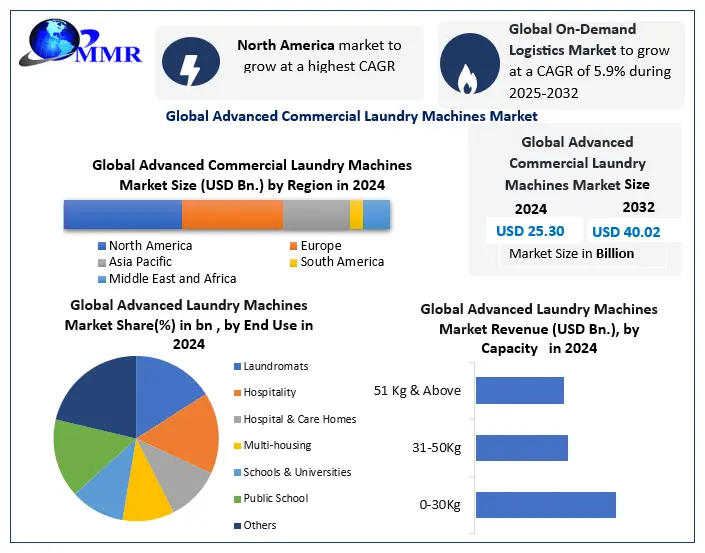
Market Valuation: The global advanced commercial laundry machines market stood at USD 25.30 billion in 2024.
Growth Trajectory: Revenues are projected to reach USD 40.02 billion by 2032, expanding at a 5.9% CAGR.
Dominant Category: Washer-Extractors lead market share due to space, water, and operational time efficiencies.
Regional Leader: North America holds the dominant share, driven by aggressive adoption of energy and water-efficient systems.
Growth Engine: The Asia Pacific region, specifically India and China, is experiencing accelerated demand linked to rising disposable incomes and expanding commercial laundromat footprints.
Why This Matters Now
Supply chains are tightening, and operational overhead is eating into margins across FMCG, food and beverage, and hospitality sectors. Upgrading to advanced commercial laundry systems is no longer a localized facilities decision; it is a critical sustainability and cost-control mandate. High-capacity operations require hardware that minimizes water usage and accelerates turnaround times without breaking down under continuous industrial loads. The shift toward smart, connected washer-extractors provides exact tracking of resource consumption—a necessity as ESG reporting shifts from voluntary to heavily scrutinized.
Market Overview
The global Advanced Commercial Laundry Machines market is fundamentally restructuring how large-scale facilities manage linen, uniform, and fabric throughput. Valued at USD 25.30 billion in 2024, the market is on pace to eclipse USD 40.02 billion by 2032. A consistent 5.9% compound annual growth rate underscores sustained capital expenditure by commercial operators. Equipment ranges from 0-30 Kg units to massive 51 Kg and above industrial setups, built for high-demand environments. Sectors dependent on impeccable hygiene standards—such as hospitals, FMCG processing plants, and hospitality chains—are retiring legacy machines in favor of intelligent, high-efficiency models.
Key Trends Driving Growth
Resource scarcity and operational efficiency are forcing hardware upgrades across the commercial sector. Institutional buyers demand machines that cut utility costs and increase daily throughput.
Smart laundry technology is the primary driver. Connected machines allow facility managers to monitor cycle times, energy draw, and mechanical health in real time, shifting maintenance from reactive to predictive. This data-driven approach directly reduces machine downtime. Furthermore, stringent water and power consumption metrics dictate procurement. Modern advanced commercial machines use drastically less water and power per cycle, aligning heavy operational needs with corporate sustainability targets. Lastly, the rapid expansion of laundromats in emerging markets creates a massive secondary growth pillar.
Segment Insights
Dominant Segment: Washer-Extractors. This equipment rules the market by merging washing and dewatering into a single, balanced cycle. For facilities managing high daily tonnage, washer-extractors require less floor space, consume lower water volumes, and dramatically reduce cycle times compared to decoupled washing and extracting systems.
Fastest-Growing Segment: Smart, energy-efficient machines (by capability). As utility costs rise globally, hardware that promises quantifiable reductions in energy and water input is capturing the majority of new CapEx allocations in the commercial laundry space.
End-Use Dynamics: While laundromats remain a core volume driver, adoption is scaling rapidly across hospitality, multi-housing, schools, and hospitals, where internal laundry operations are vital for cost control and sanitation.
Regional Growth Story
North America controls the largest share of the market. Market dominance here is sustained by an unexpected crossover: high demand for commercial-grade, energy-efficient units by residential consumers, coupled with strict environmental regulations pushing institutional buyers toward low-water-consumption models.
Meanwhile, the Asia Pacific region functions as the market’s primary growth accelerator. Surging disposable income levels and rapid urbanization in China and India have triggered an explosion in commercial laundromat setups. For global manufacturers, APAC represents the critical expansion zone where capturing early market share guarantees long-term service and replacement revenue.
Competitive Landscape
The market is highly concentrated at the top, governed by heavyweights like Alliance Laundry Systems, Samsung, Electrolux AB, and Whirlpool Corporation. Competition is fought primarily on the R&D floor. Manufacturers are injecting heavy capital into smart diagnostics, automated resource management, and aggressive water-reduction engineering.
These R&D investments signal a permanent industry shift: hardware alone is commoditized, but data-yielding, resource-efficient hardware commands a premium. We are seeing a distinct move toward strategic partnerships. Established players are linking with regional entities to bypass supply chain bottlenecks and immediately scale their geographic footprint. For rivals, this means organic growth is too slow; maintaining market position requires aggressive technological development or strategic M&A to secure localized distribution channels.
Recent Developments
Accelerated R&D funding directed strictly at manufacturing smart laundry machines with industry-leading water and energy efficiency ratings.
Formation of strategic geographic partnerships among tier-one manufacturers to rapidly capture market share in high-growth emerging economies.
Expansion of product portfolios to cover a wider spectrum of capacities, specifically targeting the 51 Kg & above industrial segment.
Strategic Implications
For procurement officers and operational heads in FMCG, F&B, and institutional sectors, the mandate is clear: delaying equipment upgrades guarantees higher variable costs. The transition to advanced commercial washer-extractors offers immediate ROI through reduced utility consumption and faster throughput. Companies that leverage smart laundry networks can integrate machine data directly into their ESG reporting, providing transparent, verifiable proof of water and energy reductions. Capital allocation must pivot toward intelligent hardware that actively manages resource deployment.
Future Outlook
Between 2025 and 2032, the advanced commercial laundry market will heavily penalize inefficient hardware. Adoption of connected, ultra-efficient washer-extractors will become the absolute baseline for operational viability. Manufacturers who fail to integrate smart, low-water technology into their industrial lines will rapidly lose relevance. Facilities that delay modernizing their laundry infrastructure will face compounding utility costs and regulatory friction, while early adopters will secure defensible margin protections and superior operational agility.
Analyst Perspective
“The pivot toward smart laundry technology and high-efficiency washer-extractors represents a fundamental operational upgrade for high-volume sectors. As utility costs escalate and sustainability metrics become mandatory, advanced commercial laundry machines transition from basic utility hardware to strategic assets driving tangible cost reductions.” — Siddhi Dole, Analyst, Maximize Market Research
About Maximize Market Research
Maximize Market Research Pvt. Ltd. (MMR) is a global market research and consulting company that provides reliable, data-focused, and practical business insights. The firm serves a wide range of industries, including healthcare, pharmaceuticals, technology, automotive, electronics, chemicals, personal care, and consumer goods. Through market forecasts, competitive analysis, strategic consulting, and industry impact assessments, MMR helps organizations understand changing market conditions, identify growth opportunities, and make informed business decisions for long-term success.
2nd Floor, Navale IT Park Phase 3
Pune Banglore Highway, Narhe
Pune, Maharashtra 411041, India
+91 9607365656
sales@maximizemarketresearch.com
