Key Highlights
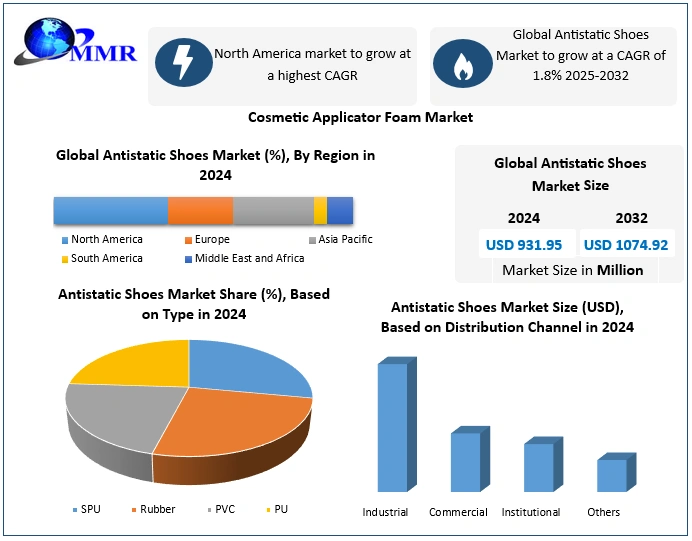
Market Valuation: Global Antistatic Shoes Market reached USD 931.95 million in 2024.
Growth Trajectory: Market revenue is projected to grow at a CAGR of 1.8% from 2025 to 2032.
Revenue Milestone: Projected market value is expected to hit USD 1074.92 million by 2032.
Sector Impact: Increasing demand for Electrostatic Discharge (ESD) protection in automated food processing and FMCG packaging lines.
Why This Matters Now
Workplace safety in high-tech food manufacturing is no longer a peripheral concern; it is a critical operational bottleneck. Any failure in electrostatic discharge control during high-speed packaging or volatile ingredient handling threatens production continuity and creates massive liabilities.
Market Overview
The Global Antistatic Shoes Market operates as a backbone for specialized industrial safety. Valued at USD 931.95 million in 2024, the sector provides essential protection in environments where static electricity poses an ignition or equipment-damage risk. Growth remains steady, with a forecasted CAGR of 1.8% through 2032.
Reaching a total market value of USD 1074.92 million by 2032 suggests a market transitioning from a discretionary safety upgrade to a baseline compliance requirement. Operators in the FMCG and F&B sectors are increasingly prioritizing this technology to secure sensitive automated systems.
Key Trends Driving Growth
Industrial automation dominates current investment cycles. As food and beverage facilities integrate more sensors and precise circuitry, the threshold for acceptable static discharge vanishes.
Health and safety regulatory bodies are intensifying oversight. Corporations are shifting from generalized safety footwear to specialized antistatic solutions to minimize insurance premiums and avoid OSHA-style penalties. Furthermore, the push for employee wellness includes ergonomic design improvements, making protective footwear more comfortable for long, mandatory shifts on factory floors.
Segment Insights
Dominant Segment: Low-top antistatic shoes currently command the highest market share due to their widespread adoption in general manufacturing and assembly lines.
Fastest-Growing Segment: Specialty ESD-rated boots designed for high-care cleanroom environments are experiencing rapid adoption as food safety standards move toward stricter environmental controls.
Regional Growth Story
The regional narrative is defined by the density of manufacturing infrastructure. North America and Europe lead in demand, driven by stringent workplace safety protocols and highly automated food processing facilities. The Asia-Pacific region displays consistent growth as the massive expansion of the FMCG sector necessitates higher compliance with international safety standards to participate in global supply chains.
Competitive Landscape
The competitive field is fragmented, featuring a mix of specialized protective gear manufacturers and established global footwear brands. Leading firms are aggressively pursuing proprietary material testing to certify their products against international ESD standards.
This behavior signals a shift from commodity pricing to value-based competition. Rivals who fail to achieve certified testing benchmarks will find themselves locked out of high-value contracts with major FMCG manufacturers who prioritize supply chain safety. Over the next 12–24 months, we anticipate increased M&A activity focused on acquiring specialized ESD material technology.
Recent Developments
Material Innovation: Manufacturers are integrating advanced conductive polymers into shoe outsoles, replacing traditional metal components to reduce weight.
Partnership Strategies: Leading safety footwear providers are entering exclusive supply agreements with large-scale beverage bottling conglomerates.
Distribution Shifts: Increased investment in direct-to-enterprise e-commerce platforms allows manufacturers to bypass traditional retail, capturing more margin while offering customized bulk ordering.
Strategic Implications
For FMCG leaders, footwear selection is a strategic decision. Investing in high-performance antistatic gear reduces the risk of micro-damage to automated assembly line electronics. This minimizes downtime and extends the operational lifespan of expensive machinery. Failing to prioritize this equipment is a gamble on facility uptime.
Future Outlook
Market winners will be the firms that transition from selling “safety shoes” to providing “integrated safety solutions” that include training and testing support for their clients. Losers will remain stuck in the commodity cycle, fighting for margin on generic products while being displaced by specialized, high-performance competitors.
Analyst Perspective
“The static discharge risks inherent in modern automated food production necessitate a more rigorous approach to workplace safety gear,” says Siddhi Dole, Analyst at Maximize Market Research. “Companies that view antistatic footwear as a core asset rather than an expense will see tangible improvements in operational reliability.”
About Maximize Market Research
Maximize Market Research Pvt. Ltd. (MMR) is a global market research and consulting company that provides reliable, data-focused, and practical business insights. The firm serves a wide range of industries, including healthcare, pharmaceuticals, technology, automotive, electronics, chemicals, personal care, and consumer goods. Through market forecasts, competitive analysis, strategic consulting, and industry impact assessments, MMR helps organizations understand changing market conditions, identify growth opportunities, and make informed business decisions for long-term success.
2nd Floor, Navale IT Park Phase 3
Pune Banglore Highway, Narhe
Pune, Maharashtra 411041, India
+91 9607365656
sales@maximizemarketresearch.com
