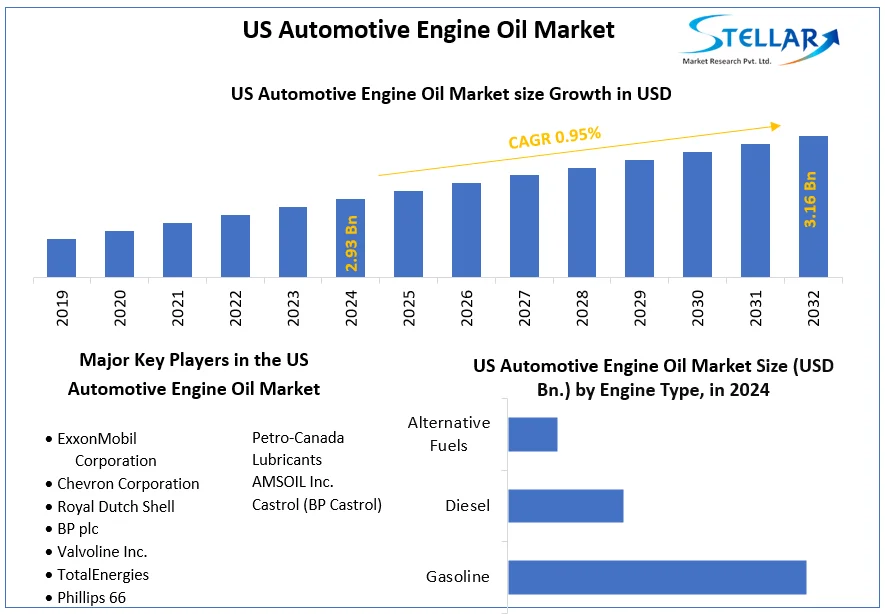
The US Automotive Engine Oil Market remains a vital segment of the automotive aftermarket, driven by the need for engine performance, durability, and maintenance. Engine oil plays a crucial role in lubrication, cooling, and protection of engine components, making it essential for both passenger and commercial vehicles.
US Automotive Engine Oil Market size was valued at USD 2.93 Bn. in 2024 and the total US Automotive Engine Oil revenue is expected to grow at a CAGR of 0.95% from 2025 to 2032, reaching nearly USD 3.16 Bn.
As the automotive industry evolves—with advancements in engine technology and the rise of electric vehicles—the engine oil market is also undergoing significant transformation.
A Market Driven by Performance and Maintenance Needs
A defining trend in the US automotive engine oil market is the shift toward high-performance and synthetic lubricants. Consumers and fleet operators are increasingly prioritizing engine efficiency, longer oil change intervals, and reduced emissions.
Synthetic engine oils are gaining popularity due to their superior performance compared to conventional oils.
Key Market Insights
- Engine oil is essential for vehicle performance and engine protection.
- Strong demand from passenger vehicles, trucks, and commercial fleets.
- Increasing adoption of synthetic and semi-synthetic oils.
- Growth of high-mileage and performance oils.
- Expansion of aftermarket service networks.
- Rising focus on fuel efficiency and emission reduction.
- Gradual impact of electric vehicles on long-term demand.
Market Drivers Accelerating Growth
1. Growing Vehicle Parc and Usage
A large number of vehicles on the road drives consistent demand.
2. Rising Demand for High-Performance Lubricants
Consumers prefer oils that enhance engine efficiency and lifespan.
3. Expansion of Automotive Aftermarket Services
Service centers and quick-lube shops are boosting sales.
Market Challenges and Restraints
1. Increasing Adoption of Electric Vehicles (EVs)
EVs do not require traditional engine oil, impacting future demand.
2. Price Sensitivity and Competition
Intense competition among brands affects pricing strategies.
Technology and Innovation Trends
Technology is transforming the US automotive engine oil market through innovations in advanced lubricant formulations, additive technologies, and eco-friendly products.
Synthetic oils with improved thermal stability and oxidation resistance are extending engine life and reducing maintenance frequency. Advanced additives are enhancing viscosity control, wear protection, and fuel efficiency.
Manufacturers are also developing low-viscosity oils to meet modern engine requirements and emission standards. Environmentally friendly and biodegradable lubricants are gaining attention as sustainability becomes a priority.
Digital tools are being used to monitor oil performance and predict maintenance needs, improving customer experience.
Visual Snapshot: Engine Oil Applications in the US
Regional Insights: Nationwide Demand Across Vehicle Segments
The US automotive engine oil market is widespread across all regions:
- Urban Areas: High demand due to dense vehicle populations.
- Suburban and Rural Areas: Strong usage driven by longer travel distances and vehicle dependency.
Commercial fleets and logistics operations are major contributors to demand.
Recent Industry Developments
- ExxonMobil (2025): Expanded synthetic engine oil portfolio.
- Shell (2024): Introduced advanced lubricant technologies.
- Valvoline (2025): Expanded quick-lube service network.
- Castrol (2024): Focused on performance and EV-compatible fluids.
- American Petroleum Institute (2025): Updated engine oil performance standards.
Competitive Landscape
The US automotive engine oil market is highly competitive, with major oil companies and lubricant manufacturers competing on product performance, brand reputation, pricing, and distribution networks.
Companies are focusing on innovation, sustainability, and customer service to maintain their market position.
Analyst Perspective
A senior market analyst notes:
“The US automotive engine oil market is evolving with advancements in engine technology and sustainability. Synthetic oils and innovation will drive future growth.”
Future Outlook
The US Automotive Engine Oil Market is expected to witness steady growth, driven by increasing vehicle usage, demand for high-performance lubricants, and expansion of aftermarket services.
While the rise of electric vehicles may impact long-term demand, the transition period will sustain strong market activity. Innovations in lubricant technology and eco-friendly solutions will shape the future of the industry.
Overall, the market presents significant opportunities for manufacturers, service providers, and investors aiming to enhance automotive performance and sustainability.
