Key Highlights
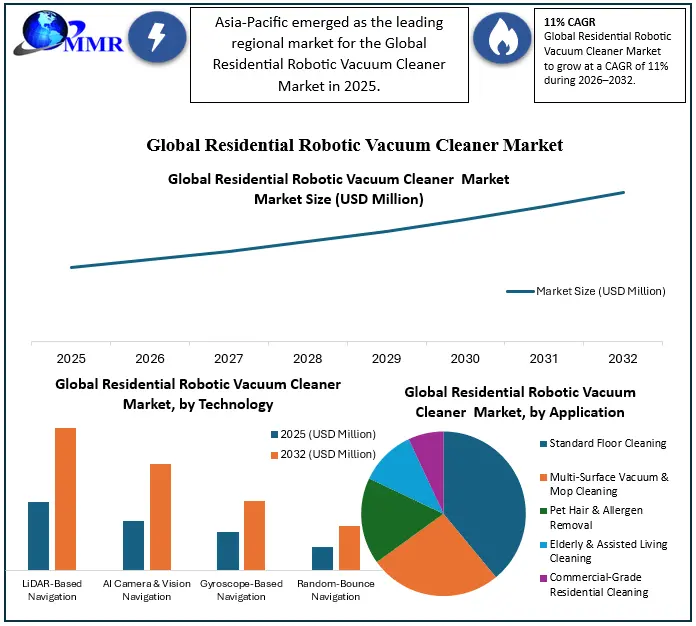
Market Valuation: Expected to reach USD 108.74 Billion by 2030.
Growth Rate: CAGR of 28.4% during the forecast period (2024–2030).
Market Dynamics: Driven by labor shortages in household management and aggressive R&D in navigation sensors.
Regional Leadership: North America and Europe currently dominate through high adoption of premium brands, while Asia-Pacific presents the highest future growth potential.
Why This Matters Now
For C-suite executives, this shift signifies more than a gadget trend; it represents a fundamental change in how consumer goods integrate into the home infrastructure. The transition from remote-operated tools to autonomous, self-drive units marks the end of the “active-engagement” era of appliances. Companies that fail to integrate seamless, algorithmic navigation into their portfolios risk obsolescence as the market pivots toward fully autonomous systems that require zero human oversight.
Market Overview
The Residential Robotic Vacuum Cleaner Market reflects a shift in household priorities, heavily influenced by the constraints of long working hours and the desire for time-saving automation. While the industry is historically rooted in simple suction devices, it has matured into a sophisticated sector leveraging IoT and advanced sensor technology. The 2024–2030 period serves as the primary acceleration phase where the integration of laser vision and spatial awareness will differentiate the market leaders from followers.
Key Trends Driving Growth
Manufacturers are currently locked in a technological race to solve the “complex environment” problem. Innovations such as Dyson’s 360-degree navigation cameras and Xiaomi’s 12-sensor spatial mapping algorithms indicate that the primary growth driver is no longer just “cleaning power,” but “navigational intelligence.” However, hardware limitations—specifically battery density—remain the industry’s largest friction point. Future market share will accrue to firms that successfully balance sensor-heavy processing power with high-capacity, long-cycle battery performance.
Segment Insights
Dominant Segment: Remote control robotic vacuum cleaners continue to hold the largest market share due to their established presence and consumer familiarity.
Fastest-Growing Segment: Self-drive robots are outpacing all other categories, signaling a market-wide pivot away from manual operation toward full autonomy.
Distribution Channels: Sales are split between traditional offline retail and online platforms, with online channels gaining traction as consumers rely on digital reviews for technical specifications.
Regional Growth Story
North America and Europe currently anchor the market, largely driven by a high concentration of consumers who prioritize premium, smart-integrated household appliances. Conversely, the Asia-Pacific region is emerging as the primary battleground for market share. As local manufacturing capabilities expand, global players are increasingly forced to re-evaluate their regional strategies to capture a middle-class demographic that is rapidly adopting home automation technology.
Competitive Landscape
The competitive environment, featuring stalwarts like iRobot, Samsung, and LG, is moving beyond price-based competition into feature-set dominance. Partnerships and internal R&D cycles are now centered on proprietary mapping software and ecosystem integration. This signals that rivals are no longer just competing for a spot on a floor; they are competing for a permanent position within the household’s broader IoT ecosystem. Rivals that cannot maintain pace with autonomous sensor innovation will likely be relegated to low-margin, budget-tier product status within 12–24 months.
Recent Developments
Navigation Evolution: Introduction of 360-degree cameras for complete room awareness.
Sensor Integration: Expansion to 12-sensor arrays for optimized algorithmic pathfinding.
Market Entry: Aggressive expansion strategies targeting the Asia-Pacific consumer base to mitigate saturation in Western markets.
Strategic Implications
The divide between winners and losers will be determined by battery efficiency and the reliability of autonomous navigation in high-clutter environments. Organizations should prioritize investments in software-driven autonomous capabilities over hardware-centric feature additions.
Future Outlook
The winners of the next decade will be the brands that master autonomous environment navigation with minimal energy footprint, while the losers will remain trapped in the cycle of hardware-only updates that fail to solve the user’s core problem: the need for true “set-and-forget” utility.
Analyst Perspective
“The residential robotics sector is moving past its novelty phase and becoming an essential component of modern home infrastructure,” says Siddhi Dole, Analyst. “The rapid shift toward self-drive units demonstrates that consumer expectations have fundamentally changed; they are no longer looking for vacuum cleaners, they are looking for autonomous home maintenance.”
About Maximize Market Research
Maximize Market Research Pvt. Ltd. (MMR) is a global market research and consulting company that provides reliable, data-focused, and practical business insights. The firm serves a wide range of industries, including healthcare, pharmaceuticals, technology, automotive, electronics, chemicals, personal care, and consumer goods. Through market forecasts, competitive analysis, strategic consulting, and industry impact assessments, MMR helps organizations understand changing market conditions, identify growth opportunities, and make informed business decisions for long-term success.
2nd Floor, Navale IT Park Phase 3
Pune Banglore Highway, Narhe
Pune, Maharashtra 411041, India
+91 9607365656
sales@maximizemarketresearch.com
