Key Highlights
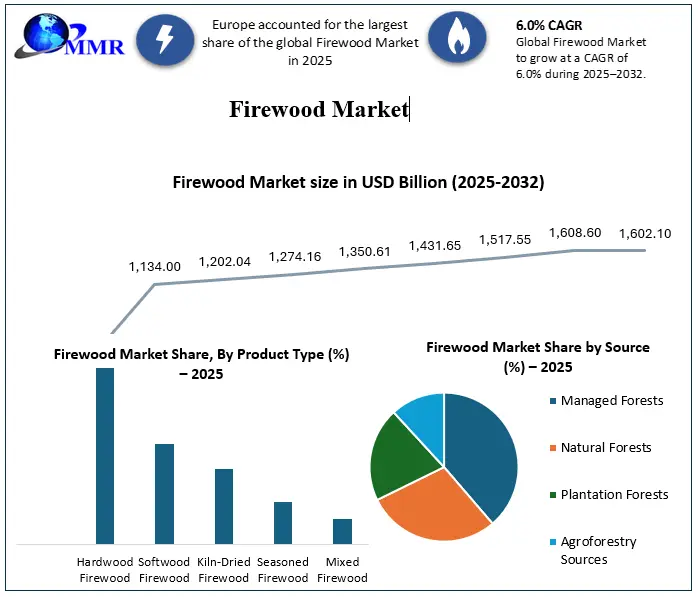
Market Growth: Valued at USD 1,134.00 million in 2025; projected to reach USD 1,602.10 million by 2032.
Growth Velocity: Registering a compound annual growth rate (CAGR) of 6.0% during the forecast period.
Dominant Segment: Hypermarkets and Supermarkets (Distribution); Log wood (Product Type).
Strategic Driver: Consumer shift toward renewable, locally sourced heating alternatives to combat rising fossil fuel costs.
Market Constraint: High logistical costs and competition from high-efficiency modern heating alternatives like pellet stoves and electric systems.
Why This Matters Now
Energy volatility has transformed firewood from a rustic tradition into a sophisticated component of the global renewable energy portfolio. As C-suite executives evaluate supply chain resilience and consumer demand for “green” household utility, the firewood sector presents an unexpected case study in decentralized energy resilience.
Market Overview
The Firewood Market is undergoing a structural pivot. Historically fragmented and hyper-local, the industry is now scaling to meet modern demand for sustainable, carbon-conscious heating. As the market expands from USD 1,134.00 million in 2025 to a forecasted USD 1,602.10 million by 2032, the primary narrative is one of adaptation. Suppliers are moving beyond simple extraction to integrate with modern retail networks and sustainable forest management, effectively branding wood-based energy as a viable hedge against volatile fossil fuel prices.
Key Trends Driving Growth
Sustainability is the primary catalyst. Consumers are re-evaluating their carbon footprint, driving a surge in wood-burning adoption for residential and commercial heating. The psychological allure of the “cozy factor” is now bolstered by the economic necessity of lower-cost heating alternatives.
Furthermore, the integration of new technology for harvesting and processing is optimizing output. These advancements allow producers to maintain margins despite the logistical complexities inherent in heavy-bulk commodities. The industry is also benefiting from its status as a local resource, insulating supply chains from the geopolitical shocks that frequently disrupt global oil and gas markets.
Segment Insights
Dominant Segment (Distribution): Hypermarkets and Supermarkets remain the primary distribution hub, offering the convenience and competitive pricing structures required for high-volume retail.
Dominant Segment (Wood Type): Log wood (roundwood) continues to lead the market, valued for its traditional reliability and suitability for both residential fireplaces and commercial cooking applications.
Emerging Competitive Segment: While not the dominant force, processed biomass—such as wood pellets—is capturing market share by offering higher efficiency and easier storage, posing a strategic challenge to traditional raw log providers.
Regional Growth Story
Regional demand is predicated on climate and the maturity of alternative infrastructure. Areas with harsh winter climates remain the bedrock of the market, though the emergence of bioproducts and biofuel markets is shifting demand in developing regions where wood remains a fundamental energy source for both heating and cooking. Local availability of forest resources is the strongest predictor of regional market maturity.
Competitive Landscape
The competitive field consists of a mix of regional aggregators and large-scale forestry enterprises. Major players are moving toward vertical integration and technological optimization to protect market share.
American Wood Fibers is diversifying production capacity to capture the growth in pellet-based fuels, signaling that top-tier companies view processed wood as the future of the segment.
Sierra Pacific Industries is deploying precision monitoring, such as drone-based forest management, to increase yields and sustainability credentials.
Stora Enso is shifting focus toward high-value biomaterials, suggesting that market leaders are preparing for a future where wood is a chemical and energy feedstock rather than just a combustible material.
Weyerhaeuser is prioritizing engineered wood and sustainable packaging, indicating that the industry’s long-term survival depends on maximizing the utility of every harvested tree.
Recent Developments
Increased capital allocation toward high-efficiency biomass processing plants.
Expansion of digital logistics tracking to manage the high storage and transportation costs associated with bulk wood products.
Stricter regulatory compliance measures enacted to prevent the spread of invasive species via firewood transport, forcing consolidation among smaller, non-compliant suppliers.
Strategic Implications
The market is bifurcating between traditional log sales and value-added, processed biomass products. Retailers must decide whether to compete on the “rustic, low-cost” value proposition or pivot toward “premium, efficient, and sustainable” wood-energy solutions. Supply chain agility—specifically the ability to source locally while navigating complex environmental regulations—will be the defining metric for operational success.
Future Outlook
Market winners will be those who successfully transition from being “firewood sellers” to “sustainable biomass providers,” while losers will be forced out by rising logistical costs and the increasing prevalence of high-efficiency, non-combustion heating technologies.
Analyst Perspective
“The firewood market is no longer just about harvesting timber; it is about providing a scalable, sustainable energy solution in a world of volatile utility pricing,” says Siddhi Dole, Analyst at Maximize Market Research. “The shift toward efficiency and environmental accountability is not merely a trend—it is a mandatory evolution for industry players who intend to remain relevant through 2032.”
About Maximize Market Research
Maximize Market Research Pvt. Ltd. (MMR) is a global market research and consulting company that provides reliable, data-focused, and practical business insights. The firm serves a wide range of industries, including healthcare, pharmaceuticals, technology, automotive, electronics, chemicals, personal care, and consumer goods. Through market forecasts, competitive analysis, strategic consulting, and industry impact assessments, MMR helps organizations understand changing market conditions, identify growth opportunities, and make informed business decisions for long-term success.
2nd Floor, Navale IT Park Phase 3
Pune Banglore Highway, Narhe
Pune, Maharashtra 411041, India
+91 9607365656
sales@maximizemarketresearch.com
