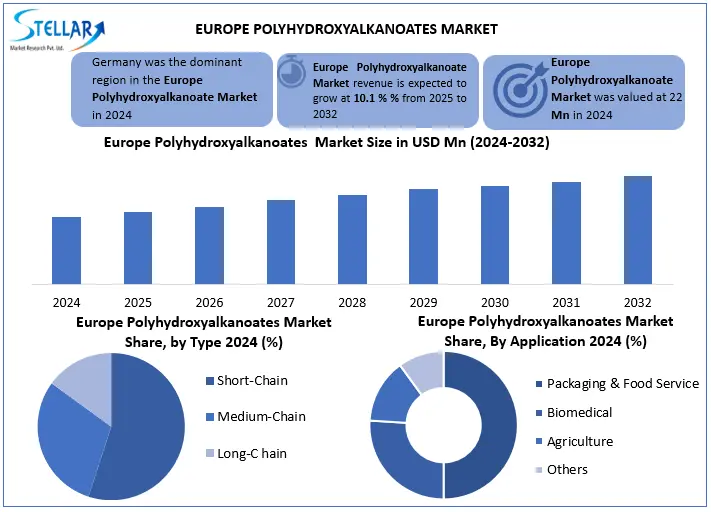
The Europe Polyhydroxyalkanoates (PHA) Market is experiencing rapid growth as stringent environmental regulations, increasing demand for biodegradable plastics, and corporate sustainability initiatives accelerate the adoption of bio-based materials across packaging, agriculture, and biomedical industries. Advancements in microbial fermentation technologies and investments in cost-effective production processes are further strengthening market expansion. According to Stellar Market Research, the Europe Polyhydroxyalkanoates Market was valued at USD 22 million in 2024 and is projected to reach USD 47.50 million by 2032, growing at a CAGR of 10.1% during the forecast period.
Understanding the Europe Polyhydroxyalkanoates Market
Polyhydroxyalkanoates (PHAs) are biodegradable, bio-based polyesters naturally produced by microorganisms through fermentation of renewable feedstocks such as corn starch, sugarcane, vegetable oils, and agricultural waste. Unlike conventional petroleum-based plastics, PHAs are compostable and capable of degrading in marine and soil environments, making them a promising solution for reducing plastic pollution.
Europe has emerged as a leading market for PHAs, supported by the European Union’s circular economy strategy, restrictions on single-use plastics, and increasing consumer demand for sustainable packaging solutions. Applications are expanding across food packaging, biomedical devices, agricultural films, and consumer goods as manufacturers seek environmentally friendly alternatives to traditional plastics.
𝐃𝐨𝐰𝐧𝐥𝐨𝐚𝐝 𝐅𝐫𝐞𝐞 𝐏𝐃𝐅 𝐁𝐫𝐨𝐜𝐡𝐮𝐫𝐞: https://www.stellarmr.com/report/req_sample/europe-polyhydroxyalkanoate-market/2890
Key Factors Driving Market Growth
Strict Environmental Regulations
European policies aimed at reducing plastic waste are significantly accelerating PHA adoption.
Regulations including the EU Single-Use Plastics Directive and circular economy initiatives are encouraging manufacturers to replace conventional plastics with biodegradable alternatives, creating strong long-term demand across multiple industries.
Rising Demand for Sustainable Packaging
Packaging remains the largest application segment as food producers, retailers, and consumer goods companies increasingly adopt compostable packaging materials.
PHA offers excellent biodegradability while helping companies meet sustainability commitments and consumer expectations for eco-friendly products.
Growing Investments in Research and Development
Manufacturers are investing heavily in advanced fermentation technologies, genetically engineered microorganisms, and waste-derived feedstocks to reduce production costs and improve polymer performance.
These innovations are expanding PHA applications into biomedical products, coatings, textiles, and agricultural films.
Market Segmentation
The Europe Polyhydroxyalkanoates Market is segmented by type, application, and country.
By Type
The market includes:
Short-chain PHA
Medium-chain PHA
Long-chain PHA
Short-Chain PHA Leads the Market
Short-chain PHAs accounted for the largest market share in 2024 due to their lower production costs, favorable mechanical properties, and excellent biodegradability.
These materials are widely used in commercial packaging and food service applications where compostability and product stability are essential.
By Application
Major application areas include:
Packaging & Food Service
Biomedical
Agriculture
Others
Packaging and food service dominated the market, accounting for approximately 62% of total revenue in 2024, reflecting increasing adoption of sustainable packaging solutions across Europe. Biomedical applications are also expanding as PHAs gain popularity in absorbable medical implants and tissue engineering.
Technology Trends Reshaping the Industry
Advanced Fermentation Processes
Companies are improving microbial fermentation technologies to increase production efficiency while lowering manufacturing costs.
Innovations in feedstock utilization and extraction techniques are making commercial-scale PHA production more economically viable.
Waste-Based Feedstocks
Manufacturers are increasingly utilizing agricultural waste and industrial by-products as renewable feedstocks, supporting both cost reduction and circular economy objectives.
High-Performance Biopolymers
Research has improved the mechanical performance of PHAs by 30–40%, enabling broader adoption across packaging, biomedical devices, and agricultural applications.
Sustainability and Regulatory Landscape
Europe continues to lead global adoption of biodegradable plastics through ambitious sustainability policies.
EU carbon reduction strategies, plastic waste regulations, and corporate ESG commitments are encouraging investments in compostable materials. PHAs align closely with Europe’s circular economy goals because they are derived from renewable resources and naturally biodegrade without generating persistent plastic waste.
Regional Market Outlook
Germany
Germany dominated the Europe Polyhydroxyalkanoates Market with 25.7% of total market share in 2024.
The country benefits from advanced biopolymer manufacturing capabilities, strong research infrastructure, and the presence of leading companies such as BASF and Biomer. Germany’s leadership in sustainable packaging and industrial innovation continues to drive market expansion.
Italy
Italy remains a major innovation hub through companies such as Novamont and Bio-on, which continue advancing biodegradable polymer technologies and sustainable packaging applications.
United Kingdom, France, Spain, and Sweden
These countries continue investing in research, commercial production, and environmentally friendly packaging materials while supporting regulatory initiatives designed to reduce plastic waste and promote bio-based products.
Market Challenges
Despite strong growth prospects, several challenges continue affecting market adoption.
PHA production remains three to five times more expensive than conventional petroleum-based plastics due to complex fermentation processes, specialized growth conditions, and high recovery costs. In addition, biomass waste generation and relatively limited thermal resistance restrict adoption in certain high-performance industrial applications.
Competitive Landscape
The Europe Polyhydroxyalkanoates Market is characterized by a mix of established chemical companies and innovative biotechnology firms focused on sustainable material development.
Leading companies include:
BASF SE
Novamont S.p.A.
Biomer
Bio-on S.p.A.
Biome Bioplastics Ltd.
Bioextrax AB
Polyhydroxyalkanoate Solutions Ltd.
Manufacturers continue investing in fermentation innovation, licensing technologies, production capacity expansion, and high-value applications such as marine-degradable packaging and biomedical materials. Bioextrax’s solvent-free extraction technology, for example, has demonstrated the potential to reduce production costs by up to 50%, strengthening industry competitiveness.
𝐃𝐨𝐰𝐧𝐥𝐨𝐚𝐝 𝐅𝐫𝐞𝐞 𝐏𝐃𝐅 𝐁𝐫𝐨𝐜𝐡𝐮𝐫𝐞: https://www.stellarmr.com/report/req_sample/europe-polyhydroxyalkanoate-market/2890
Future Outlook
The Europe Polyhydroxyalkanoates Market is expected to experience robust growth through 2032 as governments, manufacturers, and consumers increasingly prioritize biodegradable alternatives to conventional plastics. Continued investments in microbial fermentation, renewable feedstocks, and sustainable packaging technologies will improve commercial viability and broaden application areas. As production costs decline and regulatory support strengthens, PHAs are expected to become an increasingly important component of Europe’s circular economy, supporting sustainable packaging, biomedical innovation, and environmentally responsible industrial development.
Media Contact
Stellar Market Research
Website: Stellar Market Research – Global Research Reports & Consulting
Email: sales@stellarmr.com
