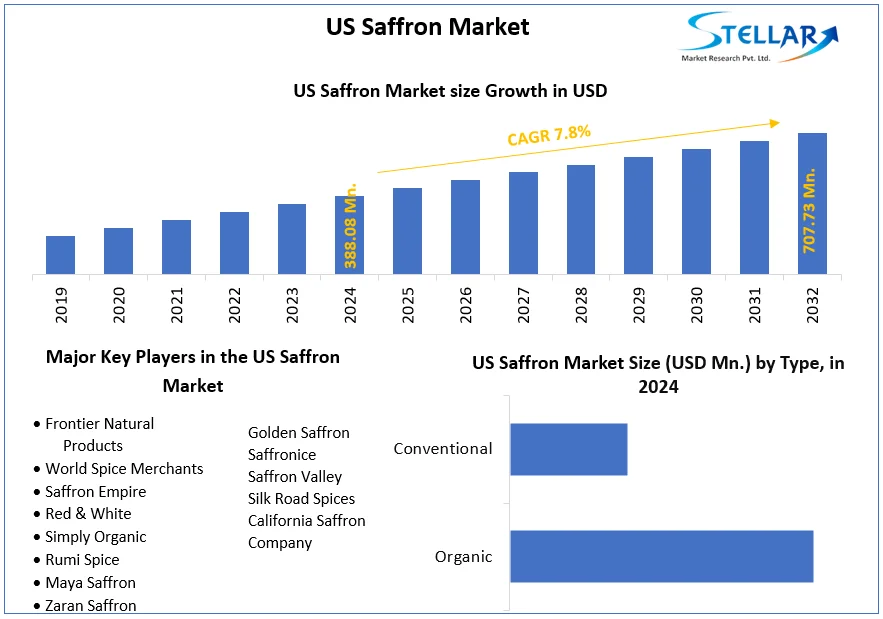
The US Saffron Market is gaining traction as demand rises for premium spices, gourmet ingredients, and natural wellness products. Known as the “red gold,” saffron is one of the most expensive spices in the world, valued for its unique flavor, aroma, and medicinal properties. Derived from the flower of Crocus sativus, saffron is widely used in culinary, pharmaceutical, and cosmetic applications.
US Saffron Market size was valued at USD 388.08 Mn. in 2024 and the total US Saffron revenue is expected to grow at a CAGR of 7.8% from 2025 to 2032, reaching nearly USD 707.73 Mn. in 2032.
With increasing consumer awareness and evolving food preferences, saffron is emerging as a high-value niche market in the United States.
A Market Driven by Premiumization and Health Awareness
A defining trend in the US saffron market is the growing preference for high-quality, natural, and functional ingredients. Consumers are willing to pay a premium for authentic and ethically sourced saffron, especially in gourmet cooking and specialty food products.
In addition, saffron’s health benefits—such as antioxidant and mood-enhancing properties—are boosting its demand in the wellness sector.
Key Market Insights
- Saffron is a high-value, premium spice with limited global supply.
- Strong demand in gourmet cuisine and specialty food products.
- Increasing use in nutraceuticals and herbal supplements.
- Growth in online retail and specialty stores.
- Rising popularity of ethnic cuisines driving adoption.
- Expansion of saffron-based beverages and functional foods.
- Growing interest in sustainable and traceable sourcing.
Market Drivers Accelerating Growth
1. Rising Demand for Premium and Exotic Ingredients
Consumers are exploring global cuisines and gourmet cooking.
2. Growing Health and Wellness Trends
Saffron is used in supplements for its potential health benefits.
3. Expansion of E-Commerce and Specialty Retail
Online platforms are improving accessibility to high-quality saffron.
Market Challenges and Restraints
1. High Cost and Limited Supply
Saffron production is labor-intensive, leading to high prices.
2. Risk of Adulteration
Quality assurance and authenticity remain key concerns.
Technology and Innovation Trends
Technology is enhancing the US saffron market through advancements in quality testing, supply chain transparency, and controlled cultivation techniques.
Modern testing methods such as spectroscopy are ensuring product authenticity and purity. Blockchain and traceability systems are being used to verify sourcing and build consumer trust.
Innovations in indoor and controlled-environment agriculture are enabling local saffron cultivation in the US, reducing reliance on imports. Product innovation is also expanding into saffron-infused foods, beverages, and skincare products.
Visual Snapshot: Saffron in the US Market
Regional Insights: Urban Markets Lead Consumption
The US saffron market is driven by major metropolitan areas:
- New York & California: High demand due to diverse culinary culture and premium food markets.
- Texas & Florida: Growing adoption driven by ethnic cuisines and hospitality sectors.
Urban consumers and upscale restaurants are key contributors to market growth.
Recent Industry Developments
- Expansion of organic and ethically sourced saffron products.
- Growth in US-based saffron cultivation initiatives.
- Increasing popularity of saffron-infused wellness supplements.
- Rising demand for premium packaging and branding.
- Development of saffron-based beverages and functional foods.
Competitive Landscape
The US saffron market is moderately competitive, with importers, specialty spice brands, and emerging domestic producers participating.
Companies are focusing on quality, authenticity, branding, and supply chain transparency to differentiate themselves.
Analyst Perspective
A senior market analyst notes:
“The US saffron market is driven by premiumization and health trends. Authenticity and innovation will be key to sustained growth.”
Future Outlook
The US Saffron Market is expected to witness steady growth, driven by increasing consumer demand for premium ingredients, expansion of gourmet food culture, and rising interest in natural wellness products.
Local cultivation and technological advancements will further support market development. As consumers continue to prioritize quality and authenticity, saffron will remain a valuable and sought-after product.
Overall, the market presents significant opportunities for producers, distributors, and brands aiming to capitalize on high-value, niche food segments.
