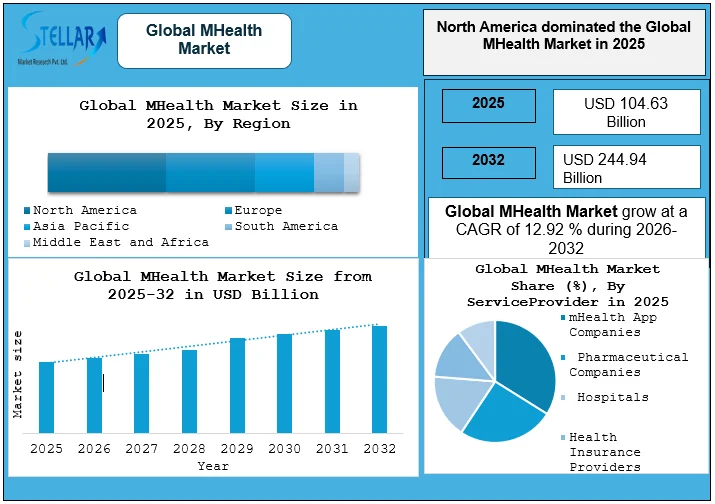
The mHealth Market is experiencing rapid expansion as healthcare systems worldwide adopt digital solutions to improve accessibility, efficiency, and patient engagement. Mobile health (mHealth) technologies are transforming healthcare delivery by enabling remote consultations, real-time health monitoring, disease management, fitness tracking, and personalized healthcare services through smartphones, wearable devices, and connected platforms. According to Stellar Market Research, the mHealth Market was valued at USD 104.63 billion in 2025 and is projected to reach USD 244.94 billion by 2032, growing at a CAGR of 12.92% during 2026–2032.
The increasing penetration of smartphones, rising adoption of telemedicine, growing prevalence of chronic diseases, and integration of artificial intelligence (AI) and wearable technologies are accelerating the development of mobile healthcare ecosystems. mHealth solutions are becoming essential tools for healthcare providers, patients, insurance companies, and pharmaceutical organizations seeking efficient and patient-centered care models.
Understanding the mHealth Market
Mobile health, commonly known as mHealth, refers to healthcare services and information delivered through mobile devices such as smartphones, tablets, wearable devices, and wireless technologies. These solutions enable users to monitor health conditions, access medical advice, manage medications, track fitness activities, and communicate with healthcare professionals remotely.
The mHealth ecosystem includes mobile healthcare applications, remote patient monitoring platforms, connected medical devices, teleconsultation services, digital therapeutics, wellness applications, and healthcare data management solutions.
The growing shift from traditional healthcare delivery toward digital and preventive care models has positioned mHealth as a major component of modern healthcare infrastructure. Mobile technologies help bridge healthcare accessibility gaps, especially in regions where healthcare facilities and medical professionals are limited.
𝐃𝐨𝐰𝐧𝐥𝐨𝐚𝐝 𝐅𝐫𝐞𝐞 𝐏𝐃𝐅 𝐁𝐫𝐨𝐜𝐡𝐮𝐫𝐞: https://www.stellarmr.com/report/req_sample/mHealth-market/2909
Key Factors Driving mHealth Market Growth
Increasing Smartphone Penetration and Internet Connectivity
The widespread adoption of smartphones is one of the strongest drivers of the mHealth Market.
Smartphones have become powerful healthcare tools capable of supporting medical applications, health monitoring platforms, and virtual consultations. The increasing availability of affordable smartphones and expanding internet connectivity are enabling more people to access digital healthcare services.
According to Stellar Market Research, smartphone penetration and mobile connectivity growth are significantly contributing to increased adoption of mHealth applications globally. More than 7.4 billion smartphones worldwide are expanding opportunities for mobile-based healthcare solutions.
Rising Burden of Chronic Diseases
The growing prevalence of chronic diseases such as diabetes, cardiovascular disorders, obesity, and respiratory conditions is increasing demand for continuous health monitoring solutions.
mHealth platforms allow patients to track vital health indicators, manage medications, receive reminders, and communicate with healthcare providers without frequent hospital visits.
Remote patient monitoring solutions are particularly valuable for managing chronic conditions because they enable early detection of health changes and support preventive interventions. According to Stellar Market Research, chronic disease management accounts for a significant portion of mHealth demand, especially for diabetes, cardiovascular, and respiratory care applications.
Growth of Telemedicine and Remote Healthcare
The expansion of telemedicine has significantly accelerated mHealth adoption.
Mobile healthcare applications allow patients to schedule virtual appointments, consult doctors remotely, access medical records, and receive prescriptions digitally. These services improve healthcare accessibility for individuals in rural and underserved areas.
Healthcare providers are increasingly integrating mobile platforms with electronic health records (EHRs), enabling seamless communication and improved care coordination.
mHealth Market Segmentation
The mHealth Market is segmented based on category, service type, service provider, application, and region.
By Category
Major categories include:
Mobile Applications
Wearable Devices
Connected Medical Devices
Digital Health Platforms
Mobile Applications Lead Market Adoption
Mobile applications represent a major segment of the mHealth Market due to widespread smartphone usage and increasing consumer preference for digital healthcare services.
Healthcare applications support various functions, including:
Disease management
Medication reminders
Women’s health monitoring
Fitness tracking
Nutrition management
Teleconsultation services
Personal health records
Healthcare-focused applications generate a significant share of market revenue as users increasingly rely on mobile platforms for managing health and wellness activities.
By Service Type
The market includes:
Monitoring Services
Fitness and Wellness Solutions
Diagnostic Services
Treatment Services
Healthcare Management Services
Remote Monitoring Services Gain Strong Demand
Remote monitoring services are becoming a leading segment due to increasing adoption among patients with chronic diseases and elderly populations.
Connected devices such as glucose monitors, blood pressure monitors, cardiac monitoring systems, and wearable sensors provide real-time health information to healthcare providers.
These solutions improve patient outcomes by enabling timely medical intervention and reducing unnecessary hospital visits.
Technology Trends Transforming the mHealth Industry
Artificial Intelligence and Predictive Healthcare Analytics
Artificial intelligence is revolutionizing mHealth solutions by improving diagnosis, monitoring, and personalized healthcare recommendations.
AI algorithms analyze health data collected from mobile applications and wearable devices to identify patterns, predict health risks, and support clinical decision-making.
AI-powered mHealth platforms are increasingly being used for early disease detection, personalized treatment recommendations, and automated health coaching.
Wearable Health Technologies
Wearable devices are becoming an important component of the mHealth ecosystem.
Smartwatches, fitness trackers, glucose monitors, and cardiac monitoring devices collect continuous health data and provide users with real-time insights.
Integration between wearable devices and mobile applications allows healthcare providers to remotely monitor patient conditions and improve treatment outcomes.
Cloud-Based Healthcare Platforms
Cloud technology is improving the scalability and accessibility of mHealth solutions.
Cloud-based platforms enable secure storage, processing, and sharing of healthcare information between patients and providers. These solutions support large-scale healthcare networks while improving data accessibility.
Data Security and Privacy Solutions
As mHealth platforms handle sensitive healthcare information, cybersecurity has become a major focus area.
Healthcare organizations and technology providers are investing in encryption technologies, secure authentication systems, and privacy management solutions to protect patient data.
Data security remains a critical challenge, as vulnerabilities in mobile healthcare applications can impact user trust and adoption.
Sustainability and Regulatory Landscape
The mHealth Market supports sustainable healthcare by reducing unnecessary hospital visits, improving resource utilization, and enabling preventive healthcare approaches.
Governments worldwide are promoting digital health adoption through healthcare modernization programs, telemedicine regulations, and electronic health record initiatives.
Regulatory frameworks related to patient data protection, medical device approvals, and digital healthcare standards continue influencing market development. Compliance with healthcare privacy regulations remains essential for companies operating in the mHealth sector.
Regional Market Outlook
North America
North America represents one of the leading regions in the mHealth Market due to advanced healthcare infrastructure, strong digital health adoption, and high investment in healthcare technology.
The United States has witnessed significant growth in mobile healthcare adoption due to increasing telemedicine usage, chronic disease management requirements, and supportive healthcare policies. Around 43% of U.S. consumers use health applications, highlighting strong digital healthcare engagement.
Asia Pacific
Asia Pacific is emerging as a high-growth region due to increasing smartphone adoption, expanding internet connectivity, and government-supported digital healthcare initiatives.
Countries such as India, China, and Japan are investing heavily in mobile healthcare solutions to improve healthcare accessibility and reduce pressure on traditional healthcare systems.
India’s digital health ecosystem, including initiatives supporting digital health records and telemedicine services, is creating significant opportunities for mHealth providers.
Europe
Europe continues to demonstrate strong market potential due to advanced healthcare systems, increasing adoption of digital healthcare technologies, and growing demand for remote patient monitoring.
Countries across the region are implementing digital health strategies focused on improving healthcare efficiency and patient access.
Market Challenges
Despite strong growth potential, the mHealth Market faces several challenges:
Data privacy and cybersecurity concerns
Lack of standardized regulations
Limited digital literacy in some regions
Integration challenges with healthcare systems
Accuracy concerns related to certain mobile health tools
Security concerns remain one of the most significant barriers, as healthcare organizations must ensure protection of sensitive patient information while maintaining seamless digital connectivity.
Competitive Landscape
The mHealth Market is highly competitive, with technology companies, healthcare providers, and digital health startups focusing on innovation, partnerships, and platform development.
Key players include:
Teladoc Health
Apple Health
Fitbit (Google)
Medtronic
Philips HealthSuite
Omron Healthcare
Oracle Health
BioTelemetry
AirStrip
WHOOP
Companies are investing in AI-powered healthcare platforms, wearable integration, remote monitoring solutions, and interoperability technologies to strengthen their market presence.
𝐃𝐨𝐰𝐧𝐥𝐨𝐚𝐝 𝐅𝐫𝐞𝐞 𝐏𝐃𝐅 𝐁𝐫𝐨𝐜𝐡𝐮𝐫𝐞: https://www.stellarmr.com/report/req_sample/mHealth-market/2909
Future Outlook
The mHealth Market is expected to maintain strong growth as healthcare continues shifting toward digital, personalized, and preventive care models.
Future expansion will be driven by AI-powered healthcare solutions, wearable technology adoption, remote monitoring services, cloud-based platforms, and increasing smartphone accessibility.
As healthcare providers and consumers increasingly prioritize convenience, affordability, and real-time health management, mHealth solutions will become a fundamental part of the global healthcare ecosystem. Companies that focus on secure, intelligent, and user-friendly digital healthcare platforms will be well positioned to capture emerging opportunities in the evolving mHealth industry.
Media Contact
Stellar Market Research
Website: Stellar Market Research – Global Research Reports & Consulting
Email: sales@stellarmr.com
