Europe High Speed Engine Market: Industry Growth, Trends, Opportunities, and Forecast (2025-2032)
The Europe high-speed engine market is experiencing steady growth due to increasing demand for reliable power generation, expanding marine transportation, industrial development, and the modernization of railway and energy infrastructure. High-speed engines are widely used in applications requiring high power density, fast response, and efficient performance, including power generation, marine propulsion, mining, oil & gas, and railway systems.
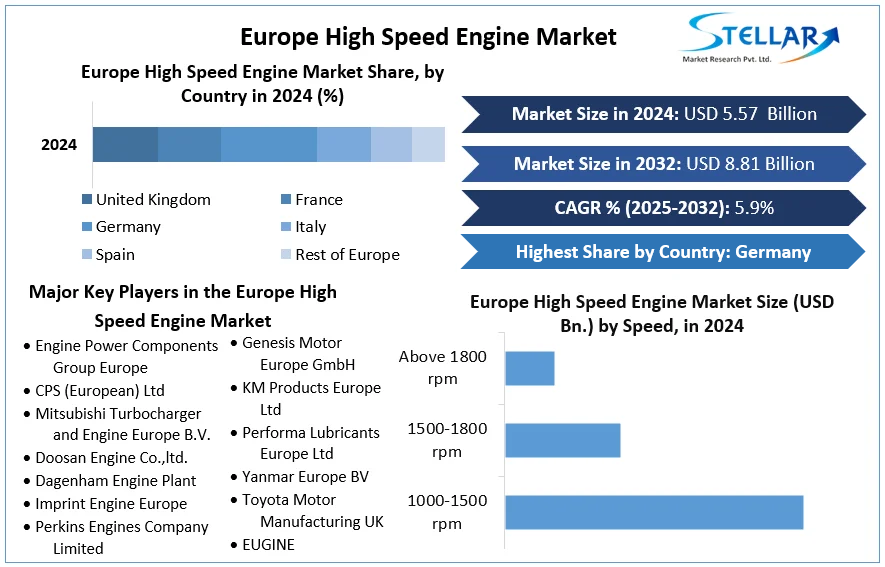
The Europe High Speed Engine Market was valued at USD 5.57 Billion in 2024 and is projected to reach USD 8.81 Billion by 2032, growing at a CAGR of 5.9% during the forecast period 2025-2032. Increasing demand for backup power systems, rising energy consumption, and advancements in engine technologies are expected to support market growth across Europe.
Growing Demand for Reliable Power Generation Systems
The increasing need for uninterrupted electricity supply is one of the major factors driving the adoption of high-speed engines in Europe. Industries, commercial facilities, hospitals, data centers, and infrastructure projects require reliable backup power solutions to maintain continuous operations.
High-speed engine-based generator systems provide rapid startup capabilities and efficient performance, making them suitable for emergency power generation and distributed energy applications. The growing expansion of data centers and industrial automation is further increasing demand for dependable power solutions.
Expansion of Marine Transportation Supporting Market Growth
The marine sector represents a significant application area for high-speed engines. These engines are widely used in commercial vessels, passenger ships, offshore support vessels, and marine power systems due to their compact design, high efficiency, and operational flexibility.
The growth of maritime trade, replacement of aging vessel fleets, and increasing investments in marine infrastructure are contributing to the demand for advanced propulsion systems. European countries with strong maritime industries are expected to create new opportunities for high-speed engine manufacturers.
Rising Adoption in Railway and Transportation Applications
High-speed engines are increasingly used in railway applications due to their ability to provide efficient power delivery and reliable performance. Diesel-powered locomotives and specialized rail systems continue to require advanced engine technologies.
The modernization of railway infrastructure across Europe, along with investments in efficient transportation systems, is supporting the adoption of high-performance engines. Manufacturers are focusing on developing engines with improved fuel efficiency and reduced emissions to meet evolving environmental standards.
𝐃𝐨𝐰𝐧𝐥𝐨𝐚𝐝 𝐅𝐫𝐞𝐞 𝐏𝐃𝐅 𝐁𝐫𝐨𝐜𝐡𝐮𝐫𝐞: https://www.stellarmr.com/report/req_sample/Europe-High-Speed-Engine-Market/1322
Increasing Demand for Backup Power in Data Centers and Industries
The rapid growth of digital infrastructure is creating additional opportunities for high-speed engine suppliers. Data centers require continuous electricity availability, making backup generator systems essential components of their operations.
High-speed engines in the 1 MW to 2 MW power range are gaining popularity for providing reliable prime and standby power solutions for industrial facilities and data centers.
Technological Advancements and Alternative Fuel Adoption
Engine manufacturers are investing in advanced technologies to improve efficiency, reduce emissions, and comply with strict European environmental regulations.
Key technological developments include:
- Improved fuel injection systems
- Digital engine monitoring
- Hybrid power solutions
- Alternative fuel compatibility
- Enhanced thermal efficiency
The shift toward cleaner fuels and sustainable power solutions is encouraging manufacturers to develop next-generation high-speed engines capable of operating with lower environmental impact.
Impact of Emission Regulations on Market Development
Strict emission standards across Europe are influencing the design and development of high-speed engines. Governments and environmental organizations are focusing on reducing greenhouse gas emissions from transportation and industrial activities.
While regulations create challenges for traditional diesel engine manufacturers, they are also encouraging innovation in cleaner technologies, including renewable fuels, hybrid systems, and efficient combustion technologies.
Market Segmentation Analysis
The Europe high-speed engine market is segmented based on speed, power output, end-user, and country.
By Speed
- 1000-1500 RPM
- 1500-1800 RPM
- Above 1800 RPM
The 1000-1500 RPM segment held a significant market share in 2024 due to its wide application in power generation, renewable energy systems, and industrial operations.
By Power Output
- 0.5-1 MW
- 1-2 MW
- 2-4 MW
- Above 4 MW
The 1-2 MW segment is expected to maintain strong demand due to increasing adoption in backup power systems and distributed energy applications.
By End User
- Power Generation
- Marine
- Mining, Oil & Gas
- Railway
- Others
The power generation segment represents a major application area due to increasing demand for reliable electricity solutions.
By Country
- Germany
- Italy
- United Kingdom
- France
- Russia
- Rest of Europe
Germany Leading the European High Speed Engine Market
Germany is expected to remain one of the important markets for high-speed engines in Europe due to its strong industrial base, advanced engineering capabilities, and established automotive and manufacturing sectors.
The country’s focus on energy security, industrial automation, and infrastructure modernization is supporting demand for efficient engine technologies. Other countries, including Italy, France, the United Kingdom, and Russia, are also contributing to regional market growth.
Key Market Drivers
Increasing Energy Demand
Growing industrialization, urbanization, and digital infrastructure expansion are increasing electricity demand and creating opportunities for high-speed engine-based power solutions.
Growth of Marine and Shipping Industries
Increasing maritime activities and fleet modernization are supporting demand for efficient marine propulsion engines.
Expansion of Renewable Energy Backup Systems
Renewable energy projects require reliable backup and balancing solutions, increasing the need for high-speed generator engines.
Industrial Infrastructure Development
Manufacturing, mining, and oil & gas industries continue to rely on high-performance engines for operational reliability.
Market Challenges
Despite positive growth prospects, the Europe high-speed engine market faces several challenges:
- Strict emission regulations
- Increasing shift toward electrification
- High maintenance requirements
- Rising fuel costs
- Competition from alternative energy technologies
The transition toward electric and renewable energy systems may influence long-term demand for conventional engine technologies.
𝐃𝐨𝐰𝐧𝐥𝐨𝐚𝐝 𝐅𝐫𝐞𝐞 𝐏𝐃𝐅 𝐁𝐫𝐨𝐜𝐡𝐮𝐫𝐞: https://www.stellarmr.com/report/req_sample/Europe-High-Speed-Engine-Market/1322
Competitive Landscape
The Europe high-speed engine market includes global and regional manufacturers focusing on innovation, efficiency improvements, and sustainable engine development. Key players include:
- Mitsubishi Turbocharger and Engine Europe B.V.
- Perkins Engines Company Limited
- Yanmar Europe BV
- Caterpillar
- Cummins
- Rolls-Royce Holdings
- Volvo Penta
- MAN Energy Solutions
- Wärtsilä
- Deutz AG
Companies are investing in cleaner engine technologies, digital monitoring systems, strategic partnerships, and product development to strengthen their market position.
Future Outlook of Europe High Speed Engine Market
The Europe high-speed engine market is expected to grow consistently during 2025-2032, supported by rising energy requirements, marine sector expansion, industrial development, and demand for reliable backup power systems.
Future growth will depend on manufacturers’ ability to develop efficient, low-emission, and alternative fuel-compatible engines. As industries continue prioritizing reliability, sustainability, and operational efficiency, high-speed engines will remain an important technology across Europe’s energy, transportation, and industrial sectors.
