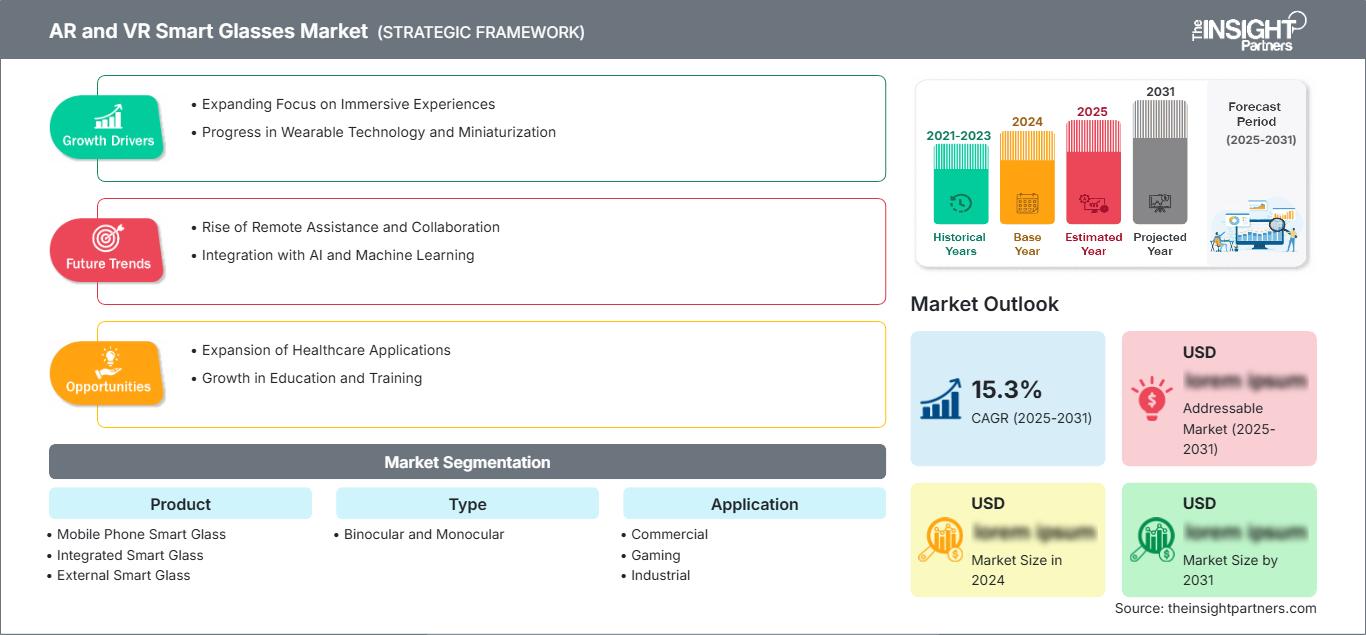
The AR and VR Smart Glasses Market is entering a new phase of technological development as artificial intelligence, immersive computing, advanced optics, and connected wearable solutions reshape how people interact with digital information. Smart glasses are gradually evolving beyond experimental devices into practical tools that support entertainment, workplace productivity, education, healthcare, industrial operations, navigation, communication, and accessibility. As users increasingly seek hands-free and context-aware digital experiences, manufacturers are focusing on lightweight designs, improved comfort, enhanced visual quality, longer battery life, and more intuitive interfaces.
Get a sample PDF of the Report: https://www.theinsightpartners.com/sample/TIPTE100001290
The AR and VR Smart Glasses Market is being influenced by the growing convergence of augmented reality, virtual reality, artificial intelligence, spatial computing, cloud connectivity, and edge processing. AR smart glasses can overlay digital information onto the physical environment, while VR-enabled devices create immersive digital spaces that support training, collaboration, gaming, and simulation. Together, these technologies are creating new opportunities for organizations seeking to improve operational efficiency and for consumers looking for more natural ways to access digital content.
Recent industry developments indicate that smart eyewear is becoming more closely connected with AI assistants and multimodal technologies. New products are increasingly designed to support features such as real-time translation, visual recognition, navigation, voice interaction, hands-free communication, contextual information, and digital content capture. The growing availability of AI-enabled smart glasses is also encouraging technology companies to develop devices that look and feel more like conventional eyewear. Industry momentum is being supported by stronger consumer interest, broader ecosystem partnerships, and continued investment in display technologies and wearable computing platforms.
AR and VR Smart Glasses Market Size, Share, Trends, Analysis, and Forecast by 2031
- Market Size: The AR and VR Smart Glasses Market is expected to expand as immersive technologies move from early adoption toward broader consumer and enterprise use.
- Market Share: Competition is likely to remain dynamic, with established technology companies, eyewear manufacturers, semiconductor providers, and specialized XR developers strengthening their positions through product innovation and strategic partnerships.
- Technology Trends: AI-powered voice assistance, real-time visual analysis, spatial computing, improved micro-displays, gesture recognition, and on-device processing are expected to influence product development.
- Consumer Trends: Lightweight, stylish, comfortable, and affordable devices are becoming increasingly important as smart glasses move closer to everyday use.
- Enterprise Analysis: Manufacturing, logistics, healthcare, retail, education, defense, and field-service organizations are adopting immersive wearables to improve training, remote support, workflow visibility, and operational accuracy.
- Regional Growth: North America is expected to remain an important innovation hub, while Asia Pacific may experience strong expansion due to manufacturing capabilities, technology investment, and growing consumer adoption.
- Forecast Through 2031: The industry is expected to progress toward more intelligent, connected, and user-friendly smart eyewear supported by expanding software ecosystems and improved hardware performance.
Key Growth Drivers Supporting Industry Development
The growing demand for immersive entertainment is an important factor supporting the AR and VR Smart Glasses Market. Consumers are showing increasing interest in interactive gaming, virtual events, digital media, and extended reality experiences that offer deeper engagement than traditional screens. Smart glasses can create more personal and immersive viewing environments while enabling users to interact with digital content through voice commands, gestures, eye tracking, and spatial interfaces.
Enterprise digital transformation is another major growth driver. Businesses are using AR and VR smart glasses to provide employees with real-time instructions, remote expert assistance, visual guidance, and digital information during complex tasks. In manufacturing and logistics, wearable displays can help workers access operational data without repeatedly checking handheld devices. In healthcare, immersive technology can support medical education, surgical visualization, remote collaboration, and simulation-based training. These applications are increasing the practical value of smart glasses across multiple industries.
Advances in hardware are also improving the overall user experience. Manufacturers are working to develop smaller optical components, higher-quality displays, more efficient processors, improved sensors, and longer-lasting batteries. The integration of AI is enabling devices to understand voice commands, recognize objects, interpret environments, and provide context-aware assistance. Research into on-device machine learning may further reduce latency and support privacy-focused processing by limiting dependence on cloud-based systems.
Updated Industry News and Technology Developments
Recent developments demonstrate increasing collaboration between technology companies, AI platforms, semiconductor providers, and established eyewear brands. New smart-glasses initiatives are emphasizing natural design, voice-based interaction, contextual AI assistance, and improved privacy protections. Industry participants are working to make devices less visually intrusive while expanding capabilities such as live translation, navigation, message summaries, visual search, and real-time information support.
The rapid growth of display-free AI glasses is also attracting attention. These products prioritize audio, cameras, voice assistants, and contextual intelligence, offering a lighter alternative to display-focused AR devices. At the same time, advancements in near-eye displays are supporting the development of more immersive AR glasses with improved visual quality and broader use cases.
Privacy and public acceptance are becoming important considerations for the AR and VR Smart Glasses Market. Camera-equipped devices have generated discussions regarding consent, recording visibility, data protection, and responsible use. In response, technology companies are increasingly exploring visible recording indicators, anti-tampering features, stronger permission controls, and privacy-focused hardware designs. Building user trust may become as important as improving technical performance.
Global and Regional Analysis
North America remains a significant center for smart-glasses innovation due to the presence of major technology companies, advanced research capabilities, strong investment in artificial intelligence, and early adoption of immersive technologies. The region is witnessing growing use of AR and VR solutions across healthcare, defense, education, enterprise training, manufacturing, and entertainment. The United States is expected to remain an important location for product development, software innovation, and strategic partnerships.
Europe is expected to benefit from increasing interest in industrial automation, digital manufacturing, immersive workforce training, and connected enterprise solutions. Regional organizations are exploring smart glasses for maintenance, remote collaboration, logistics, and technical support. Privacy regulations and responsible technology practices may also influence product design and deployment strategies.
Asia Pacific is positioned as an important production and growth region due to its strong consumer electronics ecosystem, expanding digital infrastructure, semiconductor capabilities, and growing interest in AI-powered wearables. Countries such as China, Japan, South Korea, and India are expected to contribute to technology development, manufacturing, and adoption across consumer and enterprise applications.
Latin America and the Middle East & Africa may present emerging opportunities as digital transformation initiatives, smart-city projects, immersive education, and enterprise modernization continue to develop. Increasing connectivity and wider access to advanced digital technologies could support future adoption across these regions.
Key Players
- Meta Platforms, Inc.
- Microsoft Corporation
- Apple Inc.
- Google LLC
- Samsung Electronics Co., Ltd.
- Sony Group Corporation
- HTC Corporation
- Seiko Epson Corporation
- Vuzix Corporation
- Magic Leap, Inc.
- Kopin Corporation
- Ricoh Company, Ltd.
- XREAL, Inc.
- Snap Inc.
- Optinvent
These companies are focusing on product innovation, AI integration, display improvements, ecosystem development, strategic partnerships, and user-centered design. Competition is expected to increase as technology providers work to balance performance, comfort, affordability, privacy, and everyday usability.
Get the Premium Research Report @ https://www.theinsightpartners.com/buy/TIPTE100001290
Future Outlook
The AR and VR Smart Glasses Market is expected to move toward more intelligent, lightweight, connected, and socially acceptable devices through 2031. Future products may offer stronger AI capabilities, improved spatial awareness, enhanced visual quality, more efficient processing, and greater personalization. The long-term success of the industry will depend on creating useful real-world applications while addressing concerns related to privacy, affordability, battery performance, comfort, and digital trust. As technology companies, software developers, and eyewear brands continue to collaborate, AR and VR smart glasses may become an increasingly important interface between people, artificial intelligence, and the digital world.
Related Reports –
Home Energy Management System Market Regional Share, Trend, and Growth Opportunity
Vision Transformers Market Regional Share, Trend, and Growth Opportunity
Differential-Pressure Mass Flow Controller Market Regional Share, Trend, and Growth Opportunity
About The Insight Partners
The Insight Partners is a leading market research and consulting firm delivering actionable insights through in-depth industry analysis and strategic intelligence. The firm supports clients across various industries in making informed business decisions by providing comprehensive market forecasts, competitive assessments, and growth opportunities.
Contact Us:
If you have any queries about this report or if you would like further information, please contact us:
Contact Person: Ankit Mathur
E-mail: sales@theinsightpartners.com
Phone: +1-646-491-9876
Also Available in :
Korean | German | Japanese | French | Chinese | Italian | Spanish
