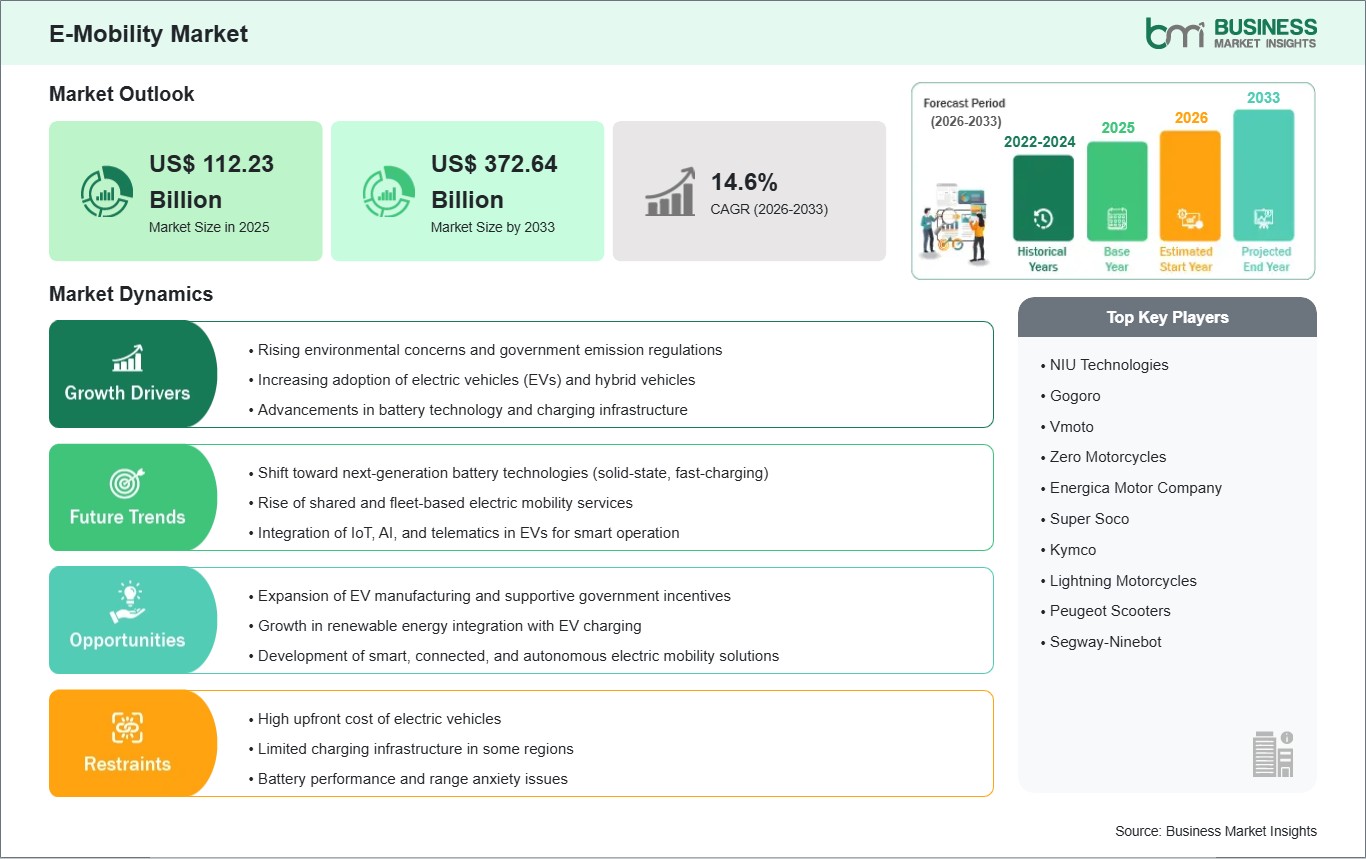
The global E-Mobility Industry is undergoing rapid expansion, driven by rising adoption of electric vehicles, stronger emissions regulations, and increasing investment in charging infrastructure and battery technologies.
According to Business Market Insights, the global E-Mobility Market size is expected to reach US$ 372.64 Billion by 2033 from US$ 112.23 Billion in 2025. The market is estimated to record a CAGR of 16.18% from 2026 to 2033.
Technological innovation is reshaping the industry through advancements in battery chemistry, fast-charging systems, vehicle connectivity, and smart grid integration. These developments are helping improve driving range, reduce charging time, and strengthen the overall usability of electric mobility solutions across passenger and commercial transport.
Download Sample Report : https://www.businessmarketinsights.com/sample/BMIPUB00032702
What Is E-Mobility?
E-mobility refers to the use of electric power for transportation, including electric vehicles, electric buses, electric two-wheelers, charging infrastructure, and related energy systems. It is designed to replace or reduce dependence on internal combustion engines by using battery-powered and connected mobility solutions.
The industry includes vehicle technologies, charging networks, power electronics, and digital platforms that support cleaner and more efficient transport. E-mobility is becoming increasingly important in both urban and long-distance transportation due to its environmental and operational benefits.
Industry Drivers
A primary driver of the E-Mobility Industry is the global push to reduce greenhouse gas emissions and improve air quality. Governments are introducing stricter emissions standards, EV incentives, and clean transportation policies that are accelerating market adoption.
The expansion of charging infrastructure is another major growth factor. As public and private charging networks become more accessible, consumer confidence in electric vehicles is improving and range anxiety is decreasing.
In addition, falling battery costs and improvements in battery performance are making electric mobility more practical and affordable. Longer driving ranges, faster charging, and lower total operating costs are encouraging both consumers and fleet operators to transition to electric solutions.
Get More Details: https://www.businessmarketinsights.com/buy/BMIPUB00032702
Industry Segmentation
By Type
- Battery Electric Vehicles: The dominant segment, driven by full electrification and zero tailpipe emissions.
- Plug-in Hybrid Electric Vehicles: Used by consumers seeking flexibility between electric and fuel-based driving.
- Electric Two-Wheelers: A fast-growing segment in urban and emerging markets.
- Electric Commercial Vehicles: Includes delivery vans, buses, and trucks used in fleet electrification.
- Charging Infrastructure: Covers chargers, stations, and related support systems.
By Component
- Batteries: The largest and most critical segment, supporting vehicle range and performance.
- Charging Systems: Includes home, public, and fast-charging solutions.
- Electric Motors: Provide propulsion and efficiency in EV platforms.
- Power Electronics: Manage energy conversion and system control.
- Others: Includes control units, software, and supporting mobility technologies.
The Battery segment held the dominant industry share in 2025 due to its central role in EV performance and adoption, while Charging Systems are expected to grow rapidly as infrastructure expands.
By Application
- Passenger Vehicles: The largest application segment, driven by consumer EV adoption.
- Commercial Vehicles: Includes fleet vehicles, delivery vans, and logistics applications.
- Public Transportation: Covers electric buses, shuttles, and transit systems.
- Two- and Three-Wheelers: A key segment in dense urban areas and developing markets.
- Others: Includes specialty and off-road electric mobility uses.
Regional Insights
- Asia-Pacific remains the dominant and fastest-growing region, supported by strong EV production, charging network expansion, and government backing in China, India, and other major economies.
- Europe is a mature and highly supportive market, with aggressive emissions goals and broad EV policy support.
- North America is witnessing strong growth, driven by charging investments, consumer demand, and fleet electrification efforts.
- Middle East & Africa is gradually adopting e-mobility, supported by pilot projects and infrastructure development.
- South & Central America is seeing steady growth as governments and private operators expand clean transport programs.
Top Players in the E-Mobility Industry
The competitive landscape includes automakers, battery manufacturers, charging companies, and technology providers focused on scale, efficiency, and ecosystem integration.
- Tesla, Inc.
- BYD Company Ltd.
- Volkswagen AG
- General Motors Company
- Stellantis N.V.
- BMW Group
- Hyundai Motor Company
- ChargePoint Holdings, Inc.
- ABB Ltd.
- Siemens AG
Leading companies are investing in battery technology, fast-charging solutions, and integrated mobility platforms to strengthen their position in the evolving industry.
Technological Innovations
Battery innovation is transforming the industry through higher energy density, improved safety, and faster charging capability. These advances are improving electric vehicle usability and making e-mobility more competitive with conventional transport.
Smart charging and vehicle-to-grid technologies are also gaining importance, allowing electric vehicles to interact more efficiently with power networks. This is helping support grid stability while improving energy management and overall system performance.
Future Industry Outlook
The future outlook for the E-Mobility Industry remains highly positive, supported by policy momentum, technology improvements, and broader consumer acceptance. The industry is expected to continue expanding as electric mobility becomes more affordable and accessible.
Industry leadership over the next decade will likely depend on battery innovation, charging network scale, and integration with digital energy systems. Companies that can combine cost efficiency, infrastructure support, and advanced vehicle technologies will be best positioned for long-term growth.
Frequently Asked Questions (FAQs)
What is the main focus of the E-Mobility Industry?
The industry focuses on electric transportation solutions, including vehicles, charging systems, batteries, and supporting infrastructure.
Which segment is dominant?
Battery Electric Vehicles held the dominant industry share in 2025 due to full electrification and strong consumer adoption.
Which component segment is dominant?
Batteries held the dominant industry share because they are essential to EV range and performance.
Which region is expected to grow the fastest?
Asia-Pacific is projected to exhibit the fastest growth and highest industry share, supported by EV adoption and infrastructure expansion.
What is the primary factor driving demand?
The primary drivers are emissions reduction policies, charging network growth, and falling battery costs.
Browse More Reports:
https://www.businessmarketinsights.com/reports/3d-camera-market
https://www.businessmarketinsights.com/reports/airflow-mangement-market
https://www.businessmarketinsights.com/reports/active-optical-cable-market
About Us
Business Market Insights is a market research platform that provides subscription service for industry and company reports. Our research team has extensive professional expertise in domains such as Automotive & Transportation; Energy & Power; Electronics & Semiconductor; Manufacturing; and Technology, Media, & Telecommunications.
Contact Us
If you have any questions about this report or would like further information, please contact us:
Contact person: Ankit Mathur
Email: sales@businessmarketinsights.com
Phone: +16467917070