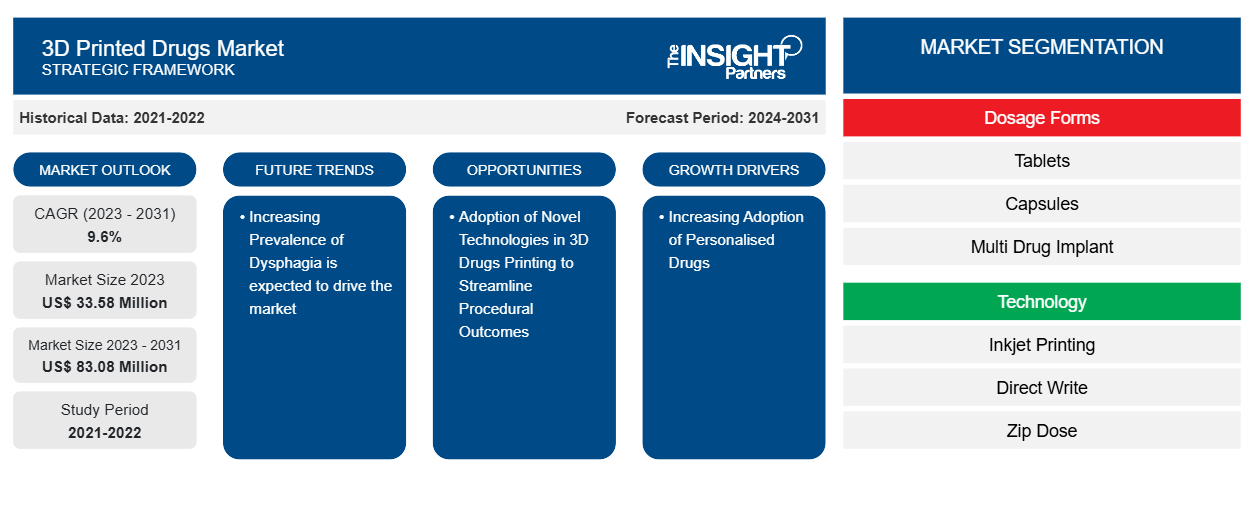
The United States holds a leading position in the 3D Printed Drugs Market, supported by its strong pharmaceutical research ecosystem, advanced healthcare infrastructure, and early adoption of innovative manufacturing technologies. The country is home to several leading pharmaceutical companies, biotechnology firms, and research institutions that are actively investing in three-dimensional printing for personalized drug development and precision medicine. Increasing funding for pharmaceutical research, favorable regulatory initiatives, and growing collaboration between academia and industry are accelerating the commercialization of three-dimensional printed medications.
According to recent market estimates, news highlights strong industry momentum fueled by technological innovation, strategic collaborations, and expanding regulatory support for advanced drug manufacturing. The 3D Printed Drugs Market is projected to grow from US$ 33.58 million in 2023 to US$ 83.08 million by 2031, registering a CAGR of 9.6% during 2023–2031. Continuous advancements in pharmaceutical-grade printing materials, artificial intelligence-assisted formulation development, and precision drug delivery technologies are creating new opportunities for manufacturers while supporting the transition toward patient-centric healthcare solutions.
Download Sample PDF: https://www.theinsightpartners.com/sample/TIPRE00010199
Why Is the 3D Printed Drugs Market Growing So Rapidly?
The growing emphasis on personalized healthcare is one of the primary factors driving the expansion of the 3D Printed Drugs Market. Unlike traditional pharmaceutical manufacturing, three-dimensional printing allows manufacturers to produce medications with customized dosages, shapes, release characteristics, and combinations of active pharmaceutical ingredients tailored to individual patient needs.
The increasing prevalence of chronic diseases, including cardiovascular disorders, neurological conditions, diabetes, and cancer, has intensified the need for more flexible drug manufacturing technologies. Three-dimensional printed pharmaceuticals can improve medication adherence by simplifying dosing regimens and creating patient-friendly formulations.
Technological advancements continue to reshape the market. Innovations in binder jetting, fused deposition modeling, stereolithography, and selective laser sintering have expanded the capabilities of pharmaceutical manufacturing. In addition, research institutions and pharmaceutical companies are investing in novel printable biomaterials and advanced formulation techniques that improve drug stability, efficacy, and manufacturing efficiency.
Growing regulatory interest in innovative manufacturing methods and increasing collaboration between pharmaceutical companies, technology providers, and academic institutions are also contributing to market growth.
What Does 3D Printed Drugs Market News Reveal About Recent Developments?
Recent 3D Printed Drugs Market News reflects increasing investment in research, product innovation, and commercialization efforts across the pharmaceutical industry. Companies are actively developing next-generation three-dimensional printed medicines capable of delivering personalized therapies for complex medical conditions.
Several pharmaceutical manufacturers are expanding research partnerships with universities, biotechnology firms, and additive manufacturing specialists to accelerate drug development. Investments are increasingly focused on improving printing accuracy, enhancing formulation flexibility, and reducing manufacturing costs through advanced automation.
The industry has also witnessed growing interest in decentralized pharmaceutical manufacturing, allowing medications to be produced closer to patients in hospitals or specialized healthcare facilities. Artificial intelligence, digital manufacturing platforms, and advanced quality control systems are being integrated into production workflows to improve consistency and regulatory compliance.
As regulatory agencies continue evaluating frameworks for personalized pharmaceutical manufacturing, market participants are preparing to commercialize a broader range of three-dimensional printed medications across therapeutic areas.
Market Drivers
The 3D Printed Drugs Market is supported by several powerful growth drivers.
The increasing demand for personalized medicine continues to reshape pharmaceutical manufacturing. Customized medications improve treatment effectiveness while reducing adverse drug reactions through patient-specific dosage optimization.
Advancements in additive manufacturing technologies have significantly enhanced printing precision, scalability, and production efficiency. Continuous improvements in pharmaceutical-grade printing materials have expanded the range of drugs suitable for three-dimensional printing.
Growing investments in pharmaceutical research and development are accelerating innovation in drug formulation and delivery systems. The healthcare industry’s shift toward precision medicine further increases demand for individualized pharmaceutical products.
Additionally, rising healthcare expenditure, expanding clinical research, and increasing awareness of advanced manufacturing technologies are creating favorable conditions for market expansion worldwide.
Competitive Landscape
The 3D Printed Drugs Market remains highly competitive, with companies focusing on innovation, intellectual property development, strategic collaborations, and commercialization of advanced pharmaceutical manufacturing technologies.
Key Players
- Aprecia Pharmaceuticals, Llc
- Fabrx Ltd
- Cycle Pharmaceuticals
- Glaxosmithkline Plc.
- Astrazeneca
- Tvasta
- Merck KGGA
These companies continue investing in research, regulatory approvals, advanced manufacturing platforms, and collaborative partnerships to strengthen their positions within the evolving three-dimensional printed pharmaceutical industry.
Purchase a Copy of this report: https://www.theinsightpartners.com/buy/TIPRE00010199
Future Outlook
The future of the 3D Printed Drugs Market appears highly promising as personalized medicine becomes increasingly integrated into modern healthcare systems. Advances in additive manufacturing, artificial intelligence, digital pharmaceutical design, and precision drug delivery are expected to transform how medications are developed and manufactured.
Future innovations will likely focus on multi-drug tablets, on-demand pharmaceutical production, decentralized manufacturing models, and highly individualized treatment solutions. Continued collaboration among pharmaceutical manufacturers, healthcare providers, regulatory authorities, and research institutions will support broader commercialization and clinical adoption.
Also Available in: Korean | German | Japanese | French | Chinese | Italian | Spanish
Related Reports:
Bulk Lyophilization Services Market Size, Share, Trends, and Forecast to 2031
Non-Gelatin Empty Capsules Market Size, Trends & Forecast 2031
About Us
The Insight Partners is a one-stop provider of actionable industry research and intelligence. We help our clients in getting solutions to their research requirements through our syndicated and consulting research services. We specialize in industries such as Semiconductor and Electronics, Aerospace and Defense, Automotive and Transportation, Healthcare IT, Manufacturing and Construction, Medical Devices, Technology, Media and Telecommunications, Food and Beverages, Consumer Goods, and Chemicals and Materials.
Contact US
Contact Person: Ankit Mathur
Phone: +1-646-491-9876
E-mail : sales@theinsightpartners.com
