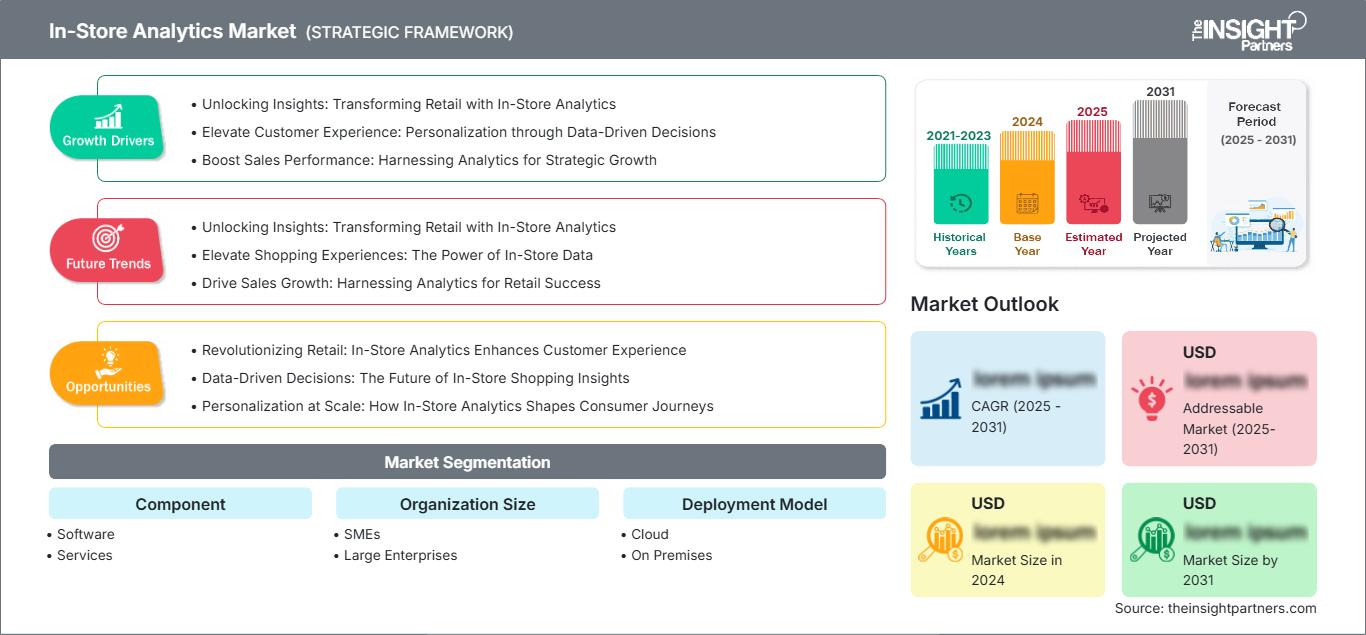
The global In-Store Analytics is experiencing rapid expansion as retailers increasingly rely on data-driven technologies to enhance customer experiences, optimize store operations, and improve profitability. In-store analytics combines artificial intelligence (AI), machine learning, computer vision, IoT sensors, video analytics, Wi-Fi tracking, and advanced data analytics to provide retailers with actionable insights into customer behavior and operational performance.
According to the latest market analysis, The In Store Analytics Market size is expected to reach US$ 19.72 Billion by 2031. The market is anticipated to register a CAGR of 23.8% during 2025–2031.
Market Overview
The Retail businesses have undergone significant digital transformation over the past decade. While e-commerce has long benefited from customer analytics, physical retail stores are now leveraging advanced in-store analytics to gain comparable insights into customer movement, buying behavior, dwell time, product interaction, and conversion rates.
Modern in-store analytics platforms integrate multiple technologies such as surveillance cameras, IoT devices, RFID systems, Bluetooth beacons, and cloud-based analytics software. These technologies enable retailers to monitor customer journeys, optimize store layouts, improve merchandising strategies, reduce waiting times, and enhance operational efficiency.
The growing importance of real-time decision-making is encouraging retailers across supermarkets, shopping malls, specialty stores, convenience stores, and department stores to invest heavily in analytics solutions.
Get Sample PDF of the report @ https://www.theinsightpartners.com/sample/TIPRE00004283
Key Market Drivers
- Rising Demand for Personalized Shopping Experiences:-Consumers increasingly expect retailers to provide personalized recommendations, promotions, and seamless shopping experiences. In-store analytics helps retailers understand customer preferences, shopping habits, and purchasing patterns, enabling personalized marketing campaigns that improve customer satisfaction and loyalty.
- Expansion of Smart Retail Technologies:-Retailers are rapidly adopting AI-powered cameras, smart shelves, digital signage, and IoT-enabled devices to automate operations and improve customer engagement. These technologies generate valuable real-time data that supports more informed business decisions.
- Growing Adoption of Artificial Intelligence:-Artificial intelligence has become a cornerstone of modern retail analytics. AI-powered computer vision can identify customer traffic patterns, analyze product interactions, detect queue lengths, and even optimize workforce allocation without manual intervention.
- Omnichannel Retail Growth:-The increasing integration of online and offline retail operations has strengthened the importance of in-store analytics. Retailers now seek unified customer insights across multiple channels to deliver consistent shopping experiences.
Emerging Market Trends
- Computer Vision-Based Analytics:-Computer vision technologies are transforming traditional surveillance systems into intelligent business tools. Modern AI-powered cameras provide real-time heat maps, customer counting, queue monitoring, and behavioral analysis while maintaining privacy compliance.
- Cloud-Based Analytics Solutions:-Cloud deployment is becoming the preferred implementation model due to its scalability, lower infrastructure costs, automatic software updates, and remote accessibility. Cloud platforms also simplify integration with existing retail management systems.
- Predictive Retail Intelligence:-Retailers are increasingly using predictive analytics to anticipate customer demand, optimize staffing schedules, forecast inventory requirements, and improve merchandising strategies.
- Integration with IoT Devices:-The growing adoption of IoT sensors throughout retail environments enables continuous monitoring of store conditions, customer movement, inventory levels, and operational performance.
Market Challenges
Despite strong growth prospects, the market faces several challenges.
- Data Privacy Concerns:-Collecting customer movement and behavioral data requires compliance with evolving privacy regulations. Retailers must ensure transparency, secure data handling, and regulatory compliance when implementing analytics systems.
- High Initial Investment:-Deploying AI-enabled cameras, sensors, networking infrastructure, and analytics software requires significant capital expenditure. Small and medium-sized retailers may find implementation costs challenging.
- Integration Complexity:-Many retailers continue operating legacy POS systems, inventory software, and surveillance infrastructure. Integrating new analytics platforms with existing systems often requires technical expertise and additional investments.
Market Opportunities
- Expansion Across Emerging Markets:-Rapid urbanization, growing organized retail sectors, and increasing digital transformation initiatives across Asia-Pacific, Latin America, and the Middle East create significant opportunities for analytics solution providers.
- AI-Powered Retail Automation:-As retailers seek greater operational efficiency, AI-driven automation will expand beyond customer analytics into inventory management, cashier-less checkout, shelf monitoring, and workforce optimization.
- Real-Time Decision Support:-Future analytics platforms will increasingly provide instant recommendations for store managers, enabling immediate responses to customer behavior, inventory shortages, and operational bottlenecks.
Segment Analysis
By Component
Software
Software solutions account for a significant market share due to increasing demand for analytics dashboards, reporting tools, customer behavior analysis, heat mapping, and predictive intelligence.
Services
Professional services, including implementation, consulting, system integration, training, and managed services, remain essential for successful deployment and ongoing optimization.
By Organization Size
Large Enterprises
Large retailers continue leading adoption owing to their extensive store networks, larger IT budgets, and digital transformation initiatives.
Small and Medium Enterprises (SMEs)
Cloud-based subscription models are making advanced analytics solutions increasingly accessible to SMEs, enabling wider market penetration.
By Deployment Model
Cloud
Cloud deployment offers flexibility, lower operational costs, and simplified scalability, making it the fastest-growing deployment model.
On-Premises
Large retailers with strict data governance requirements continue investing in on-premises deployments for greater control over sensitive operational data.
By Application
Major application areas include:
- Customer Management
- Marketing Management
- Merchandising Analysis
- Store Operations Management
- Risk and Compliance Management
- Other Retail Intelligence Applications
Each application contributes to improved customer engagement, optimized inventory placement, enhanced operational efficiency, and stronger revenue generation.
Get the Premium Research Report @ https://www.theinsightpartners.com/buy/TIPRE00004283
Regional Analysis
North America
North America dominates the global market due to early adoption of AI, cloud computing, IoT technologies, and advanced retail automation. Major retailers continue investing heavily in customer analytics and digital transformation.
Europe
European retailers are increasingly implementing analytics solutions to improve customer engagement while ensuring compliance with stringent data privacy regulations.
Asia-Pacific
Asia-Pacific represents the fastest-growing regional market, driven by rapid expansion of organized retail, increasing smartphone penetration, rising consumer spending, and government support for digital transformation initiatives.
China, India, Japan, South Korea, and Southeast Asian countries continue witnessing significant investments in smart retail infrastructure.
Middle East & Africa
Retail modernization, smart city initiatives, and expanding shopping mall developments are creating new growth opportunities across the Middle East.
South & Central America
Digital transformation initiatives and increasing retail competition are encouraging businesses to adopt advanced analytics platforms for operational improvements.
Competitive Landscape
The competitive landscape is characterized by continuous innovation in AI, machine learning, cloud analytics, and computer vision technologies. Leading companies are investing in research and development to enhance predictive capabilities, improve customer experience, and strengthen omnichannel retail solutions.
- Capillary Technologies
- Happiest Minds
- Mindtree
- Nike, Inc.
- Retail Solutions Inc
- RetailNext Inc
- Sisense Inc.
- SAP SE
- TDK Corporation
- Thinkinside
Vendors increasingly focus on delivering scalable, real-time analytics platforms that provide retailers with actionable intelligence while maintaining strong cybersecurity and regulatory compliance.
Future Outlook
The future of the In-Store Analytics Market appears exceptionally promising as retailers continue embracing digital transformation. Artificial intelligence, edge computing, advanced computer vision, and predictive analytics will become even more integrated into everyday retail operations.
About The Insight Partners
The Insight Partners is a global leader in market research, delivering comprehensive analysis and actionable insights across diverse industries. The company empowers decision-makers with data-driven intelligence to navigate evolving markets and accelerate growth.
Contact Us:
- Contact Person: Ankit Mathur
- E-mail: ankit.mathur@theinsightpartners.com
- Phone: +1-646-491-9876
Also Available in :
Korean German Japanese French Chinese Italian Spanish
