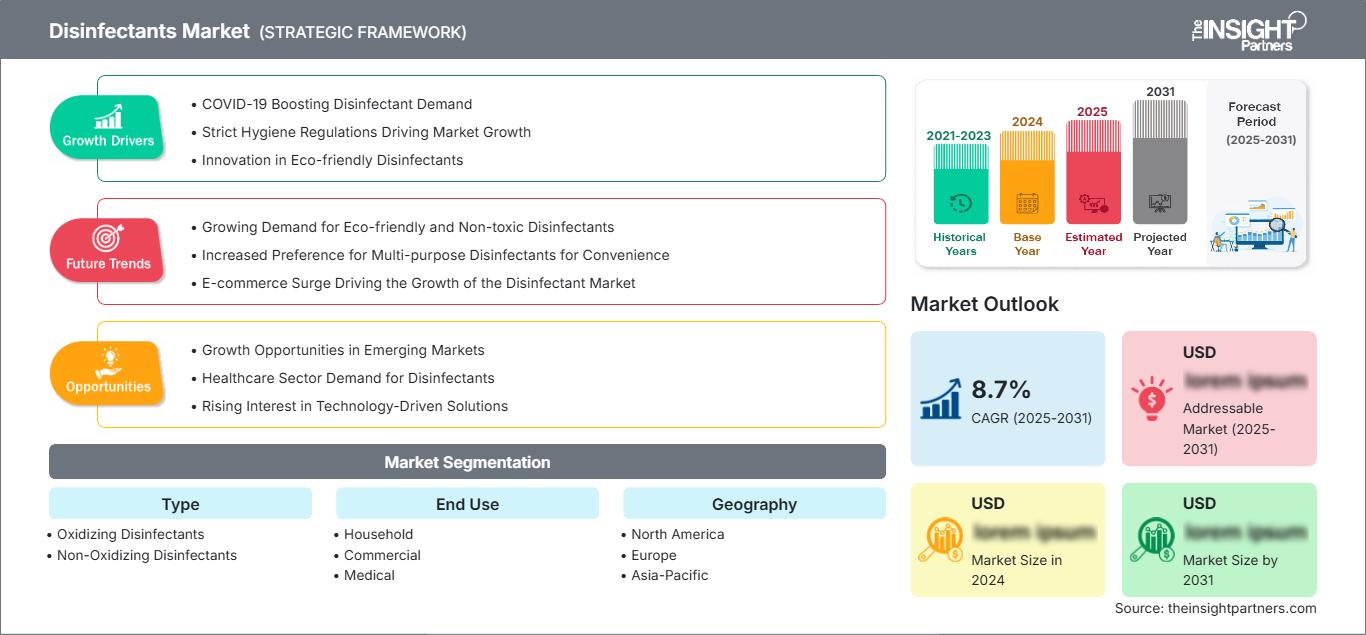
A hospital corridor, a restaurant kitchen, and a household bathroom all rely on the same basic promise: surfaces that look clean are actually clean. The Disinfectants Market was valued at US$ 37.57 Billion in 2025 and is forecasted to reach US$ 95.99 Billion by 2034, growing at a CAGR of 10.99% from 2026 to 2034. This growth reflects a world that has permanently recalibrated its relationship with hygiene, across homes, hospitals, food facilities, and commercial spaces alike.
What Is a Disinfectant?
A disinfectant is a chemical agent formulated to destroy or inactivate microorganisms, including bacteria, viruses, and fungi, on inanimate surfaces. Disinfectants differ from sanitisers and cleaners in that they are specifically designed to achieve a defined level of microbial kill, often required by regulatory or clinical standards.
Request a Sample Copy of the Report: https://www.theinsightpartners.com/sample/TIPRE00010181
What changed to push disinfectant demand onto this trajectory? Part of the answer is behavioural. Consumers who once reserved disinfectants for occasional deep cleans now use them as part of a weekly, sometimes daily, routine. That shift has not faded even as acute public health emergencies have receded, and manufacturers have responded by expanding product lines across sprays, wipes, concentrates, and foaming formats to match how people actually clean.
Healthcare demand tells a different but equally compelling story. Hospitals and clinics are under constant pressure to reduce healthcare-associated infections, and disinfection protocols have become a measurable part of accreditation and patient safety scoring. This is not just a compliance exercise, it is a direct driver of purchasing decisions across surgical suites, patient rooms, and shared medical equipment. Advanced sterilisation products and high-level disinfectants formulated for medical devices are seeing particularly strong adoption as hospitals tighten infection control budgets rather than cut them.
Food and beverage processing adds another layer of demand. Regulatory bodies overseeing food safety require documented disinfection protocols at nearly every stage of production, from raw material handling to packaging lines. Beyond regulatory pressure, food manufacturers have learned that a single contamination event can be commercially devastating, which makes disinfectant investment a form of risk management rather than a discretionary cost.
Commercial spaces, from offices to hospitality venues, have also normalised visible disinfection practices. Building managers increasingly treat disinfection schedules as part of tenant and guest experience, not just a facilities requirement. What makes this particularly significant is how permanent this expectation has become; occupants now notice its absence more than its presence.
Segments Covered
By Type:
Oxidising disinfectants, including chlorine-based and peroxide-based formulations, remain widely used for their fast-acting, broad-spectrum efficacy against a range of pathogens. Non-oxidising disinfectants, such as quaternary ammonium compounds and alcohols, are gaining preference in settings that require gentler, surface-compatible formulations without sacrificing microbial kill rates.
By Application:
Household use continues to expand as consumer hygiene habits remain elevated well beyond pre-pandemic norms. Commercial applications span offices, retail, and hospitality, where visible cleanliness has become a customer expectation. Medical applications demand the highest efficacy standards, driven by infection control protocols in hospitals and clinics. Food and beverage processing relies on disinfectants to meet strict contamination control requirements throughout the supply chain.
Key Market Players
- 3M Company
- Ecolab Inc.
- S. C. Johnson & Son, Inc.
- Advanced Sterilization Products, Inc.
- Metrex Research, LLC
- Reckitt Benckiser Group plc
- STERIS plc
- Tristel plc
- Unilever PLC
- The Procter & Gamble Company
Sustainability and Innovation Trends
Sustainability has become a genuine design constraint in disinfectant formulation, not just a marketing claim. Manufacturers are reformulating products to reduce volatile organic compound content, improve biodegradability, and cut packaging waste, all while maintaining regulatory-grade efficacy. Concentrated refill systems are gaining traction in both household and commercial channels, reducing plastic use without compromising the disinfectant’s kill claims.
On the innovation side, companies are investing in disinfectants that combine speed with reduced toxicity, addressing long-standing concerns about skin and respiratory irritation from harsher chemistries. Electrostatic sprayers and UV-assisted disinfection systems are also being paired with chemical disinfectants to improve coverage in large facilities, particularly in healthcare and food processing environments where thoroughness matters as much as speed.
Buy Premium Report: https://www.theinsightpartners.com/buy/TIPRE00010181
Regional Outlook
North America leads the market, supported by stringent healthcare infection control standards and consistently high household hygiene spending. Europe follows closely, shaped by strict regulatory frameworks governing chemical formulations and a mature institutional cleaning sector. Asia Pacific is the fastest-growing region, driven by rising healthcare infrastructure investment, expanding food processing industries, and growing consumer awareness across densely populated markets. South and Central America is emerging steadily, supported by expanding commercial and hospitality sectors that are raising baseline hygiene expectations.
Related Reports:
Industrial Wastewater Treatment Chemicals Market
About The Insight Partners
The Insight Partners is among the leading market research and consulting firms in the world. We take pride in delivering exclusive reports along with sophisticated strategic and tactical insights into the industry. Reports are generated through a combination of primary and secondary research, solely aimed at giving our clientele a knowledge-based insight into the market and domain. This is done to assist clients in making wiser business decisions. A holistic perspective in every study undertaken forms an integral part of our research methodology and makes the report unique and reliable.
Contact Us:
If you have any queries about this report or if you would like further information, please contact us:
Phone: +1-646-491-9876
E-mail: sales@theinsightpartners.com
Also Available in: Korean | German | Japanese | French | Chinese | Italian | Spanish
