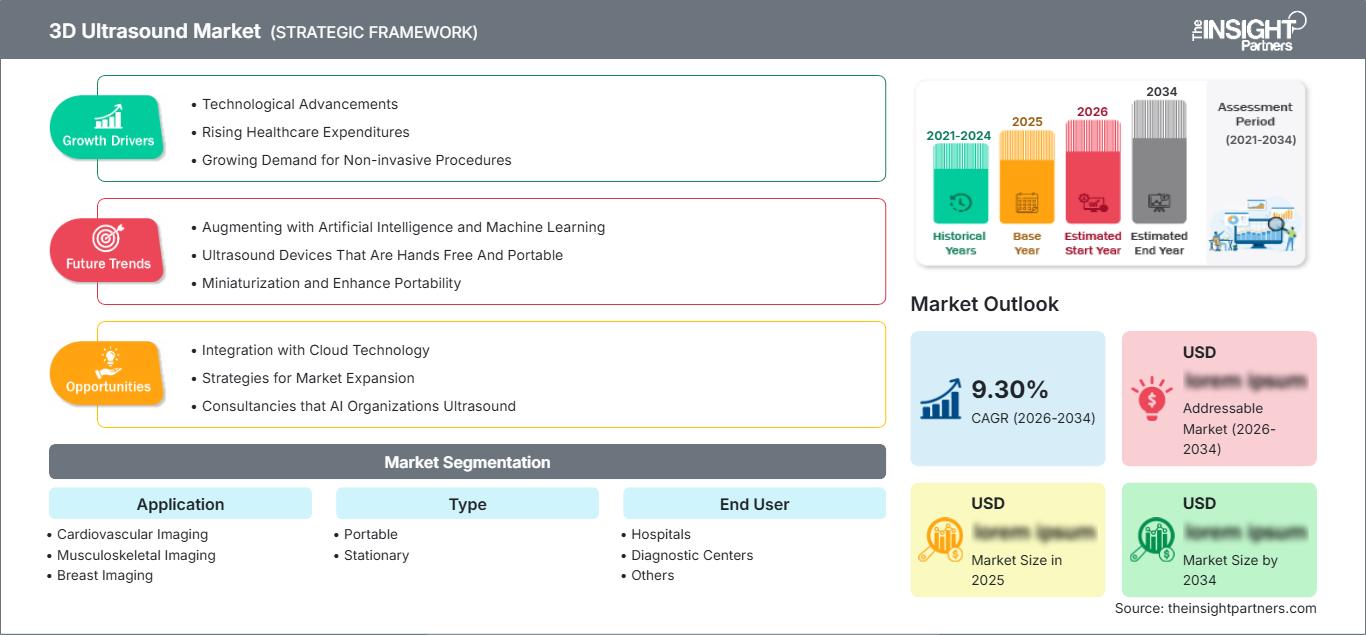
The adoption of advanced volumetric imaging technologies is transforming diagnostic practices across healthcare systems worldwide. Growing demand for precise, real-time visualization in maternal care, cardiology, breast examination, and musculoskeletal assessment continues to strengthen the role of next generation ultrasound solutions. Healthcare providers are increasingly investing in innovative imaging platforms that improve diagnostic confidence while supporting radiation-free examinations.
The 3D Ultrasound Market was valued at US$ 4.22 billion in 2025 and is projected to reach US$ 7.99 billion by 2034, registering a CAGR of 7.35% during 2026 to 2034. Growth is primarily supported by increasing utilization of 3D imaging in cardiovascular diagnostics, obstetrics and gynecology, breast imaging, musculoskeletal evaluation, and point-of-care applications. The technology is evolving beyond traditional fetal imaging and becoming an essential diagnostic tool for multiple clinical specialties due to improvements in probe design, image processing software, workflow automation, and AI-enabled analytics.
Get Sample PDF @ https://www.theinsightpartners.com/sample/TIPRE00016675
Rising Clinical Demand Driving Industry Expansion
The growing prevalence of chronic diseases and the increasing need for frequent diagnostic monitoring are major factors supporting industry growth. Cardiovascular disorders, pregnancy monitoring, breast cancer screening, and musculoskeletal injuries all require safe and repeatable imaging methods. Since ultrasound does not expose patients to ionizing radiation, it remains a preferred option for repeated examinations.
Healthcare providers are also adopting advanced volumetric imaging to improve anatomical visualization and support faster clinical decision making. Hospitals and diagnostic centers increasingly prioritize imaging systems that offer higher workflow efficiency, automated measurements, and seamless integration with hospital information systems.
Portable ultrasound devices are further expanding access to imaging services in emergency departments, outpatient clinics, rural healthcare facilities, and bedside care environments. These systems reduce patient transfers while improving diagnostic speed and operational flexibility.
Technological Advancements Strengthen Competitive Landscape
Artificial intelligence has become one of the most significant innovations shaping the industry. AI-assisted image acquisition, automated quantification, intelligent measurements, and standardized reporting reduce operator dependency while improving diagnostic consistency.
Manufacturers are also investing in cloud connectivity, cybersecurity, remote software upgrades, and fleet management capabilities. These enhancements enable healthcare organizations to monitor equipment utilization, simplify maintenance, and improve service quality across multiple facilities.
Automation is particularly valuable in cardiology and obstetrics, where consistent measurements directly influence treatment planning. Vendors are increasingly competing through software innovation, workflow optimization, and service capabilities rather than hardware specifications alone.
Regional Outlook Highlights Strong Global Opportunities
North America accounted for the largest revenue share in 2025, supported by advanced imaging infrastructure, established cardiology programs, maternal healthcare services, and continuous replacement of imaging equipment. The region also benefits from widespread adoption of AI-enabled ultrasound platforms and high investment in premium diagnostic technologies.
Europe maintains a significant position with strong demand across Germany, the United Kingdom, France, Italy, and Spain. Healthcare providers continue upgrading imaging infrastructure while emphasizing cybersecurity, interoperability, and diagnostic efficiency.
Asia Pacific is expected to record the fastest growth throughout the forecast period. Expanding hospital infrastructure, rising healthcare expenditure, increasing maternal care awareness, domestic manufacturing capabilities, and growing adoption of portable ultrasound systems are accelerating regional development. China, Japan, India, South Korea, and Australia remain key contributors to regional expansion.
Emerging economies across the Middle East and Africa are gradually increasing investments in diagnostic imaging, particularly through portable systems that improve healthcare accessibility in underserved communities.
Segment Analysis Demonstrates Diverse Growth Potential
Based on application, Obstetrics and Gynecology Imaging represented the largest segment in 2025 due to widespread use in fetal anatomy assessment, maternal monitoring, reproductive medicine, and gynecological diagnosis.
The Portable segment is projected to witness the fastest expansion during the forecast period as healthcare providers increasingly seek compact imaging systems for emergency medicine, critical care, rural healthcare delivery, and outpatient services.
Hospitals continue to dominate end user demand because they require multipurpose imaging platforms capable of supporting cardiology, obstetrics, breast imaging, emergency medicine, and procedural guidance. Diagnostic centers are also investing in advanced systems that enhance examination efficiency, improve image consistency, and increase patient throughput.
Key Players
- GE HealthCare Technologies Inc.
- Esaote S.p.A.
- QT Ultrasound LLC
- Samsung Medison Co., Ltd.
- Hitachi, Ltd.
- Siemens Healthineers AG
- Wuhan Zoncare Bio-Medical Electronics Co., Ltd.
- Koninklijke Philips N.V.
- Shenzhen Mindray Bio-Medical Electronics Co., Ltd.
- Shantou Institute of Ultrasonic Instruments Co., Ltd.
Interested in Purchasing this Report? Click here @ https://www.theinsightpartners.com/buy/TIPRE00016675
Future Outlook
The future of the 3D Ultrasound Market will be shaped by continued advancements in artificial intelligence, portable imaging platforms, cloud-enabled workflow management, and automated diagnostic tools. Rising investments in women’s health, cardiovascular imaging, and point-of-care diagnostics will continue to create new growth opportunities across developed and emerging healthcare systems.
Related Report:
1) Biologics Market Growth, Trends, and Analysis by 2031
2) Antibody Production Market Share, Growth & Forecast by 2034
3) Contract Research Organization Market Analysis and Forecast by Size
About Us –
The Insight Partners provides comprehensive syndicated and tailored market research services in the healthcare, technology, and industrial domains. Renowned for delivering strategic intelligence and practical insights, the firm empowers businesses to remain competitive in ever-evolving global markets.
Contact Us:
Ankit Mathur | The Insight Partners
E-mail: ankit.mathur@theinsightpartners.com
Phone: +1-646-491-9876
Also Available in : Korean German Japanese French Chinese Italian Spanish
