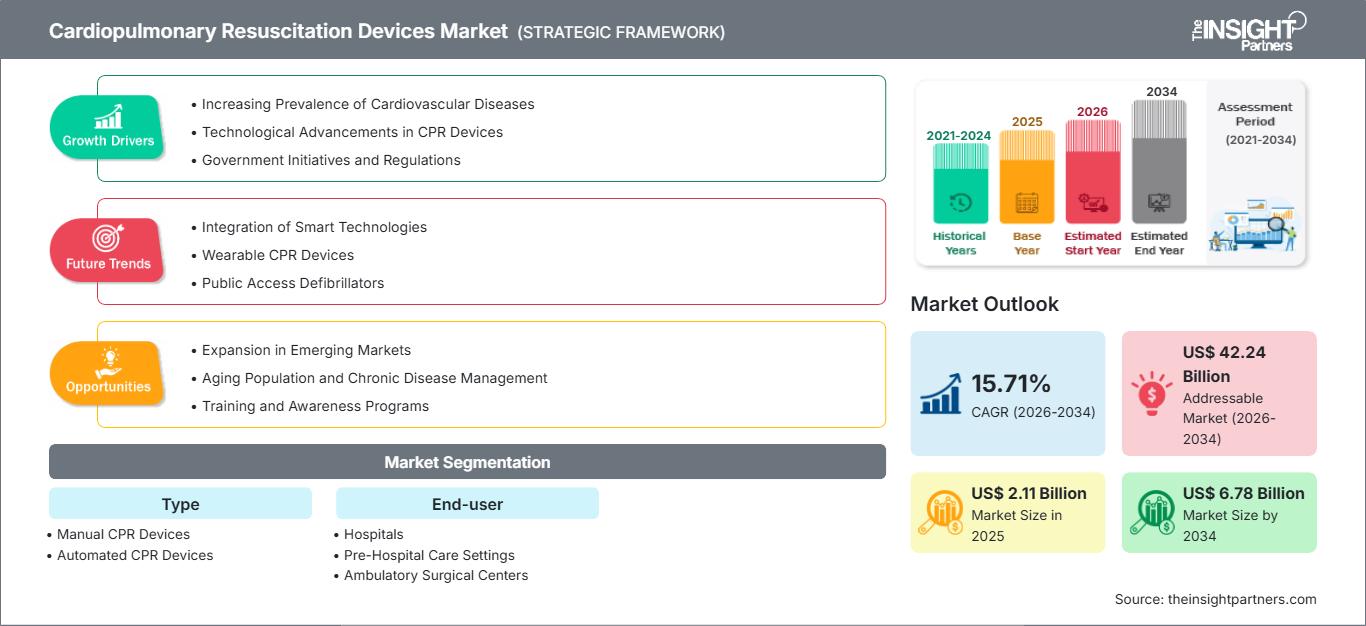
The Cardiopulmonary Resuscitation Devices Market size is expected to reach US$ 6.78 Billion by 2034 from US$ 2.11 Billion in 2025. The market is estimated to record a CAGR of 15.71% from 2026 to 2034.
The market is witnessing significant expansion due to the growing incidence of sudden cardiac arrest, increasing awareness regarding timely CPR, and rising investments in emergency medical infrastructure. Healthcare organizations are adopting automated and mechanical CPR devices to improve the consistency of chest compressions, reduce responder fatigue, and enhance patient outcomes. Continuous technological innovation and expanding emergency care capabilities are expected to sustain strong market growth during the forecast period.
Get Sample PDF – https://www.theinsightpartners.com/sample/TIPRE00040174
Rising Burden of Cardiac Emergencies
The increasing prevalence of cardiovascular diseases remains one of the primary drivers supporting demand for CPR devices. Sudden cardiac arrest continues to be a major public health concern, requiring immediate intervention to improve survival rates. Effective cardiopulmonary resuscitation plays a critical role in maintaining blood circulation until advanced medical treatment becomes available.
Hospitals, emergency departments, and ambulance services are increasingly incorporating mechanical CPR systems into their emergency response protocols to ensure uninterrupted, guideline-compliant chest compressions during patient transport and prolonged resuscitation efforts. These devices help improve procedural consistency while allowing healthcare professionals to focus on additional life-saving interventions.
Technological Advancements Supporting Market Growth
Rapid technological innovation is transforming the cardiopulmonary resuscitation devices landscape. Modern mechanical CPR systems provide automated chest compressions with consistent depth, rate, and force that align with established clinical guidelines. These systems reduce variability associated with manual CPR while improving operational efficiency during emergency situations.
Manufacturers continue introducing lightweight, portable, and user-friendly devices equipped with enhanced monitoring capabilities, intuitive controls, and improved battery performance. Integration with advanced emergency care equipment further supports seamless clinical workflows and strengthens emergency response effectiveness across healthcare settings.
Growing Adoption Across Emergency Healthcare Settings
Healthcare providers are increasingly deploying CPR devices across multiple clinical environments, including hospitals, intensive care units, ambulances, emergency response vehicles, military healthcare systems, and public emergency preparedness programs. Emergency medical service providers particularly benefit from mechanical CPR devices during patient transportation, where maintaining consistent manual compressions can be challenging.
The growing emphasis on improving survival rates from out-of-hospital cardiac arrest has also encouraged broader adoption of advanced resuscitation technologies. Healthcare organizations continue investing in emergency preparedness initiatives that include advanced CPR equipment alongside automated external defibrillators and integrated emergency response systems.
Expanding Healthcare Investments
Governments and healthcare organizations worldwide continue increasing investments in emergency medical infrastructure to strengthen critical care services. Modernization of emergency departments, expansion of ambulance fleets, and improved disaster preparedness programs are creating favorable opportunities for CPR device manufacturers.
Growing healthcare expenditure, improved access to emergency medical care, and increasing awareness regarding advanced life support technologies are supporting wider deployment of CPR devices across both developed and emerging healthcare markets. Ongoing training initiatives for healthcare professionals are also contributing to greater acceptance of mechanical resuscitation technologies.
Competitive Landscape
The Cardiopulmonary Resuscitation Devices Market remains highly competitive as leading manufacturers focus on technological innovation, product reliability, clinical effectiveness, and strategic expansion. Companies continue investing in research and development to introduce advanced mechanical CPR systems that improve patient outcomes while supporting healthcare professionals during emergency care.
Key Players
- Asahi Kasei Corporation
- Stryker Corporation
- Koninklijke Philips N.V.
- Physio-Control, Inc. (Stryker Corporation)
- Michigan Instruments
- SCHILLER AG
- CPR Medical Devices, Inc.
- Medtronic plc
- GE Healthcare
These companies continue strengthening their market presence through product innovation, strategic partnerships, clinical research, and expansion into high-growth healthcare markets while developing next-generation emergency care technologies.
Regional Market Insights
North America continues to hold a substantial share of the Cardiopulmonary Resuscitation Devices Market due to its advanced emergency healthcare infrastructure, high adoption of automated medical technologies, and growing focus on improving cardiac arrest survival rates. Europe also maintains a strong market position through established emergency response systems and continuous healthcare investments.
Get Full Copy of This Report @ https://www.theinsightpartners.com/buy/TIPRE00040174
The Asia-Pacific region is expected to experience considerable growth owing to expanding healthcare infrastructure, increasing healthcare expenditure, improving emergency medical services, and rising awareness regarding advanced resuscitation techniques. Emerging economies across Latin America and the Middle East & Africa are also investing in emergency healthcare modernization, creating additional growth opportunities for market participants.
Future Outlook
The future of the Cardiopulmonary Resuscitation Devices Market remains highly promising as healthcare providers continue emphasizing rapid emergency response, improved resuscitation quality, and enhanced patient survival. Continued advancements in automated chest compression technologies, portable device design, intelligent monitoring capabilities, and integration with emergency medical systems are expected to drive further innovation. Growing investments in emergency healthcare infrastructure, expanding public awareness of cardiac emergencies, and increasing adoption of advanced life-support technologies will continue supporting market growth through 2034. Companies focusing on technological innovation, clinical performance, and emergency care efficiency are expected to remain well positioned to capitalize on the expanding global demand for advanced CPR devices.
Related Reports @
Cardiac Pacing Market Size, Trends & Demand by 2034
About Us –
The Insight Partners provides comprehensive syndicated and tailored market research services in the healthcare, technology, and industrial domains. Renowned for delivering strategic intelligence and practical insights, the firm empowers businesses to remain competitive in ever-evolving global markets.
Contact Us:
Contact Person: Ankit Mathur
E-mail: ankit.mathur@theinsightpartners.com
Phone: +1-646-491-9876
