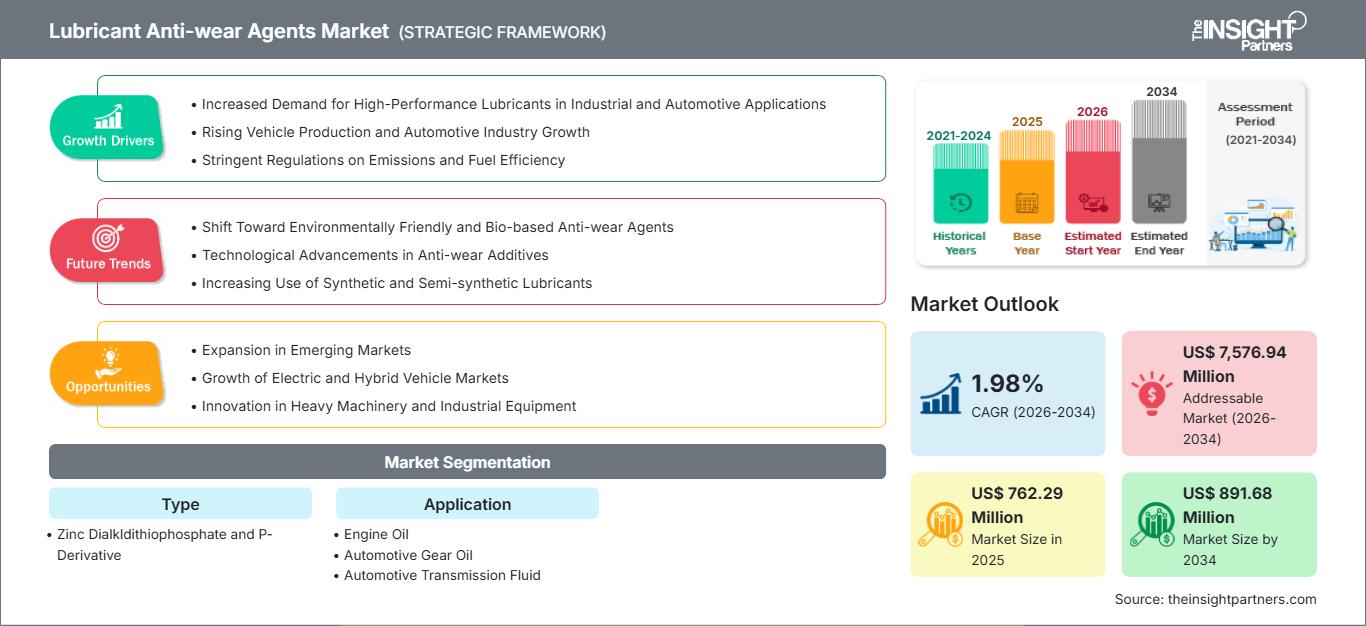
Engines run hotter and harder than they used to. Machines work longer hours with less downtime. That kind of pressure wears down metal parts fast, unless something protects them. This is where the Lubricant Anti-Wear Agents Market comes in. The market is projected to grow from US$ 762.29 Million in 2025 to US$ 891.68 Million by 2034, at a CAGR of 1.98% from 2026 to 2034. Growth is steady rather than explosive, and that steadiness tells its own story about a mature, essential industry.
What Is the Lubricant Anti-Wear Agents Market?
Lubricant anti-wear agents are additives blended into oils and greases to reduce friction between metal surfaces. They form a protective film that stops parts from grinding against each other. Without them, engines, gears, and hydraulic systems would fail much faster.
Market Drivers
What keeps this market moving forward? Vehicle longevity is a major factor. People keep cars longer now. Insurance costs and new car prices have pushed drivers to maintain older vehicles instead of replacing them. That means more oil changes, more maintenance, and steady demand for high-performance lubricant additives.
Request a Sample Copy of the Report: https://www.theinsightpartners.com/sample/TIPRE00040330
Industrial machinery adds another layer of demand. Factories run equipment around the clock in many regions. Hydraulic systems, gearboxes, and metalworking tools all depend on anti-wear protection to avoid costly breakdowns. A single equipment failure can halt production for hours. Manufacturers would rather spend a little more on quality lubricants than risk that outcome.
Regulation is shaping the market too, but not in a simple way. Stricter emissions rules have pushed engine designs toward tighter tolerances and higher operating temperatures. That actually increases the need for stronger anti-wear chemistry, not less. Zinc alkylthio phosphate remains the workhorse additive here, valued for its proven performance across engine oils and gear oils.
Electric vehicles complicate the picture. As EV adoption grows, demand from passenger car engine oil could soften over time. Yet this is offset by continued demand from heavy trucks, industrial equipment, and machinery that will not electrify anytime soon. That balance explains why growth stays modest but positive rather than flat or declining.
Segmentation Overview
Segments Covered
By Type: Zinc Dialkyldithiophosphate holds the largest share thanks to its cost-effective, proven wear protection. P-Derivative additives are gaining ground in applications where zinc content needs to be limited, particularly in modern low-emission engines.
By Application: Engine Oil leads demand, followed closely by Automotive Gear Oil and Automotive Transmission Fluid. Metalworking Fluid, Greases, and Hydraulic Oil round out the segment, each serving distinct industrial and automotive needs.
Key Market Players
- BASF SE
- Solvay
- LANXESS
- Chevron Oronite
- Afton Chemical
- Evonik Industries AG
- Eni SpA.
- Dorf Ketal
- Infineum International Limited
- BRB International BV
These companies compete on formulation performance rather than price alone. Several have invested in zinc-free and low-phosphorus alternatives to meet tightening engine specifications. Chevron Oronite and Afton Chemical, in particular, have expanded their additive portfolios to serve both automotive and industrial customers.
Sustainability and Innovation Trends
Additive chemistry is under pressure to change. Zinc and phosphorus, while effective, can damage catalytic converters over time. This has pushed suppliers to develop ashless anti-wear agents that deliver similar protection without the environmental drawbacks.
Bio-based lubricant formulations are also gaining traction. Some manufacturers are testing anti-wear agents derived from renewable feedstocks, aiming to reduce the carbon footprint of industrial lubricants. Progress here is gradual, since performance standards in this industry leave little room for compromise.
Longer oil-change intervals are another trend worth watching. As lubricant formulations improve, vehicles and machinery can run longer between service intervals. This reduces overall lubricant volume needed, which puts more weight on additive efficiency rather than sheer quantity sold.
Buy Premium Report: https://www.theinsightpartners.com/buy/TIPRE00040330
Regional Outlook
Asia Pacific leads the market, driven by massive automotive production in China, India, and Japan, along with rapid industrial expansion. Local manufacturing of lubricant additives is also increasing, reducing dependence on imports.
North America remains a strong market, supported by a large fleet of ageing vehicles and heavy industrial activity. Stringent engine performance standards keep demand for advanced anti-wear formulations steady.
Europe shows moderate but stable growth. Strict emissions regulations are pushing the region toward ashless and low-phosphorus additive technologies faster than other regions.
South and Central America is a smaller market, growing gradually alongside expanding automotive and industrial sectors in Brazil and neighbouring countries.
Related Reports:
About The Insight Partners
The Insight Partners is among the leading market research and consulting firms in the world. We take pride in delivering exclusive reports along with sophisticated strategic and tactical insights into the industry. Reports are generated through a combination of primary and secondary research, solely aimed at giving our clientele a knowledge-based insight into the market and domain. This is done to assist clients in making wiser business decisions. A holistic perspective in every study undertaken forms an integral part of our research methodology and makes the report unique and reliable.
Contact Us:
If you have any queries about this report or if you would like further information, please contact us:
Phone: +1-646-491-9876
E-mail: sales@theinsightpartners.com
Also Available in: Korean | German | Japanese | French | Chinese | Italian | Spanish
