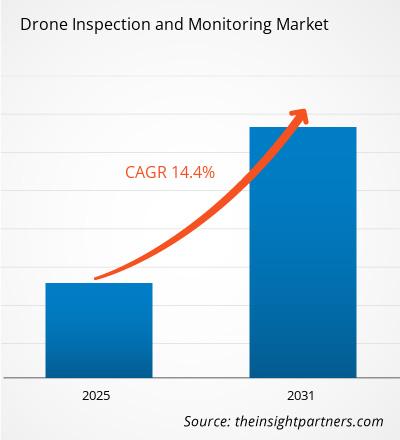
The global drone inspection and monitoring industry is undergoing a structural shift as industries around the world increasingly rely on unmanned aerial vehicles (UAVs) to streamline asset evaluation, enhance worker safety, and optimize operational costs. According to comprehensive market research published by The Insight Partners, the Drone Inspection and Monitoring Market size is expected to reach US$ 49.74 Billion by 2034 from US$ 15.49 Billion in 2025. The market is estimated to record a CAGR of 13.84% from 2026 to 2034.
This rapid expansion is driven by the growing integration of advanced technologies such as Artificial Intelligence (AI), Machine Learning (ML), thermal imaging, and LiDAR sensors into drone platforms. By automating high-risk inspection processes such as inspecting oil rigs, offshore wind turbines, high-voltage power lines, and expansive infrastructure enterprises can minimize human exposure to hazardous environments while drastically reducing downtime and maintenance costs.
Primary Drivers Catalyzing Market Demand
1. Enhanced Safety Standards and Risk Mitigation
Industrial infrastructure inspection has historically required human workers to climb scaffolds, hang from ropes, or enter confined spaces. Drone inspection completely transforms this framework by enabling remote visual and multispectral monitoring. By replacing manual climb-based inspections with autonomous or semi-autonomous flight routines, companies significantly mitigate occupational hazards, reduce workplace injury liabilities, and ensure compliance with stringent labor safety regulations globally.
2. Cost Optimization and Operational Efficiency
Traditional industrial inspection methods frequently require costly operational shutdowns to ensure safe access for personnel. Drones equipped with high-resolution optical cameras and thermal imaging systems can perform comprehensive structural health audits while facilities remain fully operational. This capability yields substantial savings by minimizing lost revenue due to downtime, cutting labor costs, and accelerating asset inspection cycles from weeks to hours.
3. Integration of AI-Driven Predictive Analytics
Modern drone systems are no longer mere floating cameras; they serve as sophisticated data-gathering terminals. Modern inspection drones utilize AI algorithms to process raw telemetry, imagery, and point-cloud data in real time. Automated edge computing allows inspection systems to detect structural micro-cracks, surface corrosion, thermal leaks, and component fatigue instantly. This shift from reactive maintenance to predictive asset health monitoring enables organizations to fix potential faults prior to catastrophic failure.
Get a PDF Sample- https://www.theinsightpartners.com/sample/TIPRE00024201
Industry-Specific Applications Across Key Sectors
Energy and Power Utilities: Drones are widely used to monitor vast solar farms, wind turbine blades, and cross-country transmission grids. Thermal sensors easily detect faulty photovoltaic cells and overloaded transformers.
Oil & Gas Infrastructure: Offshore platforms, flare stacks, and long-distance transmission pipelines are continuously monitored for methane leaks, structural degradation, and structural stress.
Construction and Civil Infrastructure: Real-time 3D mapping and photogrammetry assist civil engineers in tracking construction progress, inspecting bridge decks, verifying structural integrity, and evaluating concrete erosion.
Defense and Security: UAVs provide continuous perimeter monitoring, border surveillance, and critical facility protection, operating continuously in harsh or inaccessible environments.
Competitive Landscape and Key Players
The global drone inspection and monitoring market is characterized by a mix of technology conglomerates, defense primes, specialized UAV manufacturers, and enterprise software providers. Established defense contractors, software giants, and hardware innovators continue to drive market consolidation and technology cross-pollination through strategic partnerships, mergers, and research investments.
Key market participants profiled in the market study include:
Intertek Group plc
MISTRAS Group
Wipro Limited
Intel Corporation
Lockheed Martin Corporation
Northrop Grumman Corporation
SZ DJI Technology Co., Ltd.
Parrot SA
Maverick Inspection Ltd
Garuda UAV
Get Full Copy of This Report- https://www.theinsightpartners.com/buy/TIPRE00024201
Future Outlook
The future of the drone inspection and monitoring market points toward fully autonomous fleet operations, beyond visual line of sight (BVLOS) regulatory frameworks, and seamless integration with enterprise asset management (EAM) platforms. As civil aviation authorities worldwide progressively establish clear rules for BVLOS flights, drone inspection deployment will scale rapidly across remote utility networks and mega-infrastructure projects. Furthermore, advancements in battery energy density, hydrogen fuel cells, satellite connectivity, and swarm intelligence will allow UAVs to perform extended long-range missions autonomously. Over the coming decade, drone inspection will transition from an emerging technology into a standard, indispensable asset management utility across all capital-intensive global industries.
Related Reports-
About Us
The Insight Partners is a one-stop industry research provider of actionable intelligence. We help our clients in getting solutions to their research requirements through our syndicated and consulting research services. We specialize in industries such as Semiconductor and Electronics, Aerospace and Defense, Automotive and Transportation, Biotechnology, Healthcare IT, Manufacturing and Construction, Medical Devices, Technology, Media, and Telecommunications, as well as chemicals and Materials.
Contact Us
If you have any queries about this report or if you would like further information, don’t hesitate to get in touch with us:
Contact Person: Ankit Mathur
E-mail: ankit.mathur@theinsightpartners.com
