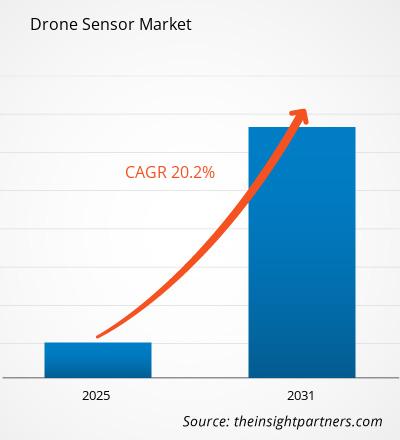
Drone sensors are critical technologies that enable unmanned aerial vehicles (UAVs) to navigate, monitor surroundings, capture high-resolution imagery, detect obstacles, and collect real-time environmental data. These sensors include inertial sensors, image sensors, position sensors, speed and distance sensors, current sensors, and other specialized sensing solutions that enhance flight stability, navigation accuracy, collision avoidance, and mission performance. Growing adoption of drones across agriculture, energy, defense, public safety, logistics, and industrial inspection continues driving demand for advanced sensor technologies.
Market Overview
The Drone Sensor Market was valued at US$ 1.69 Billion in 2025 and is projected to reach US$ 3.99 Billion by 2034, registering a CAGR of 10.02% during the forecast period 2026–2034. Market growth is driven by increasing deployment of autonomous drones, rising investments in defense modernization, expanding commercial UAV applications, and continuous advancements in artificial intelligence, computer vision, and autonomous navigation systems.
Key Market Insights
• Market Size (2025): US$ 1.69 Billion
• Forecast Market Size (2034): US$ 3.99 Billion
• CAGR (2026–2034): 10.02%
• Total Addressable Market (TAM): Approximately US$ 25.27 Billion during 2026–2034
• Key Growth Driver: Increasing adoption of autonomous drones across industrial, agricultural, defense, and commercial applications
• Major Trend: Integration of AI-powered sensor fusion, machine vision, and advanced navigation technologies into UAV platforms
• Forecast Period: 2026–2034
Get a Sample PDF of the Report: https://www.theinsightpartners.com/sample/TIPRE00012043
Market Drivers
Expansion of Autonomous Drone Operations
Growing deployment of autonomous UAVs for surveying, infrastructure inspection, mapping, logistics, and surveillance is significantly increasing demand for advanced drone sensors capable of supporting intelligent navigation and obstacle detection.
Rising Adoption in Precision Agriculture
Agricultural organizations are utilizing drones equipped with advanced image sensors and environmental monitoring systems for crop health analysis, irrigation planning, precision spraying, and yield optimization.
Increasing Defense Modernization
Defense agencies worldwide continue investing in next-generation UAVs equipped with high-performance navigation, surveillance, thermal imaging, and positioning sensors for intelligence gathering and tactical operations.
Growing Infrastructure Inspection Activities
Energy companies, utility operators, construction firms, and transportation agencies are increasingly deploying drones to inspect power lines, pipelines, wind turbines, bridges, and industrial assets while improving operational safety and reducing maintenance costs.
Market Trends
AI-Based Sensor Fusion
Manufacturers are integrating multiple sensing technologies with artificial intelligence to improve autonomous navigation, obstacle avoidance, flight stability, and environmental awareness.
Advanced Imaging Technologies
High-resolution cameras, thermal sensors, LiDAR, multispectral imaging, and infrared sensing technologies continue expanding drone capabilities across commercial and industrial applications.
Miniaturization of Sensor Systems
Sensor manufacturers are developing compact and lightweight components that improve flight endurance while maintaining high sensing accuracy and reliability.
Edge Computing Integration
Modern UAV platforms increasingly incorporate onboard processing capabilities that enable real-time analytics, autonomous decision-making, and low-latency data processing during flight operations.
Get the Premium Research Report @ https://www.theinsightpartners.com/buy/TIPRE00012043
Regional Analysis
North America
North America continues to represent a major market due to increasing investments in defense modernization, commercial drone deployment, infrastructure inspection, precision agriculture, and aerospace innovation. The United States remains a leading contributor through expanding UAV research, industrial automation, and government-supported drone programs.
Europe
Europe continues witnessing strong growth supported by increasing drone adoption across agriculture, environmental monitoring, public safety, infrastructure inspection, renewable energy, and industrial automation. Countries including Germany, France, the United Kingdom, Italy, and Spain continue investing in advanced UAV technologies.
Asia Pacific
Asia Pacific is expected to remain the fastest-growing regional market due to rapid expansion of drone manufacturing, precision farming, logistics automation, smart city initiatives, semiconductor production, and industrial digitalization across China, Japan, South Korea, India, and Southeast Asia.
Middle East and Africa
The Middle East and Africa continue increasing investments in drone technologies for oil and gas inspection, mining operations, border security, infrastructure monitoring, precision agriculture, and emergency response, supporting long-term market expansion.
Segment Analysis
By Sensor Type
The market is segmented into Inertial Sensors, Image Sensors, Speed and Distance Sensors, Position Sensors, Current Sensors, and Others. Image sensors and inertial sensors continue representing major revenue contributors due to their essential role in autonomous flight, navigation, mapping, and aerial imaging applications.
By Platform Type
The market includes VTOL, Fixed Wing, and Hybrid drone platforms. VTOL drones continue witnessing strong adoption because of their operational flexibility, vertical takeoff capability, and suitability for inspection, surveillance, and commercial operations.
By Application
Major application areas include Navigation, Collision Detection and Avoidance, Data Acquisition, Motion Detection, Air Pressure Measurement, Power Monitoring, and Others. Navigation and collision avoidance applications continue generating substantial demand as autonomous flight technologies become increasingly sophisticated.
By End User
The market serves Energy and Utilities, Precision Agriculture, Media and Entertainment, Defense, Law Enforcement, Security and Surveillance, and Others. Defense, precision agriculture, and security applications continue driving significant market expansion due to increasing deployment of intelligent unmanned aerial systems.
Competitive Landscape
The Drone Sensor Market remains highly competitive as sensor manufacturers, semiconductor companies, aerospace suppliers, and UAV technology providers continue investing in advanced sensing solutions. Companies are strengthening their product portfolios through innovations in AI-powered navigation, sensor fusion, machine vision, miniaturization, low-power electronics, thermal imaging, and autonomous flight technologies. Strategic collaborations among drone manufacturers, defense organizations, industrial solution providers, and semiconductor companies continue accelerating commercialization across both commercial and military applications.
Key Players
• AMS AG
• Bosch Sensortec
• FLIR Systems
• KVH Industries
• Lord MicroStrain
• Raytheon
• Sparton NavEx
• TDK InvenSense
• TE Connectivity
• Trimble
Emerging Trends
The drone sensor industry is advancing through AI-powered navigation, sensor fusion technologies, LiDAR integration, thermal imaging, multispectral sensing, edge computing, autonomous flight control, obstacle detection, high-precision positioning systems, and real-time environmental monitoring. Manufacturers are developing next-generation sensor platforms that deliver higher accuracy, enhanced flight safety, lower power consumption, improved durability, superior environmental awareness, and seamless integration with autonomous drone software. These technological innovations are expected to accelerate adoption across agriculture, logistics, infrastructure inspection, environmental monitoring, industrial automation, defense, public safety, and smart city applications throughout the forecast period.
Future Outlook
The future outlook for the Drone Sensor Market remains highly positive as governments and private organizations continue expanding investments in autonomous aerial technologies, industrial automation, smart infrastructure, precision agriculture, and intelligent surveillance systems. Continued innovation in artificial intelligence, semiconductor technologies, computer vision, sensor miniaturization, and autonomous navigation is expected to support sustained market growth through 2034.
For example, utility companies are deploying sensor-equipped drones for power transmission inspections, agricultural enterprises are utilizing multispectral sensors for precision farming, defense organizations are integrating advanced navigation and imaging sensors into tactical UAVs, and infrastructure operators are adopting autonomous drones for bridge, pipeline, and construction site inspections. These developments are expected to create significant long-term growth opportunities for drone sensor manufacturers worldwide.
Related Market Research Reports
Off-Highway Vehicle Lighting Market Size, Share & Trends by 2034
RF GaN Semiconductor Device Market Share, Demand & Growth by 2034
Printing Machine Market Size, Growth & Trends by 2034
IC Sockets Market Size, Share & Demand by 2034
About The Partners
The Insight Partners is a Insight global leader in market research, delivering comprehensive analysis and actionable insights across diverse industries. The company empowers decision-makers with data-driven intelligence to navigate evolving markets and accelerate growth.
Contact Us:
- Contact Person: Ankit Mathur
- E-mail: ankit.mathur@theinsightpartners.com
- Phone: +1-646-491-9876
Also Available in :
