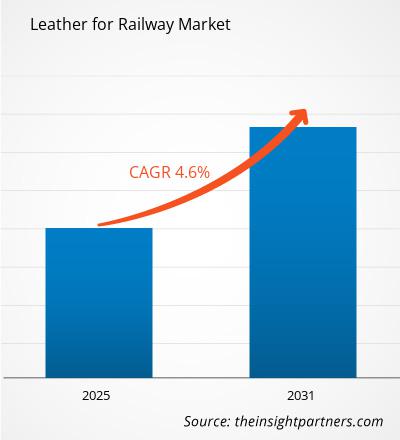
The global Leather for Railway Market is witnessing consistent commercial expansion, driven by increasing investments in high-speed rail networks, modernizations of rolling stock, expanding urban transit systems, and rising consumer demand for premium passenger travel experiences. Genuine and synthetic leather formulations are widely applied across train interiors, including passenger seats, armrests, wall paneling, driver cabs, and executive lounge facilities. The leather for railway market is projected to reach US$ 2.30 billion by 2031 from US$ 1.68 billion in 2024. The market is expected to register a CAGR of 4.6% during 2025–2031.
High-performance railway leather materials are engineered to meet strict international transport safety standards, including Fire, Smoke, and Toxicity (FST) regulations such as EN 45545-2. Applying genuine and eco-friendly artificial leather across passenger cars delivers enhanced durability, stain resistance, breathability, and ease of cleaning compared to traditional textiles. As global railway operators prioritize long-term asset lifecycle management and passenger comfort on high-speed and intercity lines, the adoption of specialized, flame-retardant surface materials continues to rise.
Download Exclusive Sample PDF of the Leather for Railway Market Study — https://www.theinsightpartners.com/sample/TIPRE00040945
Key Market Report Drivers
Global Expansion of High-Speed Rail and Suburban Transit Networks: Governments across Asia-Pacific, Europe, and North America are allocating extensive infrastructure funding to expand high-speed train networks and urban metro systems. Premium seating options in first-class, business-class, and sleeper cabins heavily utilize natural and synthetic leather to deliver superior comfort and aesthetics.
Rising Demand for High-Durability and Low-Maintenance Materials: Railway rolling stock operates under continuous high-passenger turnover, requiring interior materials that withstand intense wear, abrasion, and repeated surface sanitization. Leather upholstery provides long-lasting structural performance, reducing total cost of ownership and refurbishment frequency for transit authorities.
Stringent Safety Regulations and Flame-Retardant Standards: International fire safety compliance mandates non-flammable, self-extinguishing, and low-smoke emission upholstery materials in public rail transport. Material science advancements have enabled leather treaters and coaters to formulate high-grade flame-retardant genuine and bio-based synthetic leathers tailored for railway applications.
Shift Toward Bio-Based and Sustainable Eco-Leathers: Environmental sustainability mandates are accelerating the development of plant-based, recycled PVC/PU, and bio-derived synthetic leathers. Train operators seek eco-friendly interior coverings that align with zero-emission and circular economy strategies without compromising tactile quality or FST safety standards.
Top Players in the Leather for Railway Market
The global market features leading chemical producers, specialized tannery groups, and synthetic leather manufacturers focused on flame-retardant surface treatments, ergonomic comfort, and eco-friendly material innovation. Key players operating in the market include:
San Fang Chemical Industrial Co., Ltd.
FILWEL Co., Ltd.
BASF SE
Kuraray Co., Ltd.
Teijin Limited
Toray Industries, Inc.
Covestro AG
Wollsdorf Leder Schmidt & Co Ges.m.b.H.
Wickett-Craig
Super Tannery Ltd.
Elmo Sweden AB
Giriraj Coated Fab Pvt. Ltd.
Conceria Leonica S.p.A.
ICAIPLAST S.p.A.
BOXMARK Leather GmbH & Co KG
Buy Complete Report: https://www.theinsightpartners.com/buy/TIPRE00040945
Frequently Asked Questions (FAQs)
What was the global Leather for Railway Market size in 2024?
The global leather for railway market size was valued at US$ 1.68 billion in 2024.
What is the projected market size and CAGR by 2031?
The market is projected to reach US$ 2.30 billion by 2031, growing at a CAGR of 4.6% during the forecast period 2025–2031.
What types of leather are used in railway interiors?
Both genuine leather (for premium first-class/business seating) and synthetic/bio-based leathers (PU, PVC, plant-based options for high-traffic commuter trains and wall paneling) are widely used.
Which key interior applications generate demand for railway leather?
Passenger train seats, armrests, executive cabin upholstery, driver cab seating, wall paneling, and interior decorative accents represent the primary applications.
About Us
The Insight Partners is a one-stop industry research provider of actionable intelligence. We help our clients get solutions to their research requirements through our syndicated and consulting research services. We specialize in industries such as Semiconductor and Electronics, Aerospace and Defense, Automotive and Transportation, Energy and Utilities, Healthcare, Chemicals and Materials, and Technology.
Contact Us
If you have any queries about this report or would like further information, please contact us:
Contact Person: Sameer Joshi
E-mail: sales@theinsightpartners.com
Phone: +1-646-491-9876
