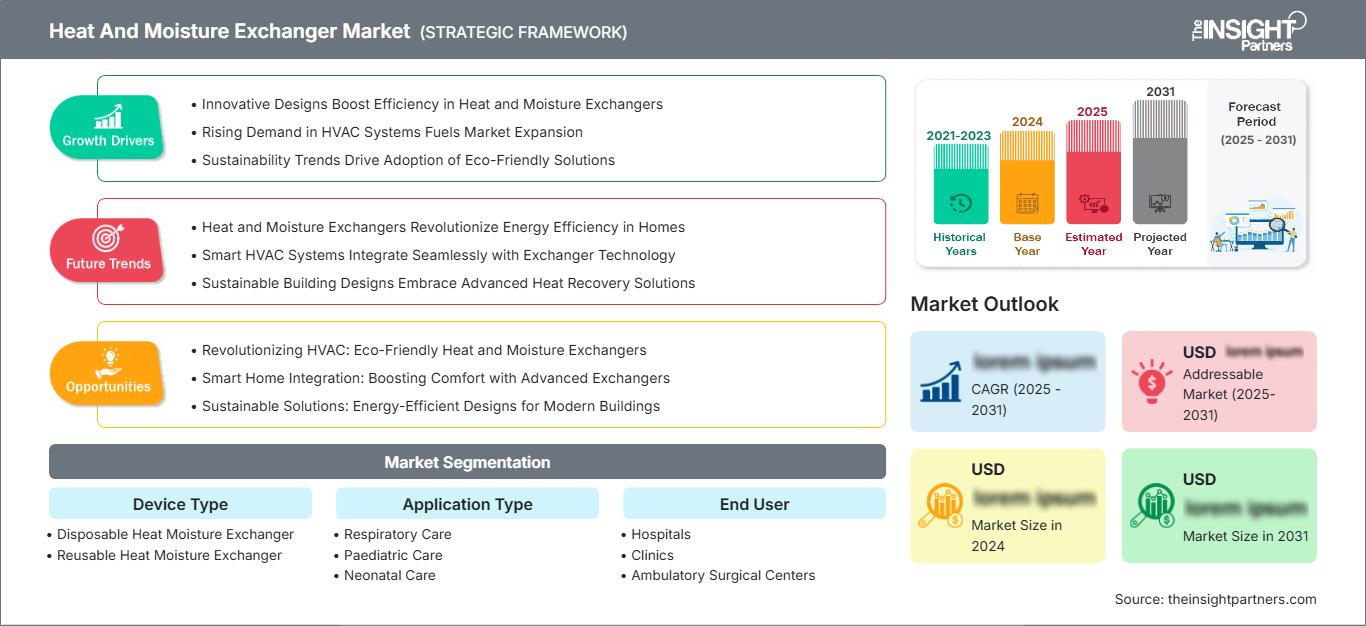
The Heat And Moisture Exchanger Market size is expected to reach US$ 363.53 Million by 2034 from US$ 281.95 Million in 2025. The market is estimated to record a CAGR of 3.23% from 2026 to 2034.
The increasing prevalence of chronic respiratory diseases, critical care admissions, and surgical procedures requiring mechanical ventilation is significantly driving the adoption of heat and moisture exchangers. These devices help maintain optimal airway conditions by conserving heat and humidity during respiratory support, improving patient comfort and reducing the risk of airway complications. Growing awareness of infection prevention and advancements in respiratory care equipment continue to support market growth throughout the forecast period.
Get Sample PDF – https://www.theinsightpartners.com/sample/TIPRE00021576
Key Market Drivers
The growing incidence of respiratory disorders such as chronic obstructive pulmonary disease (COPD), asthma, pneumonia, and acute respiratory distress syndrome is one of the primary factors driving the heat and moisture exchanger market. Increasing numbers of patients requiring intensive care, anesthesia, and long-term mechanical ventilation are contributing to sustained demand for airway humidification solutions.
Another significant driver is the expansion of healthcare infrastructure and critical care services worldwide. Hospitals are increasingly adopting advanced respiratory management devices to improve patient outcomes and optimize ventilation protocols. The growing elderly population, which is more susceptible to respiratory complications, is also supporting market expansion.
Additionally, greater emphasis on patient safety and infection control is encouraging healthcare providers to use high-quality disposable HMEs that reduce the risk of cross-contamination.
Technological Advancements Improving Respiratory Care
Continuous innovation is enhancing the design and performance of heat and moisture exchangers. Manufacturers are developing compact, lightweight HMEs with improved moisture retention, low airflow resistance, and efficient filtration capabilities. These innovations help optimize respiratory support while minimizing breathing effort for ventilated patients.
Many advanced HMEs now incorporate bacterial and viral filtration features, providing additional protection against healthcare-associated infections. Improved biocompatible materials and ergonomic designs have enhanced device durability, patient comfort, and ease of clinical use.
Manufacturers are also focusing on integrating HMEs with modern ventilator systems and anesthesia workstations to improve workflow efficiency and ensure consistent respiratory care across healthcare environments.
Applications Across Healthcare Settings
Heat and moisture exchangers are widely used in hospitals, intensive care units, operating rooms, emergency departments, ambulatory surgical centers, and long-term care facilities. They are essential components of mechanical ventilation systems, anesthesia circuits, and respiratory support devices used during surgical procedures and critical care treatment.
The growing adoption of non-invasive ventilation, home respiratory care, and portable ventilator systems is creating additional opportunities for HME manufacturers. Healthcare providers continue to emphasize respiratory humidification solutions that improve patient safety while simplifying ventilation management.
Increasing demand for disposable respiratory consumables is also contributing to broader utilization across healthcare facilities.
Regional Market Insights
North America continues to account for a significant share of the heat and moisture exchanger market due to its advanced healthcare infrastructure, high adoption of mechanical ventilation systems, and strong focus on infection prevention. Increasing investments in respiratory care technologies and expanding critical care services continue to support regional market growth.
Europe remains an important market supported by established healthcare systems, increasing respiratory disease management programs, and widespread use of advanced anesthesia equipment. Meanwhile, Asia Pacific is expected to experience notable growth due to expanding healthcare infrastructure, rising healthcare expenditure, growing awareness of respiratory care, and increasing access to critical care services. Latin America and the Middle East & Africa are also witnessing gradual market expansion as investments in healthcare modernization continue to increase.
Competitive Landscape
The heat and moisture exchanger market is characterized by continuous product innovation and strong competition among global medical device manufacturers. Companies are focusing on improving filtration efficiency, humidification performance, patient comfort, and compatibility with advanced respiratory systems.
Strategic collaborations, product launches, manufacturing expansion, and investment in research and development remain important competitive strategies. Manufacturers continue introducing next-generation respiratory consumables that meet evolving clinical requirements while supporting infection control initiatives.
Top Players
- Biopsybell
- King Systems
- Vadi Medical
- Toshiba Air Conditioning
- Galemed
- Draeger
- Pharma Systems AB
- Smiths Medical
- Sarnova
- Intersurgical
- Medtronic
- Teleflex
Emerging Industry Trends
Several emerging trends are influencing the future of the heat and moisture exchanger market. The increasing use of disposable respiratory devices is encouraging manufacturers to develop cost-effective HMEs with enhanced filtration performance. Integration of bacterial and viral filters into humidification devices is becoming increasingly common as healthcare providers strengthen infection prevention practices.
Get Full Copy of This Report @ https://www.theinsightpartners.com/buy/TIPRE00021576
Manufacturers are also investing in lightweight materials, environmentally responsible production methods, and improved product compatibility with portable ventilation systems. As home healthcare and outpatient respiratory management continue to expand, demand for compact and user-friendly HMEs is expected to increase.
Future Outlook
The future outlook for the heat and moisture exchanger market remains positive as healthcare providers continue prioritizing advanced respiratory care and effective airway management. Rising prevalence of respiratory diseases, increasing use of mechanical ventilation, and expanding critical care infrastructure are expected to support sustained market growth through 2034. Ongoing innovation in humidification technologies, filtration efficiency, and disposable respiratory products will create new opportunities for manufacturers. As hospitals and healthcare systems continue emphasizing patient safety, infection prevention, and high-quality respiratory support, the heat and moisture exchanger market is expected to experience steady long-term growth.
Related Reports @
Breathing Circuits Market Statistics, Trends, Size, Share, Analysis, Key Players by 2031
Respiratory Care Devices Market Trends and Analysis by 2031
About Us –
The Insight Partners provides comprehensive syndicated and tailored market research services in the healthcare, technology, and industrial domains. Renowned for delivering strategic intelligence and practical insights, the firm empowers businesses to remain competitive in ever-evolving global markets.
Contact Us:
Contact Person: Ankit Mathur
E-mail: ankit.mathur@theinsightpartners.com
Phone: +1-646-491-9876
Also Available in : Korean German Japanese French Chinese Italian Spanish
