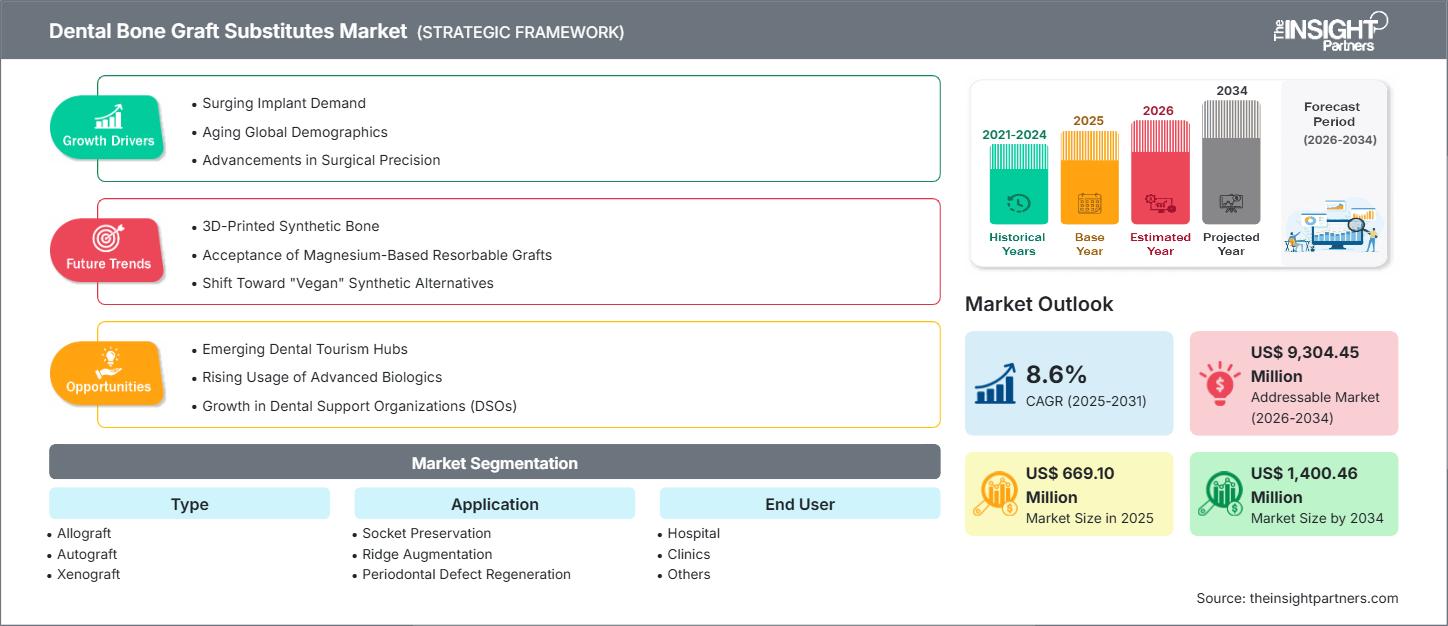
The dental bone graft substitutes market size is projected to reach US$ 1,400.5 million by 2034 from US$ 669.1 million in 2025. The market is expected to register a CAGR of 8.6% during 2026–2034.
The market is expanding as dental professionals increasingly adopt advanced bone graft materials to improve treatment outcomes and implant success rates. Growing investments in cosmetic dentistry, expanding dental care infrastructure, and increasing patient preference for minimally invasive restorative procedures are creating favorable opportunities for market participants. Continuous innovation in synthetic and biologically derived graft materials is further enhancing clinical performance and procedural efficiency.
Get Sample PDF – https://www.theinsightpartners.com/sample/TIPRE00022571
Key Market Drivers
One of the primary factors driving the dental bone graft substitutes market is the increasing demand for dental implants. Successful implant placement often requires adequate bone volume, making bone graft substitutes an important part of implant-supported restorations.
The rising prevalence of periodontal disease, tooth loss, and age-related bone deterioration is also contributing significantly to market growth. As the global population ages, the need for regenerative dental procedures continues to increase.
Growing awareness of aesthetic dentistry is encouraging patients to seek long-lasting restorative treatments that improve both oral function and appearance. Bone graft substitutes help create stable foundations for implants while enhancing overall treatment outcomes.
Increasing access to specialized dental care, expanding healthcare expenditure, and improvements in dental reimbursement policies in several regions are further supporting market expansion.
Technological Advancements Supporting Market Growth
Continuous innovation in biomaterials is transforming the dental bone graft substitutes market. Manufacturers are developing advanced synthetic, xenograft, allograft, and bioactive graft materials that offer improved osteoconductive properties and faster bone regeneration.
Modern graft substitutes are designed to enhance biological compatibility while reducing the risk of disease transmission and minimizing surgical complications. Improved material formulations provide better handling characteristics, structural stability, and predictable clinical outcomes.
Advancements in tissue engineering and regenerative medicine are also supporting the development of next-generation bone graft substitutes capable of accelerating bone healing and improving implant integration.
Digital dentistry technologies, including three-dimensional imaging and computer-guided implant planning, further improve treatment precision by enabling accurate assessment of bone defects and optimized graft placement.
Applications Across Dental Procedures
Dental bone graft substitutes are widely used in implant dentistry, ridge augmentation, sinus lift procedures, periodontal regeneration, socket preservation following tooth extraction, and maxillofacial reconstruction. Implant dentistry remains the largest application segment due to increasing global demand for permanent tooth replacement solutions.
Periodontal specialists frequently utilize graft substitutes to regenerate bone lost as a result of advanced gum disease, helping preserve natural teeth and improve long-term oral health.
Oral and maxillofacial surgeons also rely on bone graft substitutes during reconstructive procedures involving trauma, congenital abnormalities, and complex bone defects. Their versatility across multiple dental specialties continues to expand market demand.
Growing patient awareness regarding advanced dental treatments and improved access to specialized dental care are expected to support broader clinical adoption throughout the forecast period.
Competitive Landscape
The dental bone graft substitutes market remains highly competitive as manufacturers focus on biomaterial innovation, clinical research, and expanding global distribution networks. Companies continue investing in research and development to introduce graft materials that improve regenerative performance, simplify clinical procedures, and enhance long-term treatment success.
Strategic collaborations with dental clinics, academic institutions, and implant manufacturers are supporting product commercialization while accelerating technology adoption. Continuous product development and regulatory approvals remain important competitive strategies within the evolving regenerative dentistry market.
Top Players in the Dental Bone Graft Substitutes Market
- Dentsply Sirona Inc
- Geistlich Pharma AG
- ZimVie Inc
- Straumann Holding AG
- Medtronic Plc
- Johnson & Johnson
- BioHorizons Inc
- LifeNet Health Inc
- Henry Schein Inc
- Envista Holdings Corporation
Regional Market Insights
North America continues to hold a significant share of the dental bone graft substitutes market due to its advanced dental care infrastructure, high adoption of dental implants, and increasing awareness of regenerative dentistry. Strong presence of leading dental technology companies and growing investments in cosmetic dental procedures continue to support regional growth.
Europe also represents an important market driven by increasing demand for implant dentistry, expanding aging populations, and continuous advancements in dental biomaterials. High standards of dental care and increasing adoption of regenerative treatment techniques contribute to sustained market expansion.
Get Full Copy of This Report @ https://www.theinsightpartners.com/buy/TIPRE00022571
The Asia-Pacific region is expected to witness substantial growth owing to improving access to dental care, rising disposable incomes, increasing awareness of oral health, and expanding dental tourism. Growing investments in modern dental clinics and advanced treatment technologies are expected to create significant opportunities for market participants.
Future Outlook
The future of the dental bone graft substitutes market remains highly promising as regenerative dentistry continues to evolve through biomaterial innovation and advanced clinical techniques. Continued research in tissue engineering, bioactive materials, and synthetic graft technologies is expected to improve bone regeneration while supporting higher dental implant success rates.
Increasing demand for aesthetic and restorative dentistry, expanding global access to dental implant procedures, and growing awareness of oral health will continue driving market growth through 2034. As dental professionals increasingly adopt advanced regenerative solutions that improve patient outcomes and treatment efficiency, the dental bone graft substitutes market is expected to experience sustained expansion supported by technological innovation and increasing investments in modern dental care.
Related Reports @
Dental Turbines Market Trends, Share & Demand by 2034
Dental Implants Market Size, Share & Forecast by 2034
About Us –
The Insight Partners provides comprehensive syndicated and tailored market research services in the healthcare, technology, and industrial domains. Renowned for delivering strategic intelligence and practical insights, the firm empowers businesses to remain competitive in ever-evolving global markets.
Contact Us:
Contact Person: Ankit Mathur
E-mail: ankit.mathur@theinsightpartners.com
Phone: +1-646-491-9876
Also Available in : Korean German Japanese French Chinese Italian Spanish
