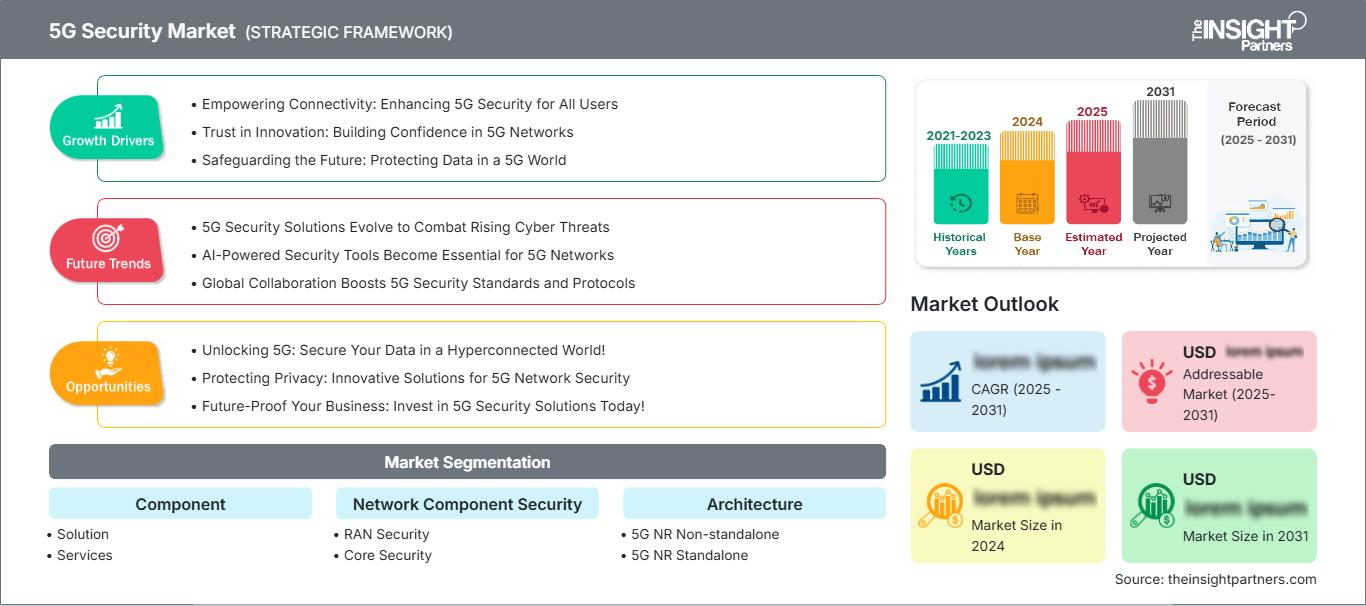
The global 5G security market is experiencing explosive growth, driven by the rapid commercialization of 5G infrastructure, the expansion of private cellular networks, and the proliferation of connected Internet of Things (IoT) endpoints. As telecommunication operators and enterprises migrate toward cloud-native, software-defined 5G architectures, traditional perimeter-based security measures are no longer sufficient.
The 5G security market was valued at US$ 5.34 Billion in 2025 and is projected to reach US$ 108.12 Billion by 2034, expanding at a CAGR of 39.68% during 2026–2034
Key Market Drivers
- Escalating Cyber Threat Environment: The high-bandwidth, ultra-low latency nature of 5G networks enables massively connected environments. Cybercriminals increasingly target core network functions, API endpoints, and edge nodes, forcing enterprises to invest heavily in next-generation firewalls (NGFW) and threat prevention systems.
- Rapid Adoption of Private 5G Networks: Enterprises across industrial automation, mining, and logistics are deploying dedicated private 5G infrastructure. To protect proprietary operational technology (OT) data, these organizations require carrier-grade, micro-segmented security protocols.
- Proliferation of Industrial IoT and Connected Devices: Billions of IoT devices lack native security controls. 5G security platforms offer real-time behavioral monitoring and automated threat mitigation to protect these vulnerable entry points.
- Strict Regulatory and Data Sovereignty Compliance: National governments and regulatory bodies are instituting stringent cybersecurity mandates for telecommunication providers and critical national infrastructure, driving demand for compliant signaling and user plane security solutions.
Download Sample Report@ https://www.theinsightpartners.com/sample/TIPRE00019483
Market Opportunities
The integration of Artificial Intelligence (AI) and Machine Learning (ML) into security orchestration represents the single largest growth opportunity in the market. AI-driven security platforms can analyze petabytes of real-time network traffic, identify anomalous behavior, and trigger automated countermeasures without human intervention.
Additionally, Network Slicing Security opens dynamic revenue channels for vendors. Security providers can offer specialized Security-as-a-Service (SECaaS) models tailored to specific slice parameters, such as ultra-secure slices for military communications, financial transactions, or remote surgical operations.
Market Segmentation
The global 5G security market is structured across several key operational and application segments:
By Offering
- Solutions: Includes Next-Generation Firewalls (NGFW), Intrusion Prevention Systems (IPS), DDoS Mitigation, Signaling Security (SEPP, Diameter, GTP), Network Access Control (NAC), and Identity and Access Management (IAM). Solutions hold the dominant share of market revenue.
- Services: Encompasses Professional Services (Integration, Consulting, Deployment) and Managed Security Services (MSS). Services represent the fastest-growing component as organizations face a shortage of specialized cybersecurity talent.
By Security Layer
- RAN (Radio Access Network) Security
- Transport Security
- Core Network Security (Leading revenue generator)
- Edge / Multi-Access Edge Computing (MEC) Security (Fastest-growing layer)
- Application Security
By Deployment Mode
- On-Premises: Preferred by telecom carriers and highly regulated government sectors prioritizing data sovereignty.
- Cloud-Native & Hybrid: Gaining rapid momentum due to operational agility, scalability, and seamless integration with virtualized network functions (VNFs).
By End-User Vertical
- Telecommunication Operators
- Manufacturing and Industry 4.0 (Largest enterprise segment)
- Healthcare and Telemedicine
- Automotive and Connected Vehicles
- Banking, Financial Services, and Insurance (BFSI)
- Government and Public Safety
Market News and Recent Developments
Leading security vendors and telecom giants continue to forge strategic partnerships, release innovative platforms, and acquire niche solution providers to strengthen their market positioning:
- Cisco and Homeland Security Collaborations: Cisco announced advanced collaborations leveraging 5G and artificial intelligence technologies to reinforce critical infrastructure defense and public safety communications against complex cyber threats.
- Nokia’s GenAI Cybersecurity Enhancements: Nokia integrated its generative AI assistant with the NetGuard Cybersecurity Dome, enabling automated security orchestration, rapid incident response, and predictive threat analytics across global 5G networks.
- Palo Alto Networks Edge Security Innovations: Palo Alto Networks expanded its zero-trust network security suite tailored specifically for multi-access edge computing (MEC) environments, facilitating secure low-latency data processing at the network edge.
Competitive Landscape and Market Analysis
The competitive landscape of the 5G security market is highly consolidated at the top, yet characterized by rapid innovation from specialized cybersecurity firms. Established telecom infrastructure vendors and dedicated cybersecurity providers are expanding their portfolios through software-defined orchestration and cloud-native solutions.
Strategic differentiation relies on delivering zero-trust architecture, automated threat intelligence sharing, and low-latency decryption capabilities that do not compromise 5G throughput speeds.
Top Market Players
- Cisco Systems, Inc. (United States)
- Palo Alto Networks, Inc. (United States)
- Ericsson (Sweden)
- Nokia Corporation (Finland)
- Huawei Technologies Co., Ltd. (China)
- Fortinet, Inc. (United States)
- Check Point Software Technologies Ltd. (Israel)
- Juniper Networks, Inc. (United States)
- A10 Networks, Inc. (United States)
- ZTE Corporation (China)
Get Full Copy of This Report @ https://www.theinsightpartners.com/buy/TIPRE00019483
Future Outlook
Looking ahead to 2034, the 5G security landscape will evolve from reactive perimeter defense toward fully autonomous, self-healing network ecosystems. The transition toward 6G research and widespread Open RAN deployments will further accelerate the demand for standardized zero-trust security architecture. Organizations that proactively embed AI-powered security into their core network operations will be best positioned to protect critical data, maintain service reliability, and capitalize on the digital transformation unlocked by next-generation wireless connectivity.
About The Insight Partners
The Insight Partners provides comprehensive syndicated and tailored market research services in the healthcare, technology, and industrial domains. Renowned for delivering strategic intelligence and practical insights, the firm empowers businesses to remain competitive in ever-evolving global markets.
Contact Information
- Email: sales@theinsightpartners.com
- Website: theinsightpartners.com
- Phone: +1-646-491-9876
Also Available in : Korean|German|Japanese|French|Chinese|Italian|Spanish
