Military vehicle tires serve as a critical operational component for defense forces worldwide. Unlike standard commercial automotive tires, military-grade tires are engineered to withstand extreme environmental conditions, heavy armor loads, ballistic threats, and severe off-road terrains. As global defense forces accelerate fleet modernization and transition toward next-generation armored fighting vehicles (AFVs), tactical wheeled vehicles (TWVs), and light utility vehicles, the demand for high-durability, specialized tire technology is experiencing steady, sustainable growth.
Get a PDF Sample- https://www.theinsightpartners.com/sample/TIPRE00024482
The expansion of this market is further propelled by heightened geopolitical tensions, increased national defense budgets across major economies, and ongoing investments in ground force logistics infrastructure. Defense departments worldwide are systematically replacing legacy combat vehicles with advanced wheeled mobility platforms capable of traversing mud, sand, snow, and urban rubble while maintaining operational safety during critical missions.
Key Growth Drivers Fueling Market Demand
Rising Global Defense Budgets and Fleet Modernization: Governments around the world are significantly allocating resources toward ground fleet updates. Transitioning from legacy tracked platforms to agile wheeled combat platforms demands advanced tire engineering that supports higher payload capacities, rapid troop movement, and heavy ballistic armor plating.
Advancements in Run-Flat and Tire Pressure Systems: Tactical mobility requires operational continuity even under enemy attack or severe tire punctures. Modern run-flat tire systems allow military vehicles to travel long distances at operational speeds despite complete inflation loss. Additionally, Central Tire Inflation Systems (CTIS) permit real-time pressure adjustments from inside the cabin, maximizing traction across soft sand, mud, and uneven terrain.
Emergence of Hybrid and Electric Tactical Platforms: As defense forces explore electric and hybrid-electric powertrains for silent reconnaissance missions and reduced heat signatures, tire manufacturers are developing specialized rubber compounds. Electric combat vehicles feature heavy battery packs and high instant torque, requiring tires with lower rolling resistance and greater structural load capacity.
Market Forecast-
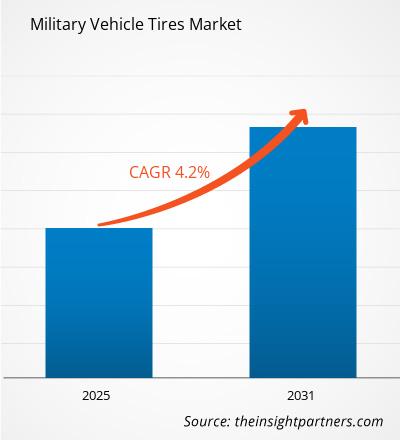
The Military Vehicle Tires Market size is expected to reach US$ 2.33 Billion by 2034 from US$ 1.45 Billion in 2025. The market is estimated to record a CAGR of 6.11% from 2026 to 2034.
Key Players in the Military Vehicle Tires Market
Major defense suppliers and global tire manufacturers are continuously investing in research and operational testing to engineer heavy-duty military tires. The leading key players in the market include:
Bridgestone Corporation: A global tire manufacturer offering heavy-duty off-road and tactical tires built for high endurance and extreme load conditions.
Michelin: Renowned for pioneering innovative run-flat technology and high-performance radial tires tailored for armored and logistics defense platforms.
Coker Tire: Recognized for supplying specialty rubber, vintage defense tire patterns, and custom wheel formulations for military support fleets.
Nokian Tyres plc: A specialist in extreme-climate tire solutions, delivering superior grip and endurance for arctic and winter military operations.
Madras Rubber Factory (MRF): A leading manufacturer providing heavy-duty tactical tires engineered for rugged terrains and diverse defense utility vehicles.
The Goodyear Tire and Rubber Company: A global defense supplier delivering advanced run-flat systems, terrain-matching tread designs, and resilient tire compounds for tactical ground forces.
Market Segmentation & Geographical Dynamics
The military vehicle tires market is categorized by vehicle type, tire architecture, and geographical presence:
Pneumatic vs. Run-Flat vs. Non-Pneumatic (Airless): While traditional pneumatic tires remain widely deployed across light utility and logistics transports, run-flat variants dominate primary combat vehicles, Armored Personnel Carriers (APCs), and Mine-Resistant Ambush-Protected (MRAP) vehicles where battlefield survivability is essential. Non-pneumatic or airless tire technologies are rapidly advancing for autonomous ground vehicles (UGVs) and light tactical assault vehicles.
Regional Insights: North America currently holds a significant share of the market, driven by large-scale procurement programs from the U.S. Department of Defense. However, the Asia-Pacific and European regions are recording rapid growth due to heightened border security measures, NATO fleet modernization mandates, and expanded local defense manufacturing initiatives.
Get Full Copy of This Report- https://www.theinsightpartners.com/buy/TIPRE00024482
Future Outlook
The future of the military vehicle tires market is set for transformative growth as ground mobility merges with vehicle telemetry, material science, and fleet automation. Over the coming decade, smart tire technologies featuring embedded micro-sensors will provide real-time operational feedback—including tread depth wear, internal heat buildup, and pressure changes—directly to automated logistics command systems, enabling predictive maintenance during tactical deployments. Additionally, tire manufacturers will increasingly incorporate eco-friendly synthetic polymers and bio-based rubber formulations to support defense sustainability initiatives without compromising structural durability or ballistic resilience. Supported by steady compound annual growth rates and shifting defense paradigms, the military vehicle tires market will remain a cornerstone of global ground force readiness through 2034 and beyond.
