Field programmable gate arrays provide flexible, reconfigurable computing capabilities that allow electronic systems to be adapted for different processing requirements without redesigning the underlying hardware. Their programmability, parallel processing capabilities, customization, and ability to support evolving workloads make them valuable across communications, automotive, aerospace, healthcare, consumer electronics, and other technology-intensive applications.
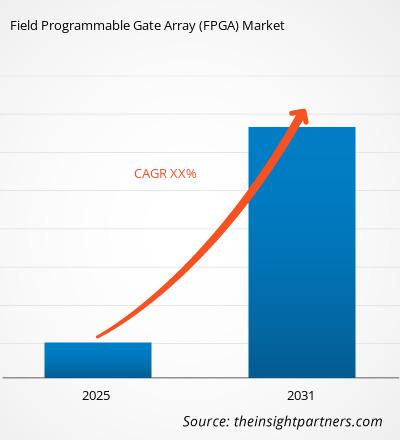
According to The Insight Partners, the Field Programmable Gate Array (FPGA) Market was valued at US$ 7.76 Billion in 2025 and is projected to reach US$ 14.80 Billion by 2034, registering a CAGR of 7.44% during 2026–2034. Growing demand for customizable computing, AI-enabled applications, connected technologies, advanced telecommunications, automotive electronics, and high-performance processing is expected to support continued industry expansion.
Key Market Insights
- Market Size in 2025: US$ 7.76 Billion
- Projected Market Size by 2034: US$ 14.80 Billion
- CAGR (2026–2034): 7.44%
- Total Addressable Market (2026–2034): Approximately US$ 101.71 Billion
- Key Technology Segments: Static RAM, Anti-Fuse Technology, Flash Technology and EPROM
- Key Application Areas: IT and Telecommunications, Automotive, Military & Aerospace, Healthcare, and Consumer Electronics
- Forecast Period: 2026–2034
Get a Sample PDF of the Report: https://www.theinsightpartners.com/sample/TIPTE100001032
Market Growth Drivers
The growing demand for flexible and customizable computing is a major factor supporting FPGA adoption. Unlike fixed-function processors, FPGAs can be reconfigured for specific workloads, allowing organizations to adapt hardware architectures according to changing application requirements. This flexibility is particularly valuable in technology environments where performance, customization, and rapid development are important.
The expansion of advanced telecommunications is also creating opportunities for FPGA solutions. Increasing data traffic, connected devices, and high-speed communication infrastructure require processing technologies capable of handling demanding workloads efficiently. FPGAs can support signal processing, networking, acceleration, and other computational tasks across communication systems.
Automotive electronics represents another important growth area. Modern vehicles increasingly incorporate advanced driver assistance systems, intelligent sensing, connectivity, and automated functions. FPGAs can provide the processing flexibility and real-time capabilities required for complex automotive electronic architectures.
Technology Trends
AI and machine learning are creating new opportunities for FPGA-based acceleration. FPGAs can be configured to support specific AI workloads and provide parallel processing capabilities for applications requiring high throughput and low latency. Their adaptability makes them attractive for organizations seeking to optimize AI inference and edge computing applications.
Edge computing is another significant technology trend. As more data is processed closer to where it is generated, organizations require compact and efficient computing architectures capable of handling real-time workloads. FPGAs can support edge applications across industrial automation, telecommunications, automotive systems, and intelligent devices.
Energy efficiency and hardware customization are also influencing product development. FPGA architectures can be optimized for specific workloads, helping organizations balance processing performance, power consumption, and system requirements.
Get the Premium Research Report @ https://www.theinsightpartners.com/buy/TIPTE100001032
Regional Outlook
North America remains an important region due to strong investments in semiconductor technologies, telecommunications, aerospace and defense, healthcare electronics, and advanced computing. The United States continues to contribute significantly through technology development, high-performance computing, AI adoption, and demand for customizable processing solutions.
Europe is supported by automotive innovation, industrial automation, aerospace applications, healthcare technologies, and advanced electronics development. Increasing investments in intelligent vehicles and connected industrial systems are expected to create additional opportunities for FPGA technologies.
Asia Pacific represents a significant growth opportunity due to expanding electronics manufacturing, telecommunications infrastructure, automotive production, and consumer electronics. China, Japan, India, South Korea, and other economies are increasing investments in semiconductor technologies and digital infrastructure, supporting demand for programmable computing solutions.
South and Central America, along with the Middle East and Africa, are also expected to witness increasing adoption as telecommunications networks, industrial automation, healthcare infrastructure, and digital technologies expand.
Market Segmentation
By technology, the Field Programmable Gate Array (FPGA) Market is segmented into Static RAM, Anti-Fuse Technology, Flash Technology, and EPROM. These technologies provide different approaches to FPGA configuration and reprogrammability, supporting a broad range of application requirements.
By application, the market covers IT and Telecommunications, Automotive, Military & Aerospace, Healthcare, and Consumer Electronics. Telecommunications and IT applications benefit from flexible processing and acceleration, while automotive, aerospace, healthcare, and consumer electronics applications increasingly require customizable and high-performance electronic architectures.
Competitive Landscape
Competition is driven by FPGA architecture innovation, processing performance, power efficiency, customization capabilities, software ecosystems, and application-specific solutions. Leading companies are focusing on advanced programmable devices for telecommunications, AI, automotive systems, aerospace, healthcare, and consumer electronics.
Key companies analyzed in the report include:
- Intel Corporation
- Microsemi Corporation
- Xilinx
- Lattice Semiconductor
- Altera Corporation
- Atmel Corporation
- Texas Instruments
- Quick Logic Corporation
- Cypress Semiconductor Corporation
- Teledyne e2v
Future Outlook
The Field Programmable Gate Array (FPGA) Market is expected to maintain steady growth through 2034 as industries increasingly require adaptable, high-performance, and application-specific computing solutions. The expansion of AI, edge computing, 5G and advanced telecommunications, automotive electronics, aerospace systems, and industrial automation is expected to broaden FPGA adoption.
Future opportunities are likely to emerge from AI acceleration, intelligent edge devices, connected vehicles, advanced networking, defense electronics, and next-generation healthcare systems. Companies that combine programmable hardware with efficient architectures, powerful development tools, AI acceleration capabilities, and application-specific optimization are expected to strengthen their competitive position.
Related Market Research Reports
Cartesian Robot Market Growth Report | Size & Forecast 2031
IPS Display Market Demand, Size & Forecast by 2034
Telepresence Equipment Market Growth, Trends & Demand by 2034
Digital Security Control Market Demand, Share & Growth by 2034
About The Partners
The Insight Partners is a Insight global leader in market research, delivering comprehensive analysis and actionable insights across diverse industries. The company empowers decision-makers with data-driven intelligence to navigate evolving markets and accelerate growth.
Contact Us:
- Contact Person: Ankit Mathur
- E-mail: ankit.mathur@theinsightpartners.com
- Phone: +1-646-491-9876
Also Available in :
