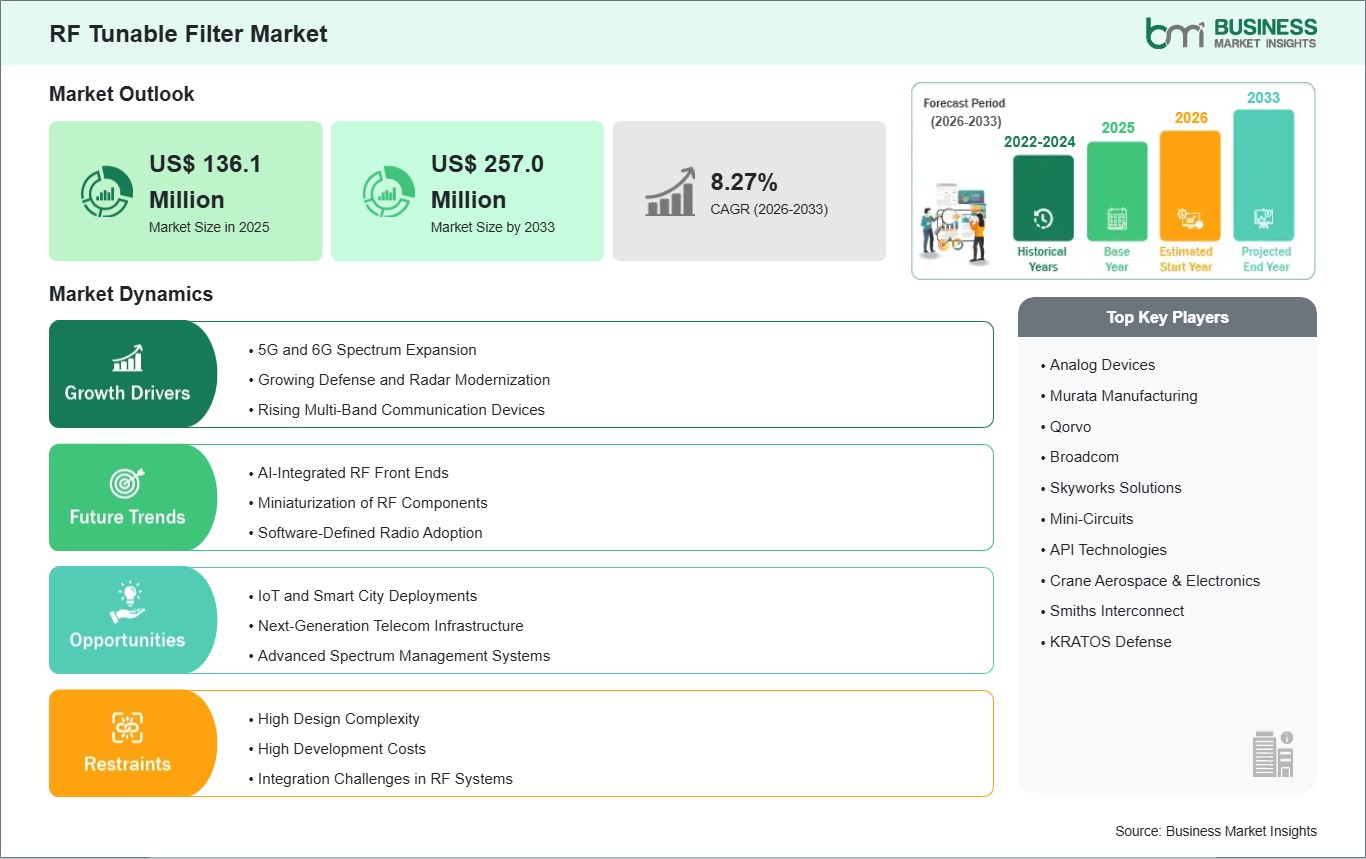
The global RF Tunable Filter Industry is experiencing robust growth, driven by the escalating demand for advanced wireless communication systems, the rapid rollout of 5G networks, and the increasing complexity of RF front-end architectures in modern electronic devices.
According to Business Market Insights, the global RF Tunable Filter Market size is expected to reach US$ 315.40 Million by 2033 from US$ 142.60 Million in 2025. The market is estimated to record a CAGR of 10.42% from 2026 to 2033.
Technological advancement is continuously shaping the industry landscape, with major semiconductor and component manufacturers focusing on RF MEMS (Micro-Electromechanical Systems), varactor diodes, and advanced piezoelectric materials. Innovations in software-defined radio (SDR) and cognitive radio are demanding superior frequency agility and interference mitigation. Strategic investments in research and development are accelerating the deployment of these next-generation filter systems across defense radars, mobile handsets, and IoT infrastructure globally.
Get More Details: https://www.businessmarketinsights.com/buy/BMIPUB00034278
What Are RF Tunable Filters?
RF (Radio Frequency) tunable filters are specialized electronic components used to selectively pass specific frequencies while blocking or attenuating unwanted signals. Unlike traditional fixed filters, which are limited to a single specific frequency band, tunable filters can be dynamically adjusted either electronically or mechanically to change their center frequency or bandwidth on the fly.
These highly specialized instruments are fundamental to demanding applications where spectrum flexibility is essential. They serve as the critical signal-processing backbone for multi-band smartphones, tactical military radios, test and measurement equipment, and satellite communications, allowing a single device to operate across multiple frequency standards seamlessly.
Market Drivers
A primary driver of the RF Tunable Filter Market is the massive global expansion of 5G networks and the early development phases of 6G. As cellular networks utilize an increasingly fragmented spectrum—including sub-6 GHz and mmWave bands—the need for tunable filters to manage interference, aggregate carriers, and reduce the physical footprint of RF front-end modules is skyrocketing.
The modernization of aerospace and defense communication systems acts as another major catalyst. Modern military operations rely heavily on software-defined radios (SDR) and cognitive radio networks that must autonomously adapt to jammed or crowded frequency environments. RF tunable filters provide the necessary agility to hop frequencies securely and maintain robust communication links.
Furthermore, the explosion of the Internet of Things (IoT) and connected vehicle architectures is accelerating market growth. The requirement for multi-protocol wireless connectivity (Wi-Fi, Bluetooth, Cellular, GPS) within a single compact device drives manufacturers to adopt tunable RF solutions that minimize component count and optimize battery life.
RD URL: https://www.businessmarketinsights.com/reports/rf-tunable-filter-market
Market Segmentation
By Type
- Bandpass Filters: The dominant and largest revenue-generating subsegment, essential for isolating a specific band of frequencies while rejecting all others, widely used in wireless receivers.
- Bandstop (Notch) Filters: Crucial for eliminating specific, narrow bands of interference, highly utilized in military and radar applications.
- Lowpass and Highpass Filters: Continuously adjusted to block high-frequency noise or low-frequency hums, adapting to changing signal conditions in test and measurement equipment.
By Tuning Mechanism
- Varactor Diode: The most common and cost-effective electronic tuning method, widely adopted in mobile devices and commercial communication electronics for rapid tuning speeds.
- RF MEMS: A fast-growing segment offering extremely low insertion loss, high linearity, and compact sizes, heavily targeted for advanced 5G smartphones and IoT devices.
- YIG (Yttrium Iron Garnet): The premium standard for ultra-wide tuning ranges and high performance, favored in aerospace, defense, and high-end laboratory testing equipment.
- Others: Includes switched capacitor arrays, ferroelectric tunable filters, and digitally tunable capacitors (DTCs).
By End User
- Telecommunications: The largest end-use segment, driven by 5G base stations, mobile handsets, and wireless network infrastructure requiring multi-band support.
- Aerospace & Defense: Driven by military radar systems, secure satellite communications, and software-defined radio systems requiring extreme reliability and agility.
- Consumer Electronics: High-volume adoption in smart devices and wearables aiming to reduce internal board space.
- Test & Measurement: Essential for spectrum analyzers and signal generators that must evaluate a broad range of frequencies.
Regional Insights
- North America maintains a preeminent position within the global industry, fueled by heavy defense spending, advanced aerospace infrastructure, and the early, large-scale rollout of 5G networks in the United States.
- Asia-Pacific represents the fastest-growing region and a dominant manufacturing hub. This is propelled by massive consumer electronics production, extensive telecommunications infrastructure upgrades in China, South Korea, and India, and rising investments in domestic semiconductor ecosystems.
- Europe holds a robust market share, driven by a strong presence of automotive radar and connected vehicle manufacturers, alongside rigorous telecommunications standards and active defense consortiums.
- Middle East & Africa is experiencing reliable growth, propelled by modernization of military communication networks and increasing smart city initiatives that rely on diverse IoT connectivity.
- South & Central America is witnessing steady market expansion as regional telecom operators expand 4G LTE and initiate 5G spectrum auctions, driving infrastructure upgrades.
Top Players in the RF Tunable Filter Market
The competitive landscape features legacy defense contractors and advanced semiconductor manufacturers dedicated to pushing the boundaries of RF miniaturization and tuning speed.
- Analog Devices, Inc.
- Qorvo, Inc.
- Broadcom Inc.
- Murata Manufacturing Co., Ltd.
- NXP Semiconductors N.V.
- Smiths Interconnect
- Skyworks Solutions, Inc.
- Dover Corporation (Pole/Zero)
- DiCon Fiberoptics, Inc.
- RS Microwave Company, Inc.
Technological Innovations
The commercialization and mass-production scaling of RF MEMS (Micro-Electromechanical Systems) technology represent a critical technological leap in the tunable filter market. By using microscopic mechanical switches rather than solid-state semiconductor junctions, MEMS tunable filters achieve near-zero power consumption when static, incredibly high linearity, and significantly lower insertion loss. This is revolutionary for battery-powered 5G mobile devices, where thermal management and battery drain are major constraints.
Additionally, the integration of Artificial Intelligence (AI) and machine learning into cognitive radio networks is driving the development of autonomous, closed-loop tuning systems. These next-generation smart filters can instantly sense their RF environment, identify jamming signals or spectral congestion, and automatically retune their frequency characteristics in real-time without human intervention, ensuring uninterrupted communication in highly volatile defense and emergency scenarios.
Future Market Outlook
The future outlook for the RF Tunable Filter Market is highly promising through 2033. As global wireless standards progress toward 6G, utilizing Terahertz (THz) frequencies and even more densely packed spectrums, the demand for adaptable, low-loss RF filtering will become absolute. Devices will no longer be able to physically house enough fixed filters to cover all global bands.
Market leadership over the coming decade will belong to component developers capable of providing fully integrated, highly miniaturized system-in-package (SiP) solutions—combining tunable filters, power amplifiers, and low-noise amplifiers into a single, intelligent RF front-end module.
Industry Snippet URL: https://www.businessmarketinsights.com/industry-overview
Frequently Asked Questions (FAQs)
What is the projected size of the RF Tunable Filter Market by 2033?
The global market is projected to reach US$ 315.40 Million by 2033, expanding from US$ 142.60 Million in 2025.
What is the CAGR for the RF Tunable Filter Market?
The market is estimated to record a steady CAGR of 10.42% during the forecast period from 2026 to 2033.
Which technology segment is critical for compact smartphone applications?
The RF MEMS and Varactor Diode segments are standard for mobile applications, favored for their rapid tuning capabilities, miniaturized form factors, and low power consumption.
Which region is leading market growth?
North America maintains a dominant position due to substantial aerospace and defense spending, while the Asia-Pacific region is experiencing the fastest growth driven by consumer electronics and 5G infrastructure.
What is the primary factor driving demand for RF tunable filters?
Key drivers include the global rollout of complex 5G networks requiring multi-band support, the modernization of software-defined radios in the defense sector, and the need to reduce component count in compact IoT devices.
Browse More Reports:
About Us
Business Market Insights is a market research platform that provides subscription service for industry and company reports. Our research team has extensive professional expertise in domains such as Electronics & Semiconductor; Aerospace & Defense; Automotive & Transportation; Energy & Power; Healthcare; Manufacturing & Construction; Food & Beverage; Chemicals & Materials; and others.
Contact Us
If you have any questions about this report or would like further information, please contact us:
Contact person: Ankit Mathur
Email: sales@businessmarketinsights.com
Phone: +16467917070
