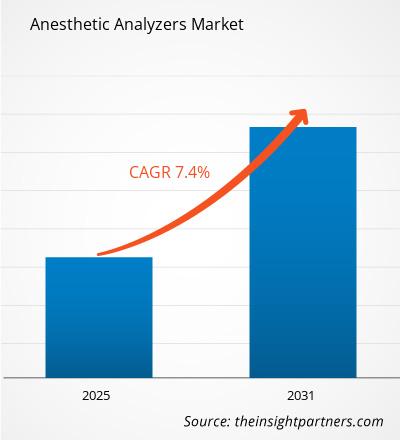
The Anesthetic Analyzers Market is gaining momentum as healthcare facilities increasingly prioritize accurate monitoring of anesthetic gases during surgical and critical-care procedures. Anesthetic analyzers are designed to measure concentrations of anesthetic agents and respiratory gases, helping anesthesia professionals assess and manage patients during procedures. Growing surgical volumes, increasing adoption of advanced anesthesia workstations, and the need for enhanced patient monitoring are contributing to continued demand for anesthetic analysis technologies.
The Anesthetic Analyzers Market is projected to increase from US$ 317.62 Million in 2025 to US$ 503.99 Million by 2034, registering a CAGR of 5.26% during 2026–2034. Recent developments across the industry are centered on improved sensor technologies, enhanced monitoring capabilities, integration with anesthesia workstations, automation, and the development of more compact and user-friendly analytical systems. These developments are helping healthcare providers improve monitoring efficiency and support safer anesthesia management.
Download Sample PDF: https://www.theinsightpartners.com/sample/TIPRE00008687
What Recent Developments Are Shaping the Anesthetic Analyzers Market?
Recent developments in anesthesia monitoring are increasingly focused on improving measurement accuracy, real-time monitoring, connectivity, and workflow efficiency. Manufacturers are working to develop analyzers capable of delivering reliable measurements of anesthetic agents and respiratory gases while integrating more effectively with anesthesia delivery systems.
The increasing sophistication of operating-room equipment is encouraging manufacturers to improve interoperability between anesthetic analyzers and other monitoring technologies. Connected systems can allow clinicians to access information more efficiently and support continuous assessment throughout surgical procedures.
Another notable development is the increasing use of advanced sensor technologies. Improvements in sensing components can contribute to more precise gas measurement and faster response times. Manufacturers are also focusing on simplifying equipment operation so that anesthesia professionals can obtain clinically relevant information without adding unnecessary complexity to operating-room workflows.
How Is Technology Transforming Anesthetic Analyzers Market News?
Technology is playing an increasingly important role in the evolution of anesthetic analyzers. Modern healthcare environments require monitoring systems capable of supporting continuous data acquisition and integration with broader patient-monitoring infrastructure.
Digital connectivity is emerging as a significant area of development. Anesthetic analyzers that can communicate with anesthesia workstations, patient monitors, and hospital information systems may help improve data accessibility and documentation. Such connectivity can contribute to more coordinated operating-room workflows.
Miniaturization is another important development. Compact analyzer designs can provide greater flexibility for use in different clinical environments, including operating rooms, intensive care units, and other areas requiring respiratory gas monitoring. Smaller systems can also support more efficient equipment deployment without compromising essential analytical capabilities.
Manufacturers are additionally exploring software improvements that can enhance visualization and simplify interpretation of gas concentration data. These developments are consistent with the broader healthcare shift toward connected, data-driven medical technologies.
Anesthetic Analyzers Market News and Product Innovation
Product innovation remains a major component of recent industry activity. Manufacturers are focusing on developing analyzers with improved sensitivity, reliability, durability, and ease of maintenance. The objective is to provide healthcare facilities with systems capable of delivering consistent performance under demanding clinical conditions.
The integration of analyzers into advanced anesthesia workstations is another important area of innovation. Combining gas analysis with anesthesia delivery and patient monitoring can help clinicians manage multiple parameters through integrated platforms. This can improve workflow efficiency while reducing the need for multiple standalone devices.
Manufacturers are also paying greater attention to user interfaces. Clear displays, intuitive controls, configurable alarms, and accessible data visualization can improve usability for anesthesia professionals. These features are becoming increasingly relevant as hospitals seek technologies that can be efficiently operated across different clinical teams.
Recent Industry Developments and Strategic Activities
The competitive landscape of the Anesthetic Analyzers Market is characterized by continuous technological development and strategic initiatives. Companies are strengthening their product portfolios through new technologies, product enhancements, collaborations, distribution agreements, and broader healthcare solutions.
Strategic partnerships can allow companies to combine analyzer technology with complementary anesthesia and respiratory monitoring solutions. Such collaborations may support product integration and expand access to healthcare providers.
Research and development activities are also focused on improving sensor performance and reducing maintenance requirements. Longer-lasting components and simplified calibration procedures can help reduce operational burdens for hospitals and other healthcare facilities.
The increasing importance of connected healthcare is encouraging companies to explore software-enabled monitoring solutions. Future product development is likely to emphasize interoperability, data management, remote connectivity, and integration with digital hospital infrastructure.
Anesthetic Analyzers Market Trends Driving Recent Developments
One of the most significant trends is the growing demand for real-time anesthetic gas monitoring. Continuous measurement can provide anesthesia professionals with timely information during procedures and support more responsive clinical management.
Another trend is the movement toward integrated anesthesia monitoring platforms. Rather than relying on multiple disconnected systems, healthcare facilities increasingly favor solutions that consolidate monitoring functions and provide information through centralized interfaces.
The growing adoption of minimally invasive and complex surgical procedures is also influencing technology development. As surgical environments become more technologically advanced, anesthesia monitoring equipment must provide reliable performance and integrate efficiently with other operating-room systems.
Automation is another important trend. Automated calibration, data recording, alarms, and system diagnostics can reduce manual workload and improve operational consistency.
Anesthetic Analyzers Market Growth Opportunities
The increasing number of surgical procedures worldwide presents significant opportunities for manufacturers. Hospitals, ambulatory surgical centers, and specialty healthcare facilities require reliable anesthesia monitoring equipment to support growing procedure volumes.
Emerging healthcare infrastructure represents another opportunity. Investments in new hospitals and modernization of existing facilities can increase demand for advanced anesthesia monitoring technologies. Manufacturers that provide scalable and cost-effective systems may be able to strengthen their presence in developing healthcare markets.
There is also an opportunity to develop portable and compact anesthetic analyzers for applications outside traditional operating rooms. Flexible monitoring systems could support intensive care, emergency medicine, transport medicine, and other clinical environments where respiratory gas analysis is required.
Software integration represents another promising area. Companies that combine accurate gas analysis with data connectivity, analytics, and interoperability may differentiate their offerings in an increasingly digital healthcare environment.
Anesthetic Analyzers Market Competitive Landscape
The competitive landscape includes medical device companies specializing in anesthesia, respiratory care, patient monitoring, and gas analysis technologies. Competition is driven by product performance, technological innovation, reliability, connectivity, service capabilities, and global distribution.
Key players include:
OSI Systems, Inc., imtmedical AG, Fritz Stephan GmbH, Criticare Technologies, Inc., HEYER Medical AG, GE HealthCare Technologies Inc., Drägerwerk AG & Co. KGaA, Koninklijke Philips N.V., Triton Electronic Systems Ltd., and Fluke Biomedical.
Companies are increasingly focusing on product development and strategic initiatives to strengthen their positions. Integration with broader anesthesia workstations and patient-monitoring ecosystems can provide competitive advantages, while technical support and after-sales services remain important considerations for healthcare institutions.
Purchase a Copy of this report: https://www.theinsightpartners.com/buy/TIPRE00008687
Future Outlook
The future development of the Anesthetic Analyzers Market is expected to be strongly influenced by continued advances in sensor technologies, digital connectivity, automation, and integrated patient monitoring.
Manufacturers are likely to prioritize systems that provide greater measurement accuracy, faster response, improved usability, and stronger interoperability with anesthesia workstations. Connectivity with hospital information systems and digital clinical platforms could become increasingly important as healthcare providers pursue more integrated operating-room environments.
Also Available in: Korean | German | Japanese | French | Chinese | Italian | Spanish
Related Reports:
Respiratory Inhalers Market Size and Competitive Analysis by 2028
Impulse Oscillometry Market Share, Growth & Forecast by 2034
About Us
The Insight Partners is a one-stop provider of actionable industry research and intelligence. We help our clients in getting solutions to their research requirements through our syndicated and consulting research services. We specialize in industries such as Semiconductor and Electronics, Aerospace and Defense, Automotive and Transportation, Healthcare IT, Manufacturing and Construction, Medical Devices, Technology, Media and Telecommunications, Food and Beverages, Consumer Goods, and Chemicals and Materials.
Contact Us
Contact Person: Ankit Mathur
Phone: +1-646-491-9876
E-mail : sales@theinsightpartners.com
