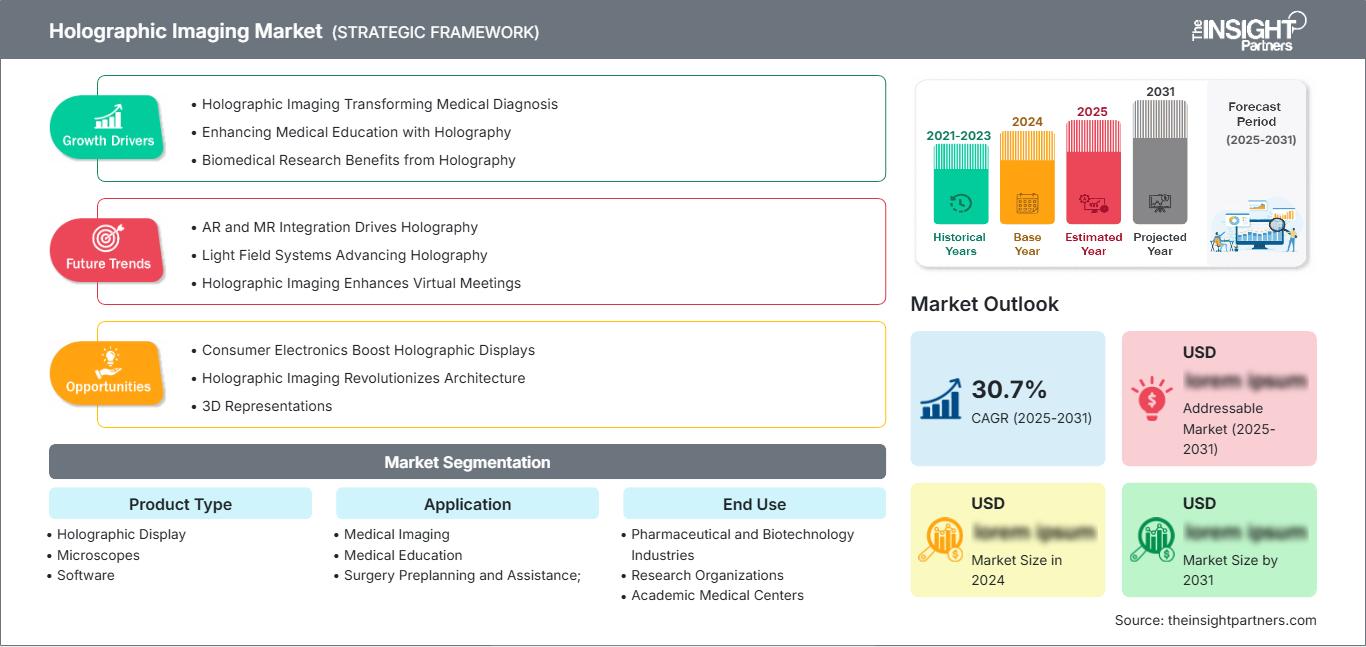
Holographic imaging utilizes principles of light interference and diffraction to record and reconstruct precise, three-dimensional spatial representations of physical objects or biological structures without requiring special eyewear. By delivering high-resolution volumetric visualization in open space, the technology enhances diagnostic accuracy, real-time spatial manipulation, and scientific examination.
The Holographic Imaging Market size is expected to reach US$ 5,515.02 Million by 2034 from US$ 1,082.65 Million in 2025. The market is estimated to record a CAGR of 19.83% from 2026 to 2034.
Key Market Drivers
- Rising Demand for Advanced Medical Visualization: The primary catalyst for market expansion is the accelerated adoption of holographic displays and microscopes in surgical preplanning, anatomical instruction, and minimally invasive procedures. Surgeons and medical specialists increasingly rely on real-time 3D models to navigate complex anatomical structures, reduce surgical risks, and improve patient outcomes.
- Technological Integration with AI and AR/VR Platforms: The convergence of holographic imaging with artificial intelligence, edge processing, and augmented reality platforms is elevating image reconstruction speeds and rendering fidelity. AI algorithms assist in filtering optical noise and processing real-time volumetric datasets, allowing instant visual feedback during clinical operations and scientific research.
- Growth in Biomedical and Pharmaceutical Research: Life science laboratories and academic medical centers heavily deploy digital holographic microscopes for live cell analysis. Because holographic imaging enables non-invasive, label-free examination of living cells, researchers can monitor dynamic cellular processes in real time without damaging specimens.
Download Sample Report@ https://www.theinsightpartners.com/sample/TIPRE00010278
Key Opportunities
- Expansion into Surgical Navigation and Interventional Radiology: As holographic systems become more compact and computationally efficient, integrating interactive 3D holograms directly into operating room navigation suites presents a massive growth avenue for medical technology vendors.
- Adoption in Medical Education and Remote Telemedicine: Higher education institutions and teaching hospitals are transitioning from traditional 2D textbooks and flat screens toward interactive holographic labs. Additionally, integrating holographic visualization into telemedicine enables remote specialists to examine three-dimensional clinical data collaboratively.
- Emergence of Software-Defined Computational Holography: Software algorithms capable of rendering high-fidelity holograms on standard hardware represent a scalable revenue model. Software-as-a-Service (SaaS) platforms for volumetric data processing lower entry barriers for smaller healthcare facilities and research labs.
Market Segmentation
The global holographic imaging market is structured across several key segments based on product type, application, end use, and geography:
- By Product Type:
- Holographic Displays
- Holographic Microscopes
- Holographic Software
- Holographic Prints and Hologram Materials
- Others
- By Application:
- Medical Imaging and Diagnostics
- Medical Education and Scientific Training
- Surgery Preplanning and Intraoperative Assistance
- Biomedical and Pharmaceutical Research
- By End Use:
- Hospitals and Specialty Clinics
- Pharmaceutical and Biotechnology Industries
- Research Organizations
- Academic Medical Centers
- By Geography:
- North America (United States, Canada)
- Europe (Germany, United Kingdom, France, Rest of Europe)
- Asia-Pacific (China, Japan, India, Australia, Rest of Asia-Pacific)
- Middle East and Africa
- South and Central America
Market News and Recent Developments
- Real-Time Interactive Holography Launches: Innovators in spatial displays have introduced high-speed volumetric projection systems capable of rendering floating, interactive human organs directly from CT and MRI scans in real time.
- AI-Enhanced Digital Holography Software: Software creators are deploying deep learning models that dramatically reduce the computational overhead needed for computer-generated holograms, allowing seamless streaming of 3D diagnostic imagery.
- Academic-Industry Research Partnerships: Major medical technology firms are partnering with university research centers to build custom digital holographic microscopes specifically designed for real-time oncology screening and drug toxicity testing.
Market Analysis and Competitive Landscape
North America currently commands the largest revenue share in the global holographic imaging market, backed by an advanced healthcare infrastructure, high research expenditure, and rapid adoption of cutting-edge clinical tools. However, the Asia-Pacific region is projected to record the fastest growth rate through 2034. Expanding healthcare spending, modernizing clinical facilities, and rising investments in biotechnology across China, Japan, and India are accelerating regional adoption.
The competitive landscape is moderately fragmented, characterized by intense innovation among niche technology pioneer companies and global imaging conglomerates. Leading players maintain their market advantage through strategic partnerships, continuous hardware miniaturization, and intellectual property expansions.
Top Market Players
- RealView Imaging Ltd.
- Lyncee Tec SA
- Holoxica Limited
- EchoPixel, Inc.
- Phase Holographic Imaging PHI AB
- EON Reality Inc.
- Light Field Lab, Inc.
- Ovizio Imaging Systems NV
- Zebra Imaging (Recognized Industry Pioneer Assets)
- HoloTech Cultural Creative Co., Ltd.
Get Full Copy of This Report @ https://www.theinsightpartners.com/buy/TIPRE00010278
Future Outlook
Through 2034, holographic imaging will solidify its role as a foundational technology in spatial medical visualization, surgical guidance, and cellular diagnostics. As hardware costs decrease and computational rendering tools mature, holographic systems will expand beyond premier medical institutions into mid-tier regional hospitals and educational centers worldwide. The integration of artificial intelligence, high-speed data processing, and cloud-based volumetric streaming will continue to redefine how clinical teams interact with complex biological data, paving the way for safer interventions and superior patient care.
About The Insight Partners
The Insight Partners provides comprehensive syndicated and tailored market research services in the healthcare, technology, and industrial domains. Renowned for delivering strategic intelligence and practical insights, the firm empowers businesses to remain competitive in ever-evolving global markets.
Contact Information
- Email: sales@theinsightpartners.com
- Website: theinsightpartners.com
- Phone: +1-646-491-9876
