The global defense sector continues to prioritize survivability, structural integrity, and enhanced operational range for aerial fleets. Military aircraft rubber tanks often manufactured as flexible, crashworthy, and self-sealing fuel bladders play a vital role in maintaining the safety and efficiency of fighter jets, transport aircraft, attack helicopters, and unmanned aerial vehicles (UAVs). Unlike traditional rigid metal fuel tanks, modern rubberized fuel bladders withstand severe mechanical shocks, vibration, and impact deformation, significantly reducing the risk of fuel leakages and post-crash catastrophic fires during military combat and tactical missions.
Get a PDF Sample- https://www.theinsightpartners.com/sample/TIPRE00017947
Driven by geopolitical tensions, force modernization programs, and escalating defense budgets globally, military air forces are increasingly replacing legacy fuel storage systems with advanced elastomeric and polyurethane-coated rubber bladders. These systems offer low weight, high tear resistance, and superior compatibility with traditional jet fuels as well as emerging sustainable aviation fuels (SAFs).
North America Military Aircraft Rubber Tanks Market
North America commands a prominent share of the global military aircraft rubber tanks market, driven by heavy defense procurement and advanced aerospace R&D. The presence of leading defense OEMs and major defense contractors across the United States and Canada ensures constant integration of next-generation fuel bladder technologies. Furthermore, large-scale fleet modernization initiatives across the U.S. Air Force, Navy, and Army continuously boost demand for both OEM integration and MRO replacement bladders. High military readiness requirements and stringent military standards (MIL-SPEC) in the region further ensure steady technological advancements and long-term supply agreements.
Market Forecast
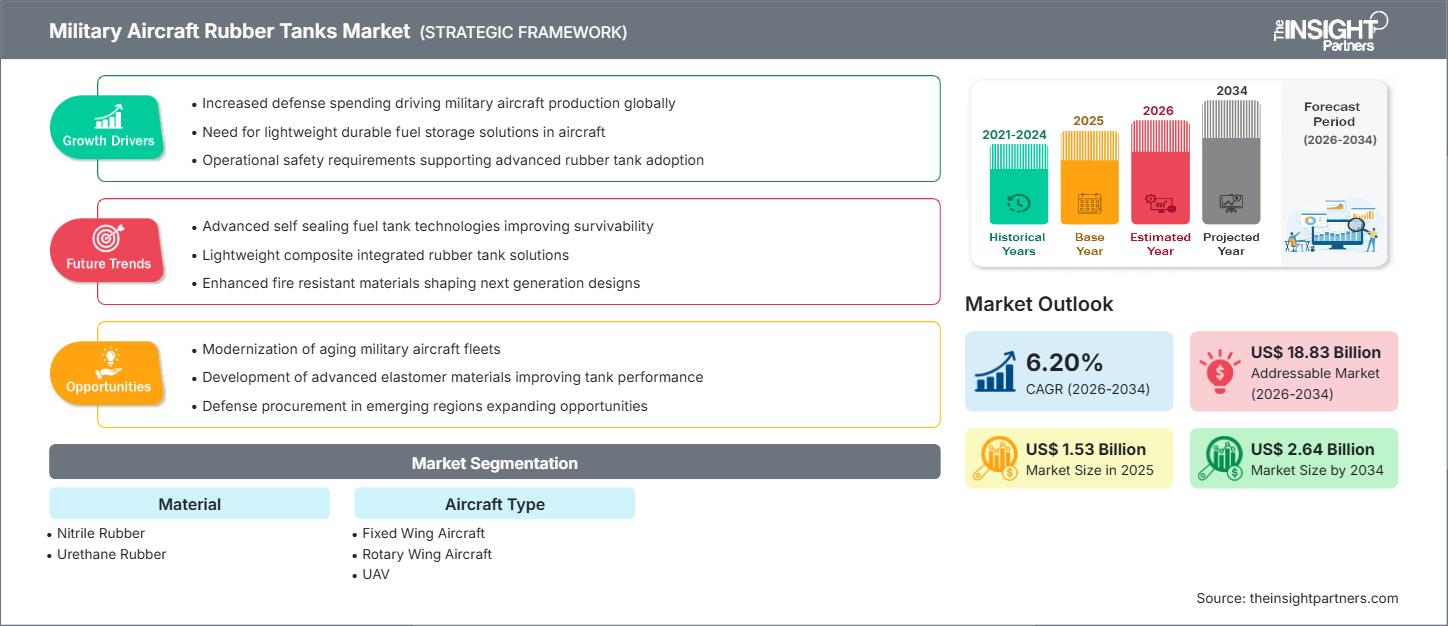
The Military Aircraft Rubber Tanks Market size is expected to reach US$2.64 billion by 2034 from US$1.53 billion in 2025. The market is anticipated to register a CAGR of 6.20% during 2026–2034.
This sustained growth reflects substantial capital investments in defense aerospace infrastructure across North America, Europe, Asia-Pacific, and the Middle East, coupled with continuous technology refinement in vulcanized rubber formulations, high-strength fabric reinforcements, and automated fabrication techniques.
Market Dynamics & Key Growth Drivers
Several key factors propel the adoption of rubber fuel tanks across global defense fleets:
Rising Modernization of Fleet Fleets: Defense ministries worldwide are allocating significant funds toward upgrading aging fixed-wing and rotary-wing aircraft with state-of-the-art avionics, lightened materials, and safer fuel retention systems.
Focus on Crashworthiness and Ballistic Protection: Modern military combat environments require fuel systems capable of self-sealing when pierced by small arms fire or fragment shrapnel. Rubber bladders integrated with self-healing chemical layers automatically seal bullet holes within milliseconds, protecting both aircrew and valuable platforms.
Expansion of Unmanned Aerial Systems (UAS): Long-endurance military UAVs demand lightweight, highly space-efficient fuel bladders that maximize interior volume without adding unnecessary structural weight.
Retrofit and Maintenance Programs: Beyond new aircraft deliveries, defense maintenance, repair, and overhaul (MRO) contractors frequently replace degraded legacy tanks during scheduled mid-life upgrades, providing a steady recurring stream of aftermarket revenue.
Key Players
The global landscape for military aircraft rubber fuel bladders is characterized by specialized engineering firms and established defense contractors. Prominent players profiled in the market study include:
Aero Tec Laboratories, Inc.
Aircraft Rubber Manufacturing (Fuel Safe Systems)
Amfuel FFC, Inc.
Magam Safety Ltd.
Meggitt PLC
M.E.RIN
Musthane
PFW Aerospace GmbH
These companies focus on strategic collaborations, military certifications, lightweight composite integration, and tailor-made bladder designs to meet custom airframe geometry requirements.
Get Full Copy of This Report- https://www.theinsightpartners.com/buy/TIPRE00017947
Market Segmentation Insights
By Material
- Nitrile Rubber
- Urethane Rubber
By Aircraft Type
- Fixed Wing Aircraft
- Rotary Wing Aircraft
- UAV
Future Outlook
Looking ahead, the military aircraft rubber tanks market is poised for transformative shifts driven by innovations in smart material integration and sustainable manufacturing processes. Advances in lightweight polyurethane elastomers, high-tensile aramid reinforcements, and integrated sensor technology capable of real-time fuel level detection and structural health monitoring will reshape next-generation fuel containment solutions. As defense forces around the globe transition toward higher-agility tactical platforms and stealth-optimized airframes, rubber tank manufacturers will increasingly focus on ultra-conformable, high-density energy storage solutions tailored for demanding operational environments.
Related Reports-
Airport Rubber Removal Systems Market
About Us
The Insight Partners is a one-stop industry research provider of actionable intelligence. We help our clients in getting solutions to their research requirements through our syndicated and consulting research services. We specialize in industries such as Semiconductor and Electronics, Aerospace and Defense, Automotive and Transportation, Biotechnology, Healthcare IT, Manufacturing and Construction, Medical Devices, Technology, Media, and Telecommunications, as well as chemicals and Materials.
Contact Us
If you have any queries about this report or if you would like further information, don’t hesitate to get in touch with us:
Contact Person: Ankit Mathur
E-mail: ankit.mathur@theinsightpartners.com
